Protein Chemistry. Structure, Properties, and Research Methods - Shendryk A.N. 2022
Methods for Experimental Investigation of Protein Structure
Electron Microscopy
Preparation and "Staining" of Samples — Shadowing
Another technique for enhancing image contrast involves coating the specimen surface with a layer of heavy metal atoms. This method consists of vacuum-evaporating a thin metal layer onto the sample surface at a shallow angle. The deposition is carried out in a vacuum chamber (see Fig. 4.15) by heating a filament positioned at a considerable distance from the specimen. Contrast is achieved because the metal atoms condense On the surface in accordance with its topography. In shadowed areas, the metal layer is thinner, whereas on exposed areas, it is thicker (see Fig. 4.16). The height of the object is related to the length of the shadow it casts by the equation: h = dtga, which makes it possible to obtain three-dimensional outlines of the studied specimens on micrographs and to estimate their geometric dimensions.
Class="center">
Fig. 4.15 Vacuum chamber for metal film shadowing of a specimen: 1 - filament; 2 - metal vapor; 3 - chamber; 4 - specimen; 5 - platform; 6 - base; 7 - electrodes

Fig. 4.16 Schematic diagram of metal film deposition on a specimen and shadow region formation during shadowing contrast enhancement
As an illustration, Fig. 4.17 shows a micrograph of the E. coli T4 bacteriophage obtained by the shadowing technique.
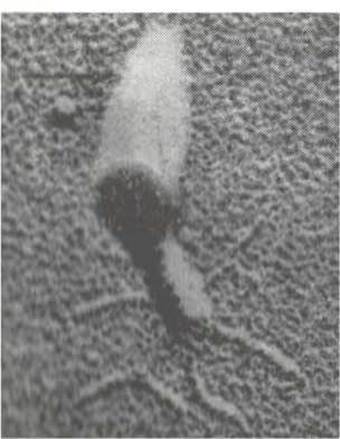
Fig. 4.17 Electron micrograph of the E. coli T4 bacteriophage. Shadowing contrast method. The shadow direction is indicated by the arrow
To gain insights into the three-dimensional Structure OF THE specimen, shadowing is performed at various angles of inclination (a) of the specimen relative to the metal atom flux.
Last update: 06/08/2026
Editorial and Educational Adaptation: This material has been compiled based on the primary/original source text. The project team performed an editorial review, corrected technical inaccuracies, structured sections, and adapted the content for an educational format.
What was processed:
- elimination of formatting defects (OCR errors, structural breaks, corrupted characters);
- editorial organization of content;
- standardization of terminology in accordance with academic sources;
- verification of factual statements against the original source text.
All mentions of the author, publication year, and origin of the primary text have been preserved in accordance with the source.