Pharmacognosy with the Basics of Plant Biochemistry - Kovalyov V. M. 2004
Special Part
Essential Oils
Medicinal plants and raw materials containing poorly studied saponins
ZAMANIHA RHIZOMES WITH ROOTS — RHIZOMATA CUM RADICIBUS ECHINOPANACIS
High oploopanax — Oplopanax elatus Nakai (syn. high zamaniha — Echinopanax horridus subsp. elatum), fam. Araliaceae.
Oplopanax elatus (high zamaniha, high echinopanax); the generic name Oplopanax derives from the Greek hoplon meaning weapon and panax, the genus name for ginseng; echinos means hedgehog in Greek; while the Latin elatus, -um means tall, and horridus, -um means bristly or prickly.
Plant description. A prickly shrub about 1 m in height. The rhizome is long, horizontal, dense, woody, cylindrical, and slightly curved. The outer surface is brownish-gray, while the fractured surface is yellowish-white. The stems are covered with long prickles. Leaves have long petioles and are densely covered with short prickles. The leaf blade is rounded, with a cordate base. The flowers are small, inconspicuous, arranged in simple umbels gathered into an oblong raceme. The fruits are juicy, yellowish-red, and spherical.
Distribution. It grows in the southern part of Primorsky Krai on stony soils in areas with high atmospheric humidity.
Harvesting. Rhizomes with roots are harvested during fruit ripening. They are dug up, freed from aerial parts, washed in running Water, cut into pieces up to 3-5 cm long, left to wilt, and then dried in attics or under sheds with occasional turning, or in dryers.
Chemical composition of the crude drug. All Organs contain triterpenoid saponins known as echinacosides (up to 7%), the Chemical Structure of which has not yet been fully elucidated. In addition, the raw material contains essential oil (1.8–5%), phenolic Glycosides, Coumarins (0.2%), Flavonoids (0.9%), and Alkaloids.
Biological activity and application. The tincture is used as a tonic for nervous and mental disorders, hypotension, and mild forms of diabetes. Its pharmacological effect is similar to that of ginseng tincture, though somewhat milder.
Class="center">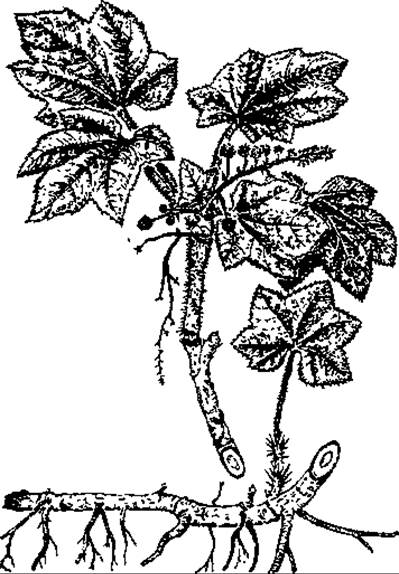
Last update: 06/08/2026
Editorial and Educational Adaptation: This material has been compiled based on the primary/original source text. The project team performed an editorial review, corrected technical inaccuracies, structured sections, and adapted the content for an educational format.
What was processed:
- elimination of formatting defects (OCR errors, structural breaks, corrupted characters);
- editorial organization of content;
- standardization of terminology in accordance with academic sources;
- verification of factual statements against the original source text.
All mentions of the author, publication year, and origin of the primary text have been preserved in accordance with the source.