Biochemistry - The Chemical Reactions of Living Cells, Volume 3 - D. Metzler 1980
Metabolism of Nitrogen-Containing Compounds
N2 Fixation and Other Transformations of Inorganic Nitrogen Compounds
Mechanism of Reduction
Although N2 is extremely inert, it nevertheless forms nitrides with metals and complexes with certain metal chelates. These complexes typically have an "end-on" Structure, such as N ≡ N—Fe. Stiefel [12] suggested that N2 first forms a complex of this type with an iron atom in the molybdoferredoxin molecule. The Mo(IV) atom can then donate two electrons to N2 [Equation (14-9), step a]:
Class="center">
which leads to The formation of an N2–Mo(VI) complex. The addition of two protons [Equation (14-9), step b] yields a diimide molecule that remains bound to the iron until the molybdenum undergoes a second reduction cycle. Next, diimide is reduced to hydrazine and, ultimately, to ammonia:

As Stiefel pointed out, Mo(VI) attracts electrons so strongly that protons bound to ligands surrounding the molybdenum, such as H2O, dissociate completely. This results in the Formation of the unprotonated molybdate ion MoO2-4. The same holds true for nitrogenous ligands, such as protein amino groups, which may be coordinated to the protein-bound molybdenum. In contrast, reduced Mo(IV) tends to be surrounded by protonated ligands. In the initial complex with N2, Mo(IV) may be bonded to protonated nitrogenous ligands. The transfer of these protons to the N2 molecule can accompany the transfer of electrons from molybdenum to N2.
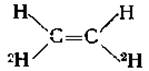
In full agreement with this hypothesis, the reaction of acetylene in the presence of 2H2O yields exclusively cis-dideuteroethylene.
Lichtenstein et al. [13] suggested that the N2 molecule binds between two molybdenum centers and receives electrons from both halves of the dimeric structure (Fig. 14-1).
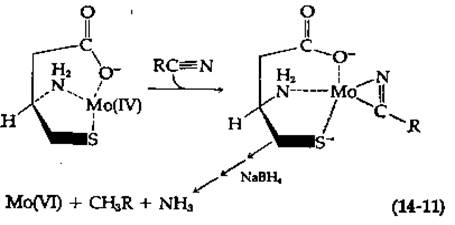
Given its immense practical significance for agriculture, The Development of more efficient non-enzymatic Nitrogen Fixation processes is of great interest. Numerous attempts have been made to create a Nitrogenase model that mimics the natural biological enzyme. For example, a 1:1 mixture of Cysteine and sodium molybdate was treated with a reducing agent such as NaBH4, assuming that this would yield a complex containing Mo(IV). This complex was expected to coordinate alkyl nitriles capable of being reduced by NaBH4 through all stages up to alkenes and ammonia [Equation (14-11)].
It goes without saying that this reaction must proceed in multiple steps. Interestingly, its rate increases significantly in the presence of ATP and iron-sulfur cluster-containing compounds; the presence of CO or N2 inhibits the reaction [14, 15]. Thus, the model system used exhibits a striking resemblance to nitrogenases in A number of features. Another model system has been reported in which a slightly different molybdenum complex and a different iron-sulfur cluster were used to reduce N2 [16]. However, for all these model systems, the reaction rates are significantly lower than those observed with native nitrogenase.
Attempts to enhance the efficiency of Biological Nitrogen Fixation are also of great interest. For instance, various genetic manipulations can be used to derepress nitrogenase genes. As a result, the expression of these genes becomes "constitutive" (Ch. 15, Sec. B, 1), which makes it possible to obtain Bacteria capable of fixing nitrogen in soil or ROOT nodules much faster than natural strains do. Normally, nitrogenase genes are repressed when glutamine accumulates in Cells, as discussed in more detail in Sec. B, 2. Nitrogen fixation genes have been found exclusively in prokaryotes. A major agricultural breakthrough would be the successful transfer of these genes (while maintaining their functional activity) into green plants (Ch. 15, Sec. 3, 4).
Last update: 06/08/2026
Editorial and Educational Adaptation: This material has been compiled based on the primary/original source text. The project team performed an editorial review, corrected technical inaccuracies, structured sections, and adapted the content for an educational format.
What was processed:
- elimination of formatting defects (OCR errors, structural breaks, corrupted characters);
- editorial organization of content;
- standardization of terminology in accordance with academic sources;
- verification of factual statements against the original source text.
All mentions of the author, publication year, and origin of the primary text have been preserved in accordance with the source.