Biochemistry - The Chemical Reactions of Living Cells, Volume 2 - D. Metzler 1980
Enzymes: Protein Catalysts of Cells
Mechanisms of Enzymatic Catalysis
Transition-State Analogue Inhibitors
Let us consider the chemical transformation of compound S proceeding with a rate constant kN via The formation of a Transition State T. Let K≠N be the Equilibrium Constant for the formation of T. Assume that the enzyme E forms a complex with the substrate, characterized by a dissociation constant KdS, and a complex with the state T, characterized by a dissociation constant КdT:
Class="center">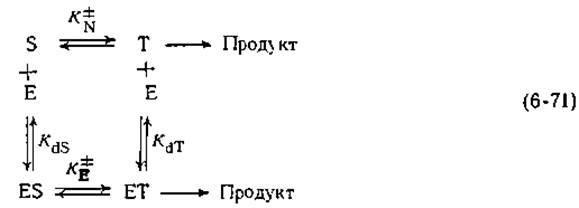
Assuming that all four steps in the scheme denoted by double arrows are at equilibrium, it is easy to demonstrate the validity of the following relation:

If the transmission coefficient ϰ = 1, then, according to Transition State Theory, T and ET must convert into products at the same rate. Thus, assuming that the mechanisms of the non-enzymatic and enzymatic reactions are identical, The ratio of the maximum rates of monomolecular transformations of ES and S will take the following form:

1) See also the article by R. Wolfenden in Transition States of Biochemical Processes, R. D. Gandour and R. L. Schowen (Eds.), New York and London, Plenum Press, 1978, pp. 555–578. — Trans. note.
For some Enzymes, the kE/kN ratio is 108 and higher. Therefore, if KdS ≈ 10-3, the constant КdT must be on the order of 10-11. This means that the enzyme forms a complex with the transition state that is 108 times more stable than that with the substrate.
It is clear from these considerations that if structural analogs of state T could be found for a given reaction, they would bind very tightly—much more tightly than conventional substrate analogs. In his review, Wolfenden [49] lists A number of transition-state inhibitors proposed in the literature. All of these inhibitors bind very tightly to enzymes
Last update: 06/08/2026
Editorial and Educational Adaptation: This material has been compiled based on the primary/original source text. The project team performed an editorial review, corrected technical inaccuracies, structured sections, and adapted the content for an educational format.
What was processed:
- elimination of formatting defects (OCR errors, structural breaks, corrupted characters);
- editorial organization of content;
- standardization of terminology in accordance with academic sources;
- verification of factual statements against the original source text.
All mentions of the author, publication year, and origin of the primary text have been preserved in accordance with the source.