Biochemistry - The Chemical Reactions of Living Cells, Volume 2 - D. Metzler 1980
How electrons meet oxygen, how ATP is formed in the process, and some related phenomena
Electron Transport Chain and Oxidative Phosphorylation
Respiratory Control, Uncoupling, and Exchange Reactions
With proper care, relatively intact Cell/35.html">Mitochondria can be isolated. They are characterized by tight coupling. By this we mean that electrons cannot flow down the Electron Transport Chain without generating ATP. Furthermore, if the concentrations of ADP or Pi are too low, both phosphorylation and Respiration cease simultaneously. Such Respiratory Control is a property of intact mitochondria. On the other hand, damaged mitochondria or submitochondrial particles are often capable of rapid electron transport without ATP synthesis; in this case, no inhibition by low concentrations of ADP is observed. Closely related to this phenomenon is uncoupling, caused by various compounds, of which 2,4-dinitrophenol is the best known. Even before the discovery of uncoupling, it was known that dinitrophenol significantly increases the respiration rate in animals. This compound was even used (with some unfortunate results) to manufacture weight-loss pills. The chemical basis of uncoupling remains unknown, but one possibility is indicated in equation (10-11), which presents a purely hypothetical chemical model of Oxidative Phosphorylation. In this scheme, three carriers, A, B, and C, function in The electron transport chain. Carrier C has more pronounced oxidative properties compared to carriers A and B, and carrier B has the special chemical ability to react in its reduced state with protein Y, forming the Y—BH2 complex. This unidentified adduct is oxidized by carrier C into a high-energy oxidized form designated as Y~B. If we admit the possibility of such an intermediate forming, it is then easy to imagine possible pathways for converting the energy of this compound into familiar forms. For example, another protein X can react with the aforementioned compound to form an X—Y complex, in which the Proteins are linked by a thioester, acyl phosphate, or other high-energy bond. We might not even consider a system of two proteins, but make do with a single one in which X and Y represent different functional groups. The components under consideration do not necessarily have to be proteins. For example, Y could be a phospholipid.
Class="center">Table 10-3 Some artificial electron acceptorsa,b

a According to Weinneau [59], pp. 106–111.
b Sites of action are indicated in Fig. 10-11.

The formation of ATP during the remaining reactions of equation (10-11) is straightforward. Suppose, for instance, that X~Y is a thioester; then ATP formation will occur As a result of reversing the S1A sequence given in Table 7-2. These same stages underlie various exchange reactions. For example, mitochondria catalyze the exchange of inorganic phosphate (H32PO2-4) with the terminal phosphate of ATP. Mitochondria and submitochondrial particles also exhibit ATP-hydrolyzing (ATPase) activity. Although ATP Hydrolysis does not appear to be a physiological reaction, There is a strong correlation between ATPase activity and the ability of submitochondrial particles to catalyze oxidative phosphorylation. Apparently, both ATPase activity and exchange reactions proceed via the same mechanism that ensures ATP Synthesis in tightly coupled mitochondria. In the scheme presented in equation (10-11), for ATPase activity to manifest itself, it is sufficient that spontaneous hydrolysis of X~Y be possible. Partial degradation of the system could lead to an enhancement of ATPase activity, which is indeed observed experimentally. Furthermore, it is easy to visualize that uncouplers, such as dinitrophenolate or arsenate ions, behave as nucleophilic substituting groups and can substitute for X in the process. The spontaneous breakdown of labile intermediates should ensure the unobstructed progression of oxidation processes. This would be especially crucial in cases where X is entirely bound in the X~Y complex and cannot undergo further transformations due to the absence of inorganic phosphate. Since there are three distinct phosphorylation sites, one might expect three different Y-type Enzymes, yet only a single X is observed.
Another observation consistent with the scheme of equation (10-11) is the inhibition of NADH oxidation by the antibiotic oligomycin (rutamycin). This compound also inhibits mitochondrial ATPase activity. However, the inhibitory effect is diminished by dinitrophenol, which indicates that oligomycin binds to The enzyme catalyzing the exchange reactions rather than to the electron transport chain itself. An important experimental discovery was the finding that the "knob-like projections" visible on negatively stained mitochondrial fragments can catalyze both ATPase and exchange reactions. The F1 protein contained within them (Sec. D,8) is one of several "coupling factors" required to reconstitute the phosphorylating system from disrupted mitochondria.
We will return to the coupling scheme presented in equation (10-11), but the reader should keep in mind that all attempts to identify an X~Y type intermediate have been unsuccessful. Moreover, most claims of having detected a Y~B compound have been refuted.
Box 10-D
Using METABOLISM for Heat Generation: Thermogenic Tissues
The second most important, yet also vital role of metabolism in warm-blooded animals is the generation of heat. In many cases, the heat released during normal metabolism is entirely sufficient, and the Organism can maintain its required body Temperature by regulating heat exchange with the environment. A very intriguing biochemical discovery was the presence in warm-blooded animals of brown adipose tissue, which differs strikingly from normal Cytology/practical/49.html">White adipose tissue. Brown fat has been found in small amounts in newborns; in newborn rabbits, it accounts for 5–6% of body weighta-c. It is especially abundant in newborns of species that are born without fur, as well as in hibernating animals. According to current views, the function of this tissue is to generate heat. The unusually high concentration of Blood Vessels and mitochondria, along with numerous sympathetic nerve fibers—all these features of brown adipose tissue are associated with efficient heat generation. An interesting biochemical question remains unresolved: is The energy released during electron transport in mitochondria dissipated as heat as a result of the uncoupling of ATP synthesis and electron transport? Or does ATP synthesis take place, but the resulting ATP is futilely hydrolyzed by the action of an active ATPase?
Some plant tissues possess thermogenic activity. For example, the spadix of Symplocarpus foetidus (skunk cabbage) can maintain its temperature 10–25 °C above ambient air temperaturec,d.
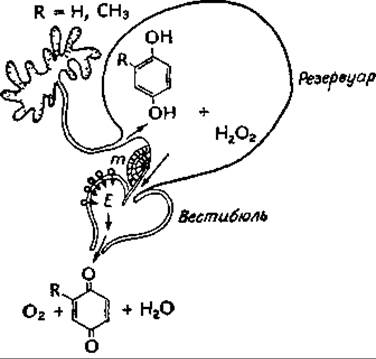
The bombardier beetle produces a hot defensive liquid containing quinone, which it ejects from a specialized chamber, with the temperature of the discharged fluid reaching 100 °C. A reaction mixture containing 25% hydrogen peroxide and 10% hydroquinone and methylhydroquinone is stored in a special reservoir [see the accompanying figure, where E designates the enzyme and M denotes the muscular channel (from Aneshansley et al.e)]. When this mixture comes into contact with catalase and peroxidase located in the chamber, an explosive force is generatedc,e,f. Also noteworthy is the system for synthesizing and storing 25% H2O2, the Organization of which raises several interesting biochemical questions.
a Lindberg O., ed., Brown Adipose Tissue, Am. Elsevier, New York, 1970.
b Dawkins M. J. R., Hull D., Sci. Am., 213, 62–67 (1965).
c Hochachka P. W., Fed. Proc., Fed. Am. Soc. Exp. Biol., 33, 2162–2169 (1974).
d Bahr J. T., Bonner W. D., Jr., JBC, 248, 3441–3445 (1973).
e Aneshansley D. J., Eisner T., Widom J. M., Widom B., Science, 165, 61–63 (1969).
f Eisner T., Meinwald J., Science, 153, 1341–1350 (1966).
c. Mitochondrial "States" and Spectrophotometric Observations
Chance and Williams [68] established the existence of five mitochondrial states, of which states 3 and 4 are frequently mentioned in current literature. Structure/97.html">Definitions of all five states are given in Table 10-4. Note that these definitions apply only to tightly coupled mitochondria. Such mitochondria, while in the active phosphorylating state (State 3), subsequently transition spontaneously to State 4, in which all ADP has already been converted into ATP.
Table 10-4 States of Tightly Coupled Mitochondria
|
Variable Conditions |
State 1: without added substrate |
State 2: mitochondria from starved animals |
State 3: active phosphorylation |
State 4: ADP depletion |
State 5: anaerobic |
|
O2 |
+ |
+ |
+ |
+ |
Absent |
|
[ADP] |
Low |
High |
High |
Low |
High |
|
Oxidizable substrate concentration |
" |
~0 |
" |
High |
" |
|
Respiration rate |
Slow |
Slow |
Fast |
Slow |
0 |
|
Rate-limiting component |
ADP |
Substrate |
Electron transport chain |
ADP |
O2 |
Table 10-5 Wavelengths used to measure the oxidation state of carriers in the mitochondrial electron-transport chaina
|
Carrier |
λmах (nm)b |
λ0 (nm) |
Carrier |
λmaх (nm)b |
λ0 (nm) |
|
NADH |
340 |
374 |
с2+ |
550 (а) |
540 |
|
Flavins |
465 |
510 |
521 (β) |
||
|
416 (у) |
|||||
|
564 (а) 530 (β) 430 (у) |
575 |
а2+ |
605 (а) 450 (у)а |
630 (595) |
|
|
с2+1 |
534 (а) 523 (β) 418 (у) |
а2+3 |
600 (а)а 445 (у) |
455 |
a According to Chance and Williams [68].
b Wavelengths used simultaneously in the dual-wavelength spectrophotometer are listed on the same line. For cytochromes, the positions of several additional absorption bands are also given.
Chance and coworkers performed spectrophotometric studies on intact mitochondria and submitochondrial particles, investigating both The sequence of carriers and the phosphorylation sites. These experiments employed a dual-wavelength spectrophotometer, which made it possible to record absorption at a wavelength λmах (the absorption maximum for the given compound) relative to absorption at a reference wavelength λ0. The main wavelengths used in the experiment are listed in Table 10-5.
These measurements made it possible to determine the oxidation or reduction state of each carrier under the various conditions given in Table 10-4, as well as in the presence of inhibitors. The experiments confirmed that electrons, as they pass along the chain, indeed reside on a given carrier for a certain period of time. In other words, under a given condition, each carrier maintains a specific ratio of oxidized to reduced forms, [ox]/[red]. Such a result presumably would not be observed if the entire chain functioned cooperatively, with electrons flowing along the entire pathway in a single concerted reaction. Furthermore, by monitoring Changes in the [ox]/[red] ratio under various conditions, it was possible to localize the three phosphorylation sites to some extent. In one experiment, antimycin A was used to block the entire chain upstream of cytochrome c1. Then, upon depletion of ADP reserves, tightly coupled mitochondria transitioned to state 4. Because the oxygen concentration was high and the KM of cytochrome a3 for O2 is low (~3 µM), cytochrome a3 was maintained in a highly oxidized state. Cytochrome a also remained oxidized, whereas Cytochromes c1 and c were in the reduced state. The existence of such a crossover point provided grounds for concluding that one of the energy-conserving sites lies somewhere near cytochrome c. More recent experiments utilizing the same approach are described in the works of Wilson et al. [72–75].
Last update: 06/08/2026
Editorial and Educational Adaptation: This material has been compiled based on the primary/original source text. The project team performed an editorial review, corrected technical inaccuracies, structured sections, and adapted the content for an educational format.
What was processed:
- elimination of formatting defects (OCR errors, structural breaks, corrupted characters);
- editorial organization of content;
- standardization of terminology in accordance with academic sources;
- verification of factual statements against the original source text.
All mentions of the author, publication year, and origin of the primary text have been preserved in accordance with the source.