Biochemistry - The Chemical Reactions of Living Cells, Volume 2 - D. Metzler 1980
Coenzymes - specialized natural reagents
Tetrahydrofolic acid and other pterin coenzymes
The reduced forms of Folic acid act as carriers of one-carbon units at all oxidation levels, except for СО2 (which is carried by biotin). Furthermore, folic acid is one of the derivatives of the pteridine ring system, which are widespread in nature. Pteridines determine the coloration of wings and eyes in insects and of Skin in amphibians and fish. Apparently, pteridines play The Role of protective light filters in insect eyes; The excretion of several photosensitive pteridines suggests that some of them may function as light receptors. Along with the reduced Coenzyme forms of folic acid, mammalian Liver contains at least one more pteridine involved in the hydroxylation of aromatic Amino Acids.
Class="center">
Given the prevalence of 2-amino-4-hydroxypteridine derivatives, this compound has been assigned the trivial name pterin. Knowing the formula of guanine, it is easy to remember the formula of pterin, as well as to understand that pterins are formed biosynthetically from guanine. We should also note the similarity between the two-ring systems of pterin and the riboflavin Nucleus (Appendix 8-I).
The first biochemist to take an interest in pteridines was apparently F. G. Hopkins, who in 1891 began studying the yellow and white pigments of common butterflies, the brimstone and the large white. About 50 years later, during which up to a million butterflies were destroyed, the formulas of two pigments—xanthopterin (yellow) and leucopterin (white)—were established.

Although the function of pterins in insect wings appears to be solely to provide wing coloration, these pigments are produced in such quantities that their synthesis can be seen as a way of excreting and storing nitrogenous waste in a dry form.

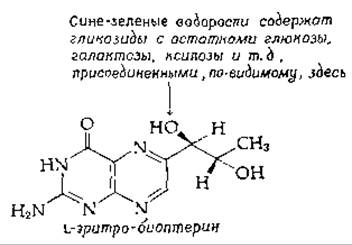
Pterins isolated from the eyes of Drosophila [151] include sepiapterin, in which the pyrazine ring is reduced at positions 7 and 8. Reduction of the carbonyl group of sepiapterin with NaBH4, followed by air oxidation, yields biopterin, a widespread compound first isolated from human urine [152, 153]. Biopterin is present in the liver (as well as in other Tissues) and is believed to function in its reduced form as a hydroxylation cofactor. It is also hypothesized to have several other roles in oxidation reactions, The regulation of electron transport, and Photosynthesis [154]. Neopterin, found in honeybee larvae, is similar to biopterin, but its side chain has the D-erythro configuration. The content of biopterin and related pterins in natural Materials can be determined based on their cofactor activity toward Pseudomonas phenylalanine hydroxylase. A less specific but widely used method for assaying pterins is measuring the growth rate of the trypanosomatid Crithidia fasciculata, a mosquito parasite. Folate derivatives are not active in this assay, and the concentrations of non-folate pterins (on the order of 0.1 mg/L) found in Blood using the Crithidia-based method exceed those of folic acid derivatives.
Last update: 06/08/2026
Editorial and Educational Adaptation: This material has been compiled based on the primary/original source text. The project team performed an editorial review, corrected technical inaccuracies, structured sections, and adapted the content for an educational format.
What was processed:
- elimination of formatting defects (OCR errors, structural breaks, corrupted characters);
- editorial organization of content;
- standardization of terminology in accordance with academic sources;
- verification of factual statements against the original source text.
All mentions of the author, publication year, and origin of the primary text have been preserved in accordance with the source.