Human Biochemistry Volume 2 - Murray R. 1993
Structure, Function, and Replication of Information Macromolecules
Nucleotides
Nucleosides and Nucleotides
Free bases are significantly less common in nature than their corresponding nucleosides and NUCLEOTIDES. Nucleoside molecules (Fig. 34.8) are composed of a purine or pyrimidine base linked via a ß-bond to a carbohydrate (usually D-ribose or 2-deoxyribose) at the N9 or N1 position, respectively. Thus, the adenine ribonucleoside (adenosine) consists of adenine and D-ribose attached at the N9 position; guanosine consists of guanine and D-ribose at the N9 position; cytidine consists of cytosine and ribose at the N1 position; and uridine consists of uracil and ribose at the N1 position.
2'-Deoxyribonucleosides contain purine or pyrimidine bases and 2'-deoxyribose attached at the same N1 and N9 atoms. The attachment of ribose or 2'-deoxyribose to the ring Structure OF THE base occurs via a relatively acid-labile N-glycosidic bond. Theoretically, the sugar residue and the purine (or pyrimidine) base are capable of free rotation around the glycosidic bond axis, but steric hindrance prevents this in reality. The anti conformation is much more favorable for naturally occurring nucleosides than the syn conformation (Fig. 34.9). A detailed explanation of this phenomenon can be found in Chapter 37. Here, we will only mention that the anti conformation is a prerequisite for the base pairing (complementary base pairing) of purine and pyrimidine bases in the double-stranded B-form DNA molecule. (Since D-ribose is depicted in its standard orientation in most figures of this and other chapters, purine and pyrimidine nucleosides and nucleotides are shown in the less favorable syn conformation.)
Class="center">
Fig. 34.7. Structures of cytosine, thymine, adenine, and guanine tautomers, indicating the predominant forms.

Fig. 34.8. Structure of ribonucleosides.
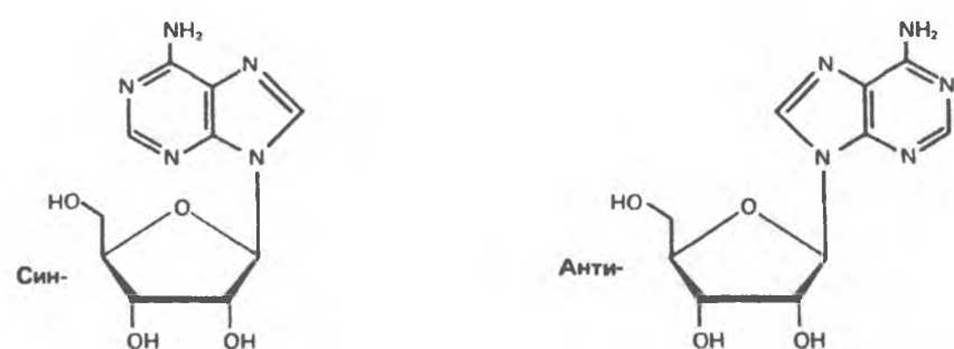
Fig. 34.9. Structure of the syn and anti Conformations of adenosine.

Fig. 34.10. Structure of adenylic acid (AMP) (left) and 2'-deoxyadenylic acid (dAMP) (right).

Fig. 34.11. Structure of uridylic acid (UMP) (left) and thymidylic acid (TMP) (right).
Nucleotides are derivatives of nucleosides phosphorylated at one or more hydroxyl groups of the ribose (or deoxyribose) residue (Fig. 34.10). For example, adenosine monophosphate (AMP or adenylate) is composed of adenine, ribose, and phosphate. 2'-Deoxyadenosine monophosphate (dAMP or deoxyadenylate) is a molecule consisting of adenine, 2'-deoxyribose, and phosphate. Typically, ribose is attached to uracil, and 2'-deoxyribose is attached to thymine. Therefore, thymidylic acid (TMP) consists of thymine, 2'-deoxyribose, and phosphate, whereas uridylic acid (UMP) is composed of uracil, ribose, and phosphate (Fig. 34.11). DNA is a polymer of thymidylic, 2'-deoxycytidylic, 2'-deoxyadenylic, and 2'-deoxyguanylic acids. RNA is formed by the copolymerization of uridylic, cytidylic, adenylic, and guanylic acids.
In addition to the above-mentioned forms of nucleotides, nucleotides with unusual structures have also been discovered. For instance, a nucleotide has been identified in tRNA molecules in which ribose is attached to uracil at the fifth position—that is, via a carbon-carbon bond rather than a nitrogen-carbon bond. The product of this unusual linkage is named pseudouridine (ψ). tRNA molecules also contain another unusual nucleotide structure: thymine linked to ribose monophosphate. This nucleotide is formed post-transcriptionally in tRNA molecules via the methylation of the UMP residue by S-adenosylmethionine (see below). Pseudouridylic acid (ψMP) is similarly formed through the rearrangement of UMP after tRNA synthesis.
Nomenclature of Nucleosides and Nucleotides
THE POSITION OF the phosphate group in a nucleotide molecule is indicated by a number. For example, adenosine with a phosphate group attached to the 3rd carbon of ribose should be designated as 3'-monophosphate. The prime symbol after the number is used to distinguish the carbon numbering in the purine or pyrimidine base from the position of the atom in the (deoxy)ribose residue. When numbering the carbon atoms of the base, no prime is used. The 2'-deoxyadenosine nucleotide with a phosphate residue at carbon-5 of the sugar molecule is designated as 2'-deoxyadenosine-5'-monophosphate (Fig. 34.12).
Nucleosides containing adenine, guanine, cytosine, thymine, and uracil are conventionally denoted by the letters A, G, C, T, and U, respectively. The presence of the letter d before the abbreviation indicates that the carbohydrate component of the nucleoside is 2'-deoxyribose. Guanosine containing 2'-deoxyribose can be denoted as dG (deoxyguanosine), and its corresponding monophosphate with a phosphate group attached to the third carbon atom of deoxyribose as dG-3'-MP. As a rule, when the phosphate is attached to carbon-5 of ribose or deoxyribose, the 5' symbol is omitted. Thus, guanosine 5'-monophosphate is commonly designated as GMP, and 2'-deoxyguanosine 5'-monophosphate is abbreviated as dGMP. If 2 or 3 phosphoric acid residues are attached to the carbohydrate moiety of the nucleoside, the Abbreviations DP (diphosphate) and TP (triphosphate) are used. Thus, adenosine + triphosphate with three phosphate groups at the 5' position of the carbohydrate will be designated as ATP. The structure of ATP, as well as the corresponding di- and monophosphates, is shown in Fig. 34.13. Because the phosphates in nucleotide molecules exist as phosphoric acid anhydrides—that is, in a low-Entropy state—they are referred to as high-energy compounds (possessing a large store of potential energy). The Hydrolysis of 1 mole of ATP to ADP releases approximately 7 kcal of potential energy.
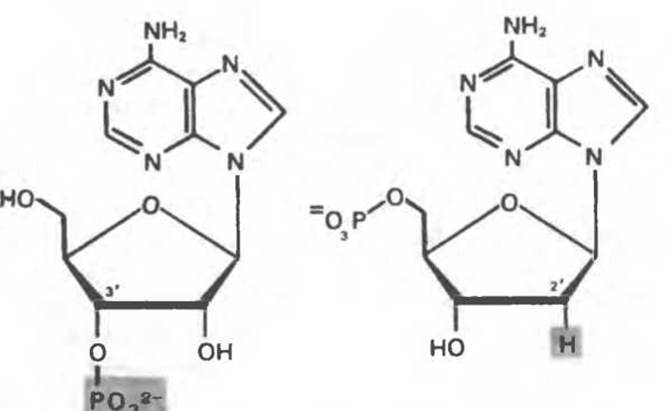
Fig. 34.12. Structure of adenosine-3'-monophosphate (left) and 2'-deoxyadenosine-5'-monophosphate (right).
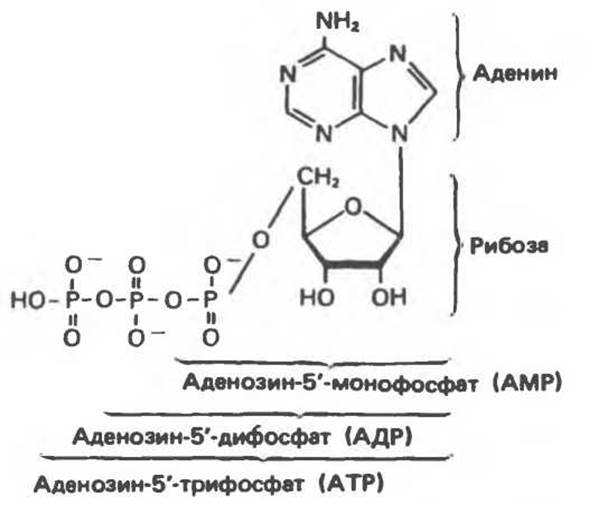
Fig. 34.13. Structure of ATP and the corresponding di- and monophosphate forms.
Last update: 06/08/2026
Editorial and Educational Adaptation: This material has been compiled based on the primary/original source text. The project team performed an editorial review, corrected technical inaccuracies, structured sections, and adapted the content for an educational format.
What was processed:
- elimination of formatting defects (OCR errors, structural breaks, corrupted characters);
- editorial organization of content;
- standardization of terminology in accordance with academic sources;
- verification of factual statements against the original source text.
All mentions of the author, publication year, and origin of the primary text have been preserved in accordance with the source.