Harper's Illustrated Biochemistry, Volume 1 - Murray R. 1993
Structure and Functions of Proteins and Enzymes
Enzymes: Mechanism of Action
Mechanism of Chymotrypsin Catalytic Action
Nature and Specificity of the Overall Reaction
Chymotrypsin catalyzes the Hydrolysis of peptide bonds in which the carboxyl group belongs to an aromatic amino acid (Phe, Tyr, or Trp) or to an amino acid with a bulky nonpolar R-group (Met).
Like many other proteases, chymotrypsin also catalyzes the hydrolysis of certain esters. Although this capability has no physiological significance, it is successfully utilized in experiments designed to study the catalytic mechanism in detail.
n-Nitrophenyl Acetate, a Useful Synthetic Substrate
The Use of the synthetic substrate n-nitrophenyl acetate (Fig. 9.1) allows chymotrypsin activity to be determined using colorimetric Methods, since the Hydrolysis of N-nitrophenyl acetate yields n-nitrophenol, which in an alkaline medium is converted into the yellow-colored n-nitrophenolate anion.
Studying Kinetics by the Stopped-Flow Method
The kinetics of n-nitrophenyl acetate hydrolysis by chymotrypsin can be studied using the stopped-flow technique. The method involves mixing approximately equimolar amounts of enzyme and substrate and performing measurements almost immediately (within a few milliseconds). The reagent solutions are loaded into two syringes and, by means of a mechanical device, are simultaneously and almost instantaneously forced into a very narrow tube passing through a spectrophotometer. The oscilloscope screen displays data on optical density as a function of time elapsed since mixing.
Class="center">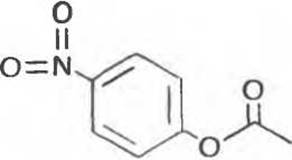
Fig. 9.1. n-Nitrophenyl acetate.

Fig. 9.2. Kinetics of n-nitrophenolate anion release during the hydrolysis of n-nitrophenyl acetate by chymotrypsin, recorded using the stopped-flow method. The amount of released n-nitrophenol is determined by measuring optical density.
Biphasic Nature of n-Nitrophenyl Acetate Hydrolysis
The kinetic curve of n-nitrophenolate anion formation exhibits two distinct phases (Fig. 9.2): 1) a "burst" phase, characterized by the rapid Formation of the n-nitrophenolate anion, and 2) a subsequent slow phase of further n-nitrophenolate anion production.
Formation and Breakdown of the Enzyme-Substrate Complex
The biphasic nature of n-nitrophenolate anion formation can be explained by examining the Sequential Stages of catalysis shown in Fig. 9.3.
The slow step represents the hydrolysis of the chymotrypsin-acetate complex (CT-Ac). Once all available chymotrypsin is converted into the complex, the release of the n-nitrophenolate anion slows down due to the lack of free enzyme, which is liberated only as the acetate ion slowly dissociates from the complex (Fig. 9.3). The "burst" phase of n-nitrophenolate anion release (Fig. 9.2) corresponds to The conversion of all available chymotrypsin into the CT-Ac complex with the simultaneous formation of the n-nitrophenolate anion. The release of this product immediately following the rapid phase is due to the slow liberation of chymotrypsin during the hydrolysis of the CT-Ac complex. This free chymotrypsin re-enters the reaction to form the CT-PNP and CT-Ac complexes, which is accompanied by the release of the n-nitrophenolate anion. The amount of released n-nitrophenolate anion is directly proportional to the number of moles of chymotrypsin present in the mixture.
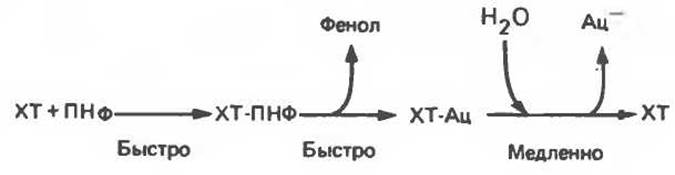
Fig. 9.3. Intermediate stages of chymotrypsin-catalyzed n-nitrophenyl acetate hydrolysis. CT — chymotrypsin; PNP — n-nitrophenyl acetate; CT-PNP — chymotrypsin-n-nitrophenyl acetate complex; CT-Ac — acetylchymotrypsin; phenol — n-nitrophenolate anion; Ac — acetate anion. The formation of the CT-PNP complex and the acetyl-enzyme CT-Ac proceeds much faster than the hydrolysis of CT-Ac.
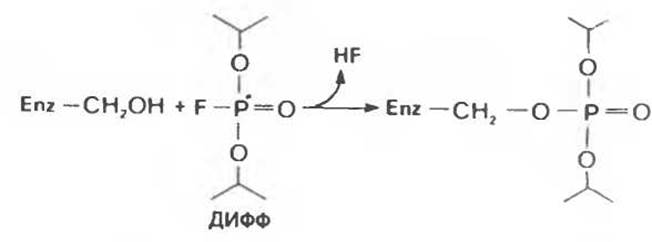
Fig. 9.4. Reaction of the Ser 195 hydroxyl group within chymotrypsin with diisopropyl fluorophosphate (DFP).
Role of Ser 195 in Catalysis
The acyl group that is part of the acyl-CT intermediate is attached to a highly reactive Serine residue, Ser 195. The special role and high reactivity of Ser 195 are manifested in the ability of this residue (which is absent in the other 27 serine residues of chymotrypsin) to react with diisopropyl fluorophosphate (DFP) (Fig. 9.4). Similar reactions are characteristic of other serine proteases as well.
Upon modification of Ser 195, chymotrypsin is inactivated. A number of other proteases are likewise inactivated in the presence of DFP via a similar mechanism. All of them are referred to as serine proteases.
Charge Relay System
During catalysis, a charge relay system Functions within the chymotrypsin molecule, serving as a proton transfer pathway. This system includes three amino acid residues that are far apart in the Primary Structure but brought close together in the tertiary structure to distances that permit interaction. These residues are Asp 102, His 57, and Ser 195. Although most charged residues in chymotrypsin are located on the molecular surface, the residues that form the charge relay system are buried in the internal nonpolar core of the molecule. These three residues form the chain Asp 102 ... His 57 ... Ser 195.
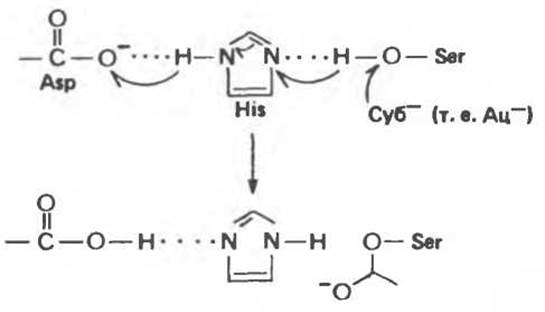
Fig. 9.5. Operation of the proton transfer system in chymotrypsin during the acylation of the Ser 195 residue by the substrate (Sub-).
Recall that Ser 195 is the very residue that undergoes acylation during catalysis. The close approach of the acetate anion (derived from μ-nitrophenyl acetate) to the oxygen atom of the Ser 195 R-group leads to a sequential proton transfer from Ser 195 to His 57 and subsequently to Asp 102 (Fig. 9.5).
During the deacylation of the acyl-Ser 195 complex, the proton moves in the reverse direction. A similar proton transfer is believed to occur during the hydrolysis of physiological chymotrypsin substrates, namely Peptides.
Last update: 06/08/2026
Editorial and Educational Adaptation: This material has been compiled based on the primary/original source text. The project team performed an editorial review, corrected technical inaccuracies, structured sections, and adapted the content for an educational format.
What was processed:
- elimination of formatting defects (OCR errors, structural breaks, corrupted characters);
- editorial organization of content;
- standardization of terminology in accordance with academic sources;
- verification of factual statements against the original source text.
All mentions of the author, publication year, and origin of the primary text have been preserved in accordance with the source.