Harper's Illustrated Biochemistry, Volume 1 - Murray R. 1993
Structure and Function of Proteins and Enzymes
Enzymes: General Properties
Enzymes in Clinical Diagnosis
Differences between functional and non-functional plasma Enzymes
Certain enzymes, proenzymes, and their substrates normally circulate continuously in human Blood, performing vital physiological Functions. Examples of functional plasma enzymes include lipoprotein lipase, pseudocholinesterase, as well as proenzymes belonging to the blood clotting and fibrinolytic systems. These are synthesized in the Liver, and their concentration in the blood is either comparable to or higher than that in the Tissues.
As the name implies, non-functional plasma enzymes serve no known physiological purpose in the bloodstream. Their substrates are typically undetectable in plasma, and their normal concentration in human blood is nearly a million times lower than in tissues. An elevated concentration of these Proteins in plasma indicates an increased rate of tissue destruction. Consequently, measuring the levels of non-functional plasma enzymes provides physicians with valuable DIAGNOSTIC AND PROGNOSTIC information.
Class="center">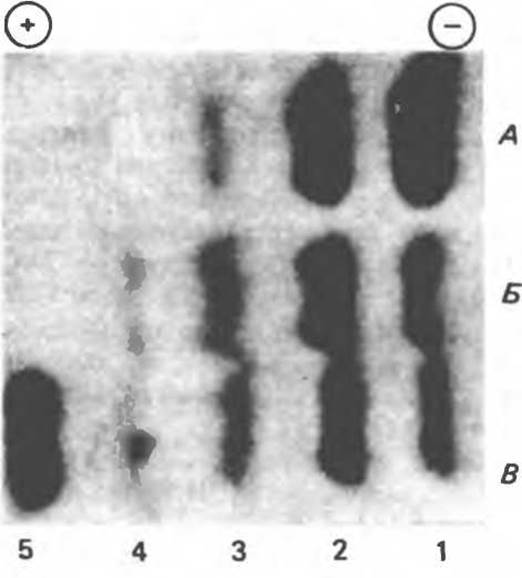
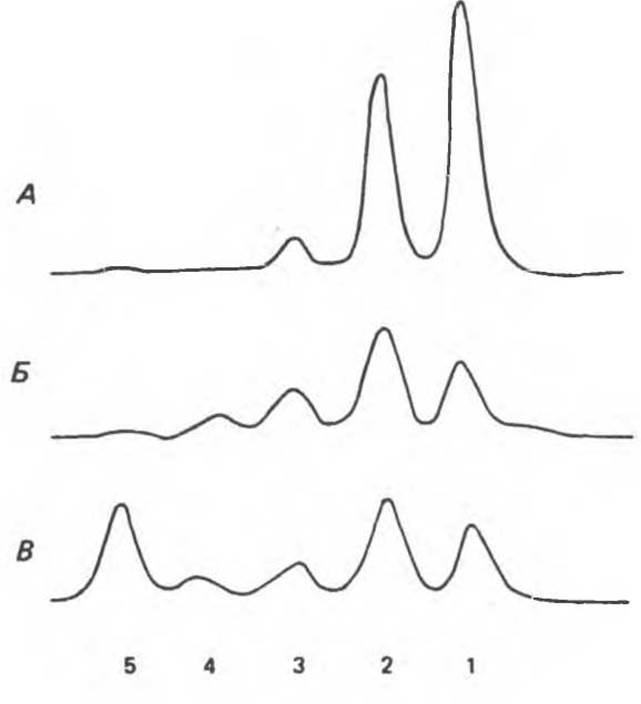
Fig. 7.10. Serum Lactate dehydrogenase (LDH) isoenzyme patterns in health and disease. Serum LDH Isoenzymes were separated by Cellulose acetate Electrophoresis at pH 8.6 and visualized using a dye-coupling reaction. Photometric scanning of the bands allows for the estimation of relative isoenzyme levels. A. Serum from a patient with myocardial infarction. B. Serum from a healthy individual. C. Serum from a patient with liver disease. (Courtesy of Dr. Melvin Black and Mr. Hugh Miller, St Luke’s Hospital, San Francisco.)
Non-functional plasma enzymes comprise secretory products of exocrine glands and true intracellular proteins. Enzymes secreted by exocrine glands—such as pancreatic amylase, pancreatic lipase, alkaline phosphatase (from Bile), and prostatic acid phosphatase—enter the plasma via simple diffusion. True intracellular proteins do not normally enter the Circulatory system.
Origin of non-functional plasma enzymes
Non-functional enzymes, typically found in small amounts in plasma, presumably originate from the normal physiological turnover and destruction of erythrocytes, leukocytes, and other Cells. When Cell death is accelerated, soluble enzymes are released into the bloodstream. While elevated plasma enzyme levels are commonly attributed to this process, engaging in strenuous physical exertion can also lead to the release of significant amounts of Muscle enzymes into the plasma.
Last update: 06/08/2026
Editorial and Educational Adaptation: This material has been compiled based on the primary/original source text. The project team performed an editorial review, corrected technical inaccuracies, structured sections, and adapted the content for an educational format.
What was processed:
- elimination of formatting defects (OCR errors, structural breaks, corrupted characters);
- editorial organization of content;
- standardization of terminology in accordance with academic sources;
- verification of factual statements against the original source text.
All mentions of the author, publication year, and origin of the primary text have been preserved in accordance with the source.