Human Biochemistry, Volume 1 - Murray R. 1993
Bioenergetics and Metabolism of Carbohydrates and Lipids
Gluconeogenesis and the Pentose Phosphate Pathway
Pentose Phosphate Pathway or Hexose Monophosphate Shunt — Clinical Aspects
The Pentose Phosphate Pathway in erythrocytes supplies NADPH for the reduction of oxidized Glutathione (G—S—S—G) to reduced glutathione (2G—SH), a reaction catalyzed by glutathione reductase. Reduced glutathione destroys Н2О2 in erythrocytes in a reaction catalyzed by glutathione peroxidase:
Class="center">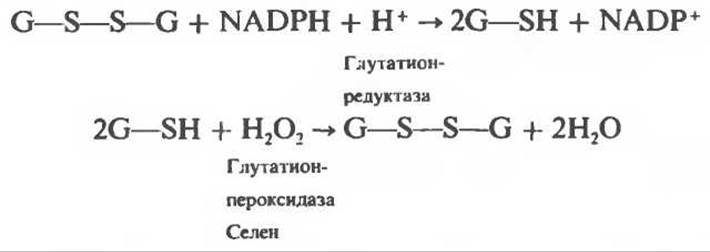
This reaction is of vital importance because the accumulation of Н2О2 can shorten the lifespan of erythrocytes (by increasing The rate of Hemoglobin oxidation to methemoglobin). It has been shown that there is an inverse relationship between glucose-6-phosphate dehydrogenase activity and erythrocyte resistance. In certain populations, a mutation has been identified that causes a deficiency of this enzyme; the consequence of this mutation is impaired NADPH production, which leads to erythrocyte hemolysis after patients take drugs that act as oxidants, such as the antimalarial drug primaquine, aspirin, and sulfonamides. The same consequences are triggered in some individuals by the consumption of fava beans (Vicia faba).
Determining transketolase activity in the Blood makes it possible to assess the degree of thiamine deficiency. The only condition in which an increase in its activity is observed is pernicious anemia.
Krebs H. A. Gluconeogenesis, Proc. R. Soc. Lond. [Biol.], 1964, 159, 545.
Landau B. R., Wood H. G. The pentose cycle in animal Tissues: Evidence for the classical and against the «L-type« pathway, Trends Biochem. Sсi., 1983, 8, 292.
Williams J. F. A critical examination of the Evidence of the Reactions of the pentose pathway in animal tissues, Trends Biochem. Sсi., 1980, 5, 315.
Wood T. The Pentose Pathway, Academic-Press, 1985.
Last update: 06/08/2026
Editorial and Educational Adaptation: This material has been compiled based on the primary/original source text. The project team performed an editorial review, corrected technical inaccuracies, structured sections, and adapted the content for an educational format.
What was processed:
- elimination of formatting defects (OCR errors, structural breaks, corrupted characters);
- editorial organization of content;
- standardization of terminology in accordance with academic sources;
- verification of factual statements against the original source text.
All mentions of the author, publication year, and origin of the primary text have been preserved in accordance with the source.