Biochemistry, Vol. 3 - A. Lehninger 1985
Selected Aspects of Human Biochemistry
Human Nutrition
Deficiency of certain vitamins can be life-threatening
Let us now examine The Role of Vitamins in Human Nutrition. In Chapter 10, we already discussed The Structure of VITAMINS AND THEIR coenzyme Functions. In this section, we will focus on human dietary requirements for vitamins and the health consequences of their deficiency.
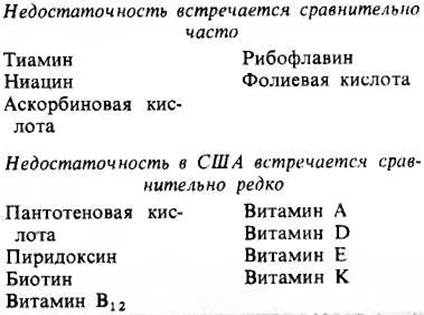
Today we can state with confidence that all vitamins essential for the normal nutrition of humans and rats have been identified. Depending on the severity of health impairment caused by their deficiency, Vitamins can be divided into two classes (Table 26-12). Deficiencies of thiamine, niacin, riboflavin, folic acid, and ascorbic acid have a substantial impact on human health and represent a pressing issue in many countries. Marginal deficiencies of these vitamins are encountered relatively frequently even in highly developed nations. As for pantothenic acid, pyridoxine, biotin, vitamin B12, and vitamins A, D, E, and K, deficiencies of these vitamins are extremely rare among residents of developed countries.
Class="center">Table 26-12. Vitamins Required by Humans
Individual requirements for specific vitamins can vary significantly depending on dietary patterns, gastrointestinal microflora activity, and genetic factors. For instance, the requirement for nicotinamide strongly depends on dietary protein composition and, specifically, on the presence of Tryptophan, which can be converted into nicotinamide in the body, whereas the requirement for pyridoxine increases with higher dietary protein content. At the same time, vitamins such as biotin, pantothenic acid, and vitamin B12 are synthesized by intestinal Bacteria in quantities sufficient to meet normal human requirements. A deficiency of these vitamins may occur only under highly unusual dietary regimens.
Most Water-Soluble Vitamins must be supplied regularly in the diet because they are relatively quickly eliminated from the body or degraded during routine enzymatic reactions. When excessive amounts of water-soluble vitamins are consumed in the form of multivitamin supplements, the excess beyond daily requirements is simply excreted, since most water-soluble vitamins cannot be stored in the body. At the same time, excessive intake of Fat-soluble vitamins (A and D) can be toxic.
Last update: 06/08/2026
Editorial and Educational Adaptation: This material has been compiled based on the primary/original source text. The project team performed an editorial review, corrected technical inaccuracies, structured sections, and adapted the content for an educational format.
What was processed:
- elimination of formatting defects (OCR errors, structural breaks, corrupted characters);
- editorial organization of content;
- standardization of terminology in accordance with academic sources;
- verification of factual statements against the original source text.
All mentions of the author, publication year, and origin of the primary text have been preserved in accordance with the source.