Principles of Biochemistry Volume 3 - A. Lehninger 1985
Selected Aspects of Human Biochemistry
Human Nutrition
Starvation and Kwashiorkor: Global Public Health Challenges
In A number of countries, located primarily in the Southern Hemisphere, the discrepancy between population growth rates and food production is becoming increasingly pronounced. There are always starving people on Earth, and their numbers inevitably rise during years of crop failure and war. According to rough estimates, the number of people on the brink of starvation is 500 million, and about 12,000 people die of hunger daily. In India alone, roughly 1 million children die each year from malnutrition. Childhood malnutrition most frequently leads to two conditions that often occur concurrently, namely marasmus and kwashiorkor (Fig. 26-7).
Marasmus is caused by a chronic deficiency of dietary calories in children. This condition is widespread in food-deficient countries. It develops in infants after they are weaned from breast milk onto artificial foods, which typically consist of a watery porridge made from grains and other plants, and generally contain very few calories or Proteins. At the same time, it is well established that calories and proteins are especially crucial precisely during this period of a child's development and growth. Marasmus is characterized by growth retardation, pronounced muscular atrophy, general weakness, and anemia; this condition is commonly complicated by vitamin and mineral deficiencies. Insufficient caloric intake in early childhood, even if later compensated for by a normal diet, leads to impaired normal growth and bodily development. Child mortality due to insufficient caloric intake in food-scarce countries is very high—over half of the children do not survive to the age of 5. Marasmus is one manifestation of a large spectrum of diseases caused by a general shortage of food, particularly protein. In countries where people suffer from starvation, their diets typically lack both calories and proteins simultaneously, though the degree of deficiency may vary; the combination of both deficiencies is termed protein-calorie malnutrition.
Class="center">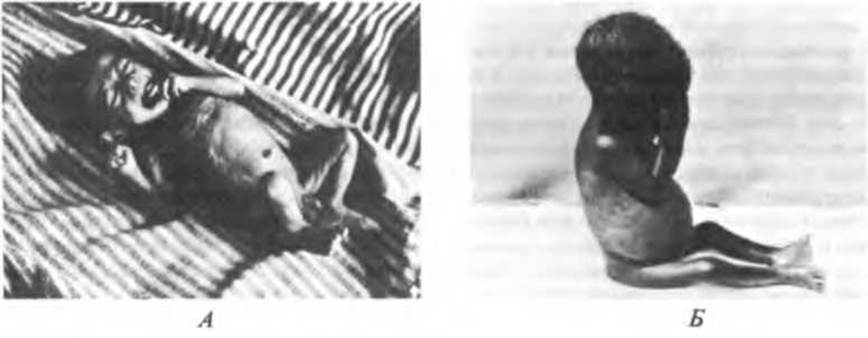
Fig. 26-7. A. A child from Indonesia suffering from marasmus caused by chronic caloric deficiency in the diet. Marasmus is commonly complicated by deficiencies of various Vitamins AND MINERALS. B. A child from Angola suffering from kwashiorkor. Dietary Protein deficiency leads to Swelling and edema of various Tissues due to impaired synthesis of serum albumin, which is necessary to maintain normal Water-salt balance.
In many countries, people lack sufficient animal-source proteins for proper Nutrition. Because plant-based foods contain protein in smaller quantities and of "inferior" quality compared to animal products, countries with particularly rapid population growth experience a significant shortage of "high-quality" proteins. A persistent dietary protein deficiency causes kwashiorkor in children, a name derived from an African word meaning "weaning." In developing countries, children are breastfed for a relatively long time; however, when they are weaned (usually prompted by the arrival of the next child), they begin receiving food with inadequate protein content. The growth of children who do not receive sufficient protein slows down, they develop anemia, and their tissues swell and become edematous due to low plasma protein levels, thereby disrupting the normal distribution of water between the Blood and tissues. Furthermore, degenerative processes also develop in the Liver, Kidneys, and Pancreas. Mortality among children suffering from kwashiorkor is extremely high. Even in cases where they survive, prolonged protein deficiency leads to irreversible impairments in their physiological Functions. More importantly, protein deficiency at an early age results in impaired mental capacity and learning ability in children. The most severe cases of this disease are observed in situations where protein deficiency spans two or three generations. Kwashiorkor was first diagnosed in Africa, but it was later found to occur in all countries where food supplies lack complete proteins.
Last update: 06/08/2026
Editorial and Educational Adaptation: This material has been compiled based on the primary/original source text. The project team performed an editorial review, corrected technical inaccuracies, structured sections, and adapted the content for an educational format.
What was processed:
- elimination of formatting defects (OCR errors, structural breaks, corrupted characters);
- editorial organization of content;
- standardization of terminology in accordance with academic sources;
- verification of factual statements against the original source text.
All mentions of the author, publication year, and origin of the primary text have been preserved in accordance with the source.