Principles of Biochemistry, Volume 3 - A. Lehninger 1985
Selected Aspects of Human Biochemistry
Digestion, Nutrient Transport, and Metabolic Interrelationships
Erythrocytes also transport CO2
Carbon dioxide produced in Tissues is also transported by the Blood to the Lungs, from where it is eliminated via exhaled air. The carbon dioxide content in venous blood flowing away from tissues is approximately 60 mL of gaseous CO2 per 100 mL of blood, whereas arterial blood leaving the lungs contains approximately 50 mL of CO2 per 100 mL of blood. About two-thirds of the total blood CO2 resides in the plasma and about one-third in the erythrocytes. However, during The transport of CO2 from tissues to the lungs, nearly all blood CO2 must pass through the erythrocytes (entering and exiting them). Both in plasma and in erythrocytes, CO2 exists in two forms: as a dissolved gas and as bicarbonate (HCO-3). Because dissolved CO2 undergoes reversible Hydration to form carbonic acid (Н2СO3), the mixture of Н2СO3 and НС-O3 in the blood forms a buffer system (Section 4.11), where Н2СO3 acts as a proton donor and the НСO-3 ion as its acceptor. The Н2СO3 – НСO-3 system serves as the primary buffer system of Blood Plasma.
Class="center">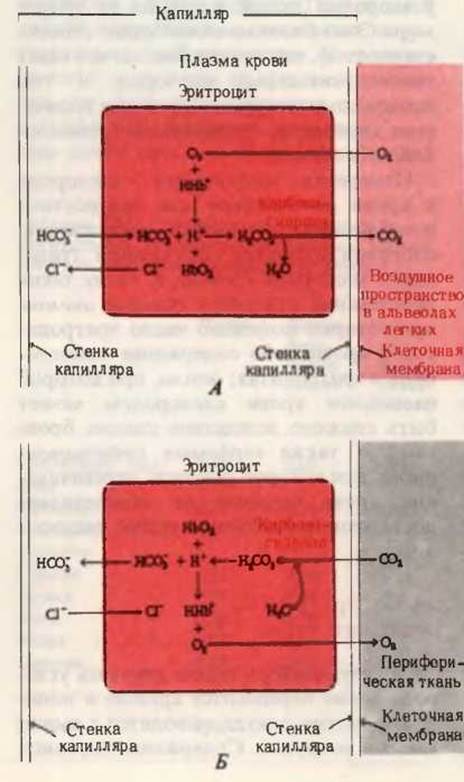
Fig. 24-22. Coordinated transport of oxygen and CO2 by erythrocytes. A. In the lungs, the Oxygenation of Hemoglobin results in the release of H+ ions, which then combine with HCO3 ions to form Н2СO3. Under the action of Carbonic anhydrase, H2CO3 undergoes dehydration, producing dissolved CO2, which diffuses into the blood plasma and from there into the air spaces of the lungs to be exhaled. B. The uptake of dissolved CO2 by erythrocytes in peripheral tissues requires the participation of carbonic anhydrase, which catalyzes the hydration of CO2 to form Н2СO3; subsequently, Н2СO3 loses an Н+ ion and is converted into НСО-3. The H+ ions released in the process shift the equilibrium of the hemoglobin-oxygen reaction toward the release of oxygen and its delivery to the tissue. Because O2 and CO2 are lipid-soluble, they readily cross Cell membranes without The Need for membrane transport systems. However, the exchange between Cl- and НСО-3 ions across The erythrocyte membrane occurs only via systems mediating anion transport.
The transport of CO2 from tissues to the lungs consists of the following steps (Fig. 24-22). Dissolved CO2, produced as an oxidation product in The Citric Acid Cycle as well as in other processes involving enzymatic decarboxylation, diffuses from the tissues into the blood plasma and further into the erythrocytes. Within the erythrocytes, CO2 is hydrated in a reversible reaction to form free carbonic acid:
CO2 + Н2O ⇄ Н2СО3
In the absence of a catalyst, this reaction proceeds relatively slowly, and The formation of carbonic acid lags behind The production of CO2 in respiring tissues. However, erythrocytes contain carbonic anhydrase—an exceptionally active enzyme that dramatically accelerates this reaction. As Н2СO3 is formed, it immediately ionizes to yield a bicarbonate ion:
Н2СO3 ⇄ Н+ + НСО-3
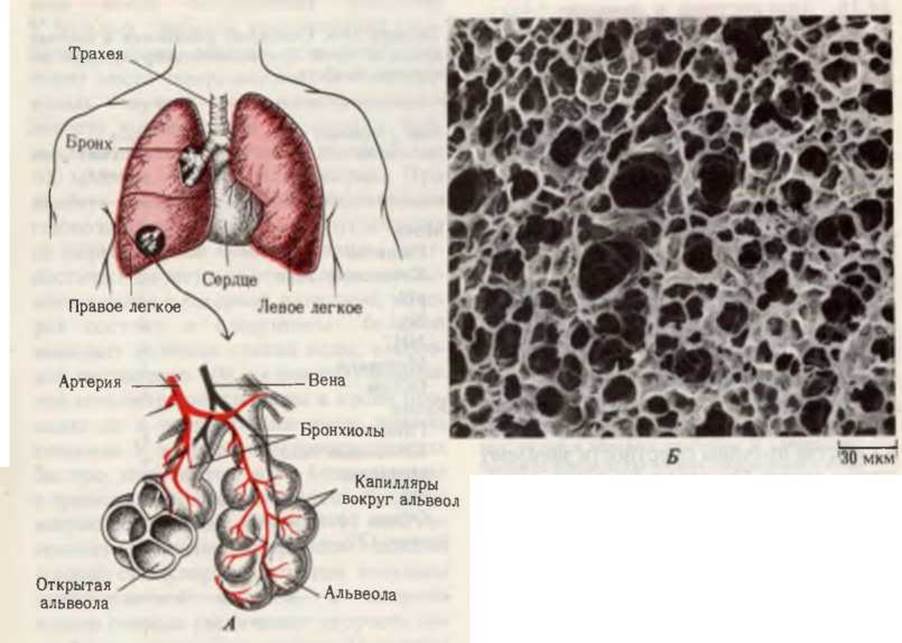
Fig. 24-23. Alveoli, or air sacs, of the lungs (A) provide a large surface area through which O2 and CO2 exchange occurs between alveolar air and blood capillaries. B. Electron micrograph showing alveoli and blood capillaries.
The HCO3 ion thus formed exits the erythrocytes into the plasma in exchange for a chloride ion (Cl-). As for the H+ ions appearing in erythrocytes from The ionization of carbonic acid (Н2СO3), they facilitate the release of oxygen from oxyhemoglobin According to the aforementioned reaction running in reverse:
Н+ + НbO2 ⇄ ННb+ + O2
Thus, the accumulation of H+ ions driven by The entry of CO2 into erythrocytes and its conversion into HCO-3 facilitates oxygen delivery by the blood as it passes through peripheral tissues.
In the carbon dioxide-rich venous blood returning to the lungs, the same cycle proceeds in reverse. The binding of oxygen by hemoglobin in the pulmonary capillaries leads to the release of H+ ions:
ННb+ + O2 ⇄ Н+ + НbO2
The accumulation of H+, in turn, promotes the formation of carbonic acid from HCO-3 within the erythrocytes:
H+ + HCO-3 ⇄ H2CO3
Next, in the presence of carbonic anhydrase, carbonic acid undergoes dehydration to yield dissolved CO2:
Н2СО3⇄ H2O + CO2
Dissolved CO2 leaves the erythrocytes, enters the blood plasma, passes through the capillary walls, and is eliminated through the vast surface area of the lungs into the air space (Fig. 24-23). Overall, Oxygen transport and CO2 transport mutually enhance each other, owing to The properties of hemoglobin, which is exquisitely adapted to perform these specialized transport Functions.
Last update: 06/08/2026
Editorial and Educational Adaptation: This material has been compiled based on the primary/original source text. The project team performed an editorial review, corrected technical inaccuracies, structured sections, and adapted the content for an educational format.
What was processed:
- elimination of formatting defects (OCR errors, structural breaks, corrupted characters);
- editorial organization of content;
- standardization of terminology in accordance with academic sources;
- verification of factual statements against the original source text.
All mentions of the author, publication year, and origin of the primary text have been preserved in accordance with the source.