Principles of Biochemistry Volume 2 - A. Lehninger 1985
Bioenergetics and Metabolism
Photosynthesis
Light induces an electron flow in chloroplasts
How exactly does the absorption of light by pigment molecules trigger a chemical change that ultimately leads to The conversion of light energy into chemical energy?
The key to answering this question was provided in 1937 at Cambridge University by Robert Hill, who made a major contribution to The Study of Photosynthesis. He found that if a non-biological hydrogen acceptor is added to leaf extracts containing METABOLISM/14.html">Chloroplasts, and these preparations are then illuminated, they evolve oxygen while simultaneously reducing the hydrogen acceptor According to the equation
Class="center">
where A is an artificial hydrogen acceptor and AH2 is its reduced form. Among the non-biological hydrogen acceptors used by Hill was the dye 2,6-dichlorophenolindophenol; its oxidized form (A) is blue, while the reduced form (AH2) is colorless. Upon illumination of extracts containing this dye, the solution was decolorized and oxygen was evolved, whereas in the dark neither oxygen evolution nor dye reduction took place. This observation served as the starting point for clarifying how absorbed light energy is converted into chemical energy: it became clear that light energy drives The transfer of electrons from H2O to an acceptor molecule. Hill also discovered that this reaction does not require carbon dioxide and that under these conditions CO2 is not reduced to any stable form. From this, Hill concluded that the processes of oxygen evolution and carbon dioxide reduction can be uncoupled. The reaction described by equation (2) is known as the Hill reaction, and the artificial electron acceptor A as the Hill oxidant.
Subsequently, researchers began searching for a natural, biologically active analog of the Hill oxidant—that is, the electron acceptor present in chloroplasts that accepts the hydrogen atoms split off from Water by light. Several years later, it was established that this natural biological electron acceptor in chloroplasts is NADP+. The reaction is described by the equation
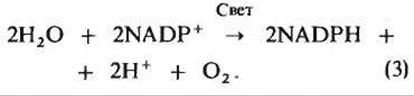
It is worth noting a very important feature of this reaction: electrons are transferred here from water to NADP+, whereas in the mitochondrial Respiratory Chain they move in the opposite direction, from NADH or NADPH to oxygen, with a loss of Free energy (Sec. 17.5). Because the light-driven electron flow in chloroplasts is directed "uphill," from H2O to NADP+, it cannot occur without an influx of free energy. This energy is supplied by the light absorbed by the chloroplasts.
Last update: 06/08/2026
Editorial and Educational Adaptation: This material has been compiled based on the primary/original source text. The project team performed an editorial review, corrected technical inaccuracies, structured sections, and adapted the content for an educational format.
What was processed:
- elimination of formatting defects (OCR errors, structural breaks, corrupted characters);
- editorial organization of content;
- standardization of terminology in accordance with academic sources;
- verification of factual statements against the original source text.
All mentions of the author, publication year, and origin of the primary text have been preserved in accordance with the source.