Principles of Biochemistry, Volume 1 - A. Lehninger 1985
Biomolecules
Biochemistry: The Molecular Logic of Living Organisms
Cells use energy in chemical form
Living Cells capture, store, and transfer energy in chemical form, primarily as energy stored in molecules of adenosine triphosphate (ATP). ATP serves as the universal carrier of chemical energy in the cells of All living organisms. By losing its terminal phosphate group, ATP can transfer energy to various other Biomolecules, converting the energy-rich ATP molecule into an energy-depleted adenosine diphosphate (ADP) molecule. In turn, ADP can recombine with a phosphate group to regenerate ATP, utilizing either solar energy (in photosynthetic cells) or chemical energy (in animal cells). ATP acts as the primary link between two extensive, interconnected networks of enzymatic reactions within The Cell. One of these systems traps chemical energy from the environment, chiefly by phosphorylating energy-poor ADP to form energy-rich ATP. The other reaction system harnesses the energy of ATP to biosynthesize cellular components from simpler precursors, perform mechanical work in contractile and motile apparatuses, and carry out osmotic work by transporting substances across membranes. Much like the biomolecules that serve as building blocks, these interdependent networks of enzymatic reactions are virtually identical across most living species.
Class="center">
Fig. 1-7. Structural formula (A) and spatial model (B) of adenosine triphosphate (ATP).
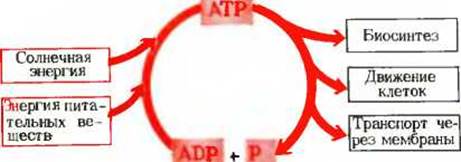
Fig. 1-8. ATP acts as a chemical energy carrier that links Energy Sources with intracellular processes requiring energy input.
Last update: 06/08/2026
Editorial and Educational Adaptation: This material has been compiled based on the primary/original source text. The project team performed an editorial review, corrected technical inaccuracies, structured sections, and adapted the content for an educational format.
What was processed:
- elimination of formatting defects (OCR errors, structural breaks, corrupted characters);
- editorial organization of content;
- standardization of terminology in accordance with academic sources;
- verification of factual statements against the original source text.
All mentions of the author, publication year, and origin of the primary text have been preserved in accordance with the source.