Principles of Biochemistry, Volume 1 - A. Lehninger 1985
Biomolecules
Water
Buffers are mixtures of weak acids and their conjugate bases
Buffers are aqueous systems that tend to resist changes in pH when small amounts of acid (H+) or base (OH-) are added. A buffer system consists of a weak acid (the proton donor) and its conjugate base (the proton acceptor). A classic example is a mixture of equal concentrations of acetic acid and the acetate ion, which is formed in solution at the midpoint of The titration curve shown in Fig. 4-10. As can be seen, the titration curve of acetic acid features a relatively linear segment extending approximately one pH unit on either side of the midpoint, which corresponds to a pH of 4.76. When the concentration of H+ (or OH-) ions is increased in the titrated solution within this range, only a slight change in pH occurs. This relatively flat region represents the buffer zone of the acetic acid–acetate conjugate acid-base pair. At the midpoint of the buffer range, where the concentration of the proton donor (acetic acid) exactly equals that of the conjugate base (acetate), the buffering capacity of the system is maximal. This means that an increase in H+ (or OH-) ion concentration causes the minimum possible change in pH at this point. Another notable feature of this point on the acetic acid titration curve is that its pH numerically equals the pK' of acetic acid. It is important to emphasize that although the pH of the acetate buffer system does change slightly upon The addition of small amounts of OH- (or H+) ions, these shifts are negligible compared to the dramatic pH changes that would occur if the same amount of OH- (or H+) were added to pure Water or to a solution of a salt composed of a strong acid and a strong base, such as NaCl, because neither water nor such salt solutions possess buffering capacity.
Class="center">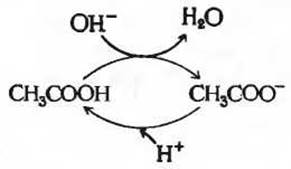
Fig. 4-12. The acetic acid–acetate system can act as a buffer capable of absorbing either H+ or OH- ions through the reversible dissociation of acetic acid (see text).
Buffering capacity is not the result of black magic, but rather a natural consequence of the equilibria of two reversible reactions occurring in a solution that contains a proton donor and its conjugate proton acceptor, provided both are present at approximately equal concentrations. Let us examine how a buffer system works using the diagram in Fig. 4-12. One of the two components of such a system—the proton donor, or weak acid (HA)—contains a reserve of bound H+ ions that can be released to neutralize added OH- ions, forming H2O. This happens because the equilibrium is momentarily disturbed, making the product [H+][OH-] greater than 1×10-14. The disturbed equilibrium is rapidly restored so that the product [H+][OH-] equals 1×10-14 again (at 25 °C), which immediately leads to a decrease in the concentration of H+ ions. However, the ratio [H+]/[OH-] now falls below the value of K', prompting further dissociation of the acid HA to re-establish equilibrium. Conversely, the other component of the buffer system—the conjugate base (the A- anion)—can bind to H+ ions added to the buffer solution and be converted into HA. Here too, the two ionization reactions regulate each other and reach equilibrium. We can now understand why a conjugate acid-base pair can prevent significant shifts in solution pH when small amounts of base or acid are added. The ability of a solution to function as a buffer is simply an automatic consequence of the two reversible reactions taking place within it and the establishment of corresponding equilibria governed by the reaction equilibrium constants, Kw and K'. When we add OH- (or H+) ions to a buffer solution, it causes a minor shift in the relative concentrations of the weak acid and its anion, and consequently, an insignificant change in pH. The decrease in the concentration of one buffer component upon the addition of a small amount of base (or acid) is exactly counterbalanced by an increase in the concentration of the other component. The total concentration of buffer components remains unchanged; only their ratio shifts.
Let us point out another important feature of buffer systems. As implied above, the ability of the acetic acid–acetate system to function as an effective buffer near pH 4.76 is an automatic consequence of the fact that the pK' of acetic acid is 4.76. Clearly, this system cannot serve as a buffer at Blood pH (approx. 7.4). The titration curves shown in Fig. 4-11 demonstrate that each conjugate acid-base pair has its own characteristic pH range in which it acts as an effective buffer system. As shown, the H2PO-4 – HPO2-4 pair has a pK' of 6.86 and thus can function as a buffer in the vicinity of pH 6.86, whereas the NH+4 – NH3 pair, with a pK' of 9.25, acts as a buffer near pH 9.25. Of all these conjugate systems, only the H2PO-4 – HPO2-4 pair can be used as an effective buffer at blood pH (pH 7.4).
The quantitative relationship among pH, the ability of a mixture of a weak acid and its conjugate base to function as a buffer system, and the pK' of that weak acid can be expressed by the Henderson-Hasselbalch equation. This simple equation, which is useful when selecting a buffer system, is discussed in Box 4-2.
The titration curves of acetic acid, H2PO4, and NH+4 (see Fig. 4-11) differ very little in shape. This suggests that they all reflect a common underlying pattern characteristic of weak acid titrations. Indeed, they do. The shape of the titration curve for any weak acid is described by the Henderson-Hasselbalch equation, an analysis of which helps clarify the buffering properties of blood and Tissues in mammalian organisms (i.e., the properties responsible for maintaining required acid-base equilibria). A simple derivation of this equation, along with several problems that can be solved using it, is given below.
The Henderson-Hasselbalch equation is essentially another way of expressing the acid dissociation constant:

First, we solve this equation for [H+]:

Next, we take the negative logarithm of both sides:

Substituting pH for –log[H+] and pK' for –logK', we obtain

Inverting the numerator and denominator of the term –log([HA]/[A-]) (which changes the sign of this term) yields the Henderson-Hasselbalch equation:
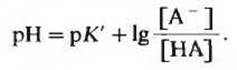
In a more general form, this equation is written as:

The Henderson-Hasselbalch equation describes the titration curves of all weak acids and allows us to derive several important quantitative relationships. From it, we can understand, for example, why the pK' of a weak acid is numerically equal to the pH of its solution at the titration midpoint. At this point, [HA] = [A-] and, consequently,
pH = pK' + log 1.0 = pK' + 0; pH = pK'.
The Henderson-Hasselbalch equation also makes it possible to calculate the pK' of any acid at a given pH (if the molar concentrations of the proton donor and acceptor are known), to determine the pH of a conjugate acid-base pair at a given molar ratio (if the pK' is known), and to calculate The ratio of the molar concentrations of the proton donor and acceptor at any pH (if the pK' of the weak acid is known).
Below are concrete Examples of all Three types of problems, along with their solutions.
1) Calculate the pK' of lactic acid if, at a free lactic acid concentration of 0.010 M and a lactate ion concentration of 0.087 M, the pH is 4.80.

2) Calculate the pH of a mixture consisting of 0,1 M acetic acid and 0,2 M sodium acetate, given that the pK' of acetic acid is 4.76.

3) Calculate the required ratio of acetate ion to acetic acid concentrations in a buffer system at pH 5.30.

Last update: 06/08/2026
Editorial and Educational Adaptation: This material has been compiled based on the primary/original source text. The project team performed an editorial review, corrected technical inaccuracies, structured sections, and adapted the content for an educational format.
What was processed:
- elimination of formatting defects (OCR errors, structural breaks, corrupted characters);
- editorial organization of content;
- standardization of terminology in accordance with academic sources;
- verification of factual statements against the original source text.
All mentions of the author, publication year, and origin of the primary text have been preserved in accordance with the source.