Principles of Biochemistry Volume 1 - A. Lehninger 1985
Biomolecules
Cells
Microfilaments are involved in cell contractile processes
High-resolution Electron Cell/15.html">Microscopy studies have demonstrated that the Cytoplasm of most Eukaryotic Cells contains numerous threads, or filaments, composed of sequentially linked protein molecules. There are three classes of such filaments, which differ in diameter, composition, and function. The thinnest of these are microfilaments (microfilaments), measuring about 5 nm in diameter (Fig. 2-15). They frequently form web-like networks directly beneath The Plasma Membrane. Microfilaments have been shown to be identical to the thin Actin filaments of the Skeletal Muscle contractile apparatus. Microfilaments are involved in generating the tension produced During Muscle contraction, The formation of folds or protrusions in The Cell membrane, and the intracellular movement of various structures.
Class="center">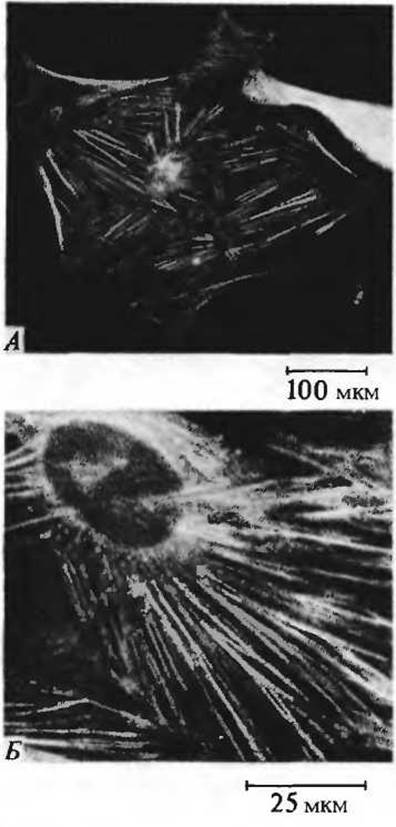
Fig. 2-15. Actin and Myosin filaments in fibroblasts, specialized Connective Tissue cells. A. Thin actin filaments visualized using a fluorescent marker. B. Myosin filaments located near The Nucleus.
The second type of filaments in eukaryotic cells is myosin filaments, which are substantially thicker than actin filaments (Fig. 2-15). Myosin filaments are a major component of the skeletal muscle contractile apparatus, yet they are also found in non-muscle cells, frequently in association with thin actin filaments. In certain cell types, myosin filaments are anchored to the cell membrane. Both actin and myosin filaments are associated with various types of cellular and intracellular motility.
Filaments of the third type are even thicker, with a diameter of approximately 10 nm. Such filaments are found in many cells and are referred to by various names.
Last update: 06/08/2026
Editorial and Educational Adaptation: This material has been compiled based on the primary/original source text. The project team performed an editorial review, corrected technical inaccuracies, structured sections, and adapted the content for an educational format.
What was processed:
- elimination of formatting defects (OCR errors, structural breaks, corrupted characters);
- editorial organization of content;
- standardization of terminology in accordance with academic sources;
- verification of factual statements against the original source text.
All mentions of the author, publication year, and origin of the primary text have been preserved in accordance with the source.