Principles of Biochemistry, Volume 1 - A. Lehninger 1985
Biomolecules
Lipids and Membranes
Steroids are non-saponifiable lipids with specific biological functions
All the Lipids discussed above belong to the category of saponifiable lipids, meaning that upon heating with alkalis they undergo Hydrolysis, and their fatty acid residues form soaps. However, Cells also contain nonsaponifiable lipids that lack fatty acid residues and therefore cannot form soaps. There are two main classes of nonsaponifiable lipids: Steroids and Terpenes. Here we will examine only those steroids that are constituents of membranes.
Steroids are complex fat-soluble substances whose molecules contain four fused rings (Fig. 12-14). The most widespread steroids are sterols, or steroid alcohols. The primary sterol in animal Tissues is Cholesterol. Cholesterol and its esters with long-chain Fatty acids are important components of plasma Lipoproteins as well as the outer Cell membrane. Plant cell membranes contain other sterols, notably stigmasterol, which differs from cholesterol solely by the presence of a double bond between carbon atoms 22 and 23. The cholesterol molecule features a polar HEAD: a hydroxyl group at the C3 position. The remainder of the molecule, as seen in the space-filling model in Fig. 12-14, is relatively rigid and hydrophobic.
Class="center">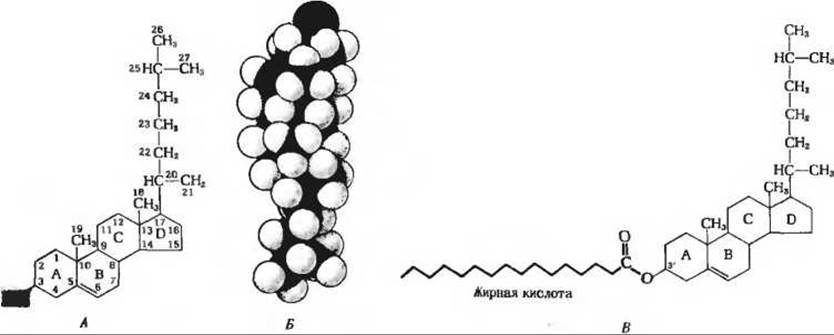
Fig. 12-14. Cholesterol, a steroid alcohol. A. Standard ring designation and carbon atom numbering for steroids. Because the four fused rings form a rigid Structure, the presence of cholesterol in membranes leads to a decrease in their fluidity. The hydroxyl group (highlighted in red) forms the polar head of cholesterol, while the rest of the molecule is hydrophobic. B. Space-filling model of cholesterol, with the hydroxyl group positioned at the top. C. Cholesterol ester. Like triacylglycerols, cholesterol esters are capable of saponification.
Last update: 06/08/2026
Editorial and Educational Adaptation: This material has been compiled based on the primary/original source text. The project team performed an editorial review, corrected technical inaccuracies, structured sections, and adapted the content for an educational format.
What was processed:
- elimination of formatting defects (OCR errors, structural breaks, corrupted characters);
- editorial organization of content;
- standardization of terminology in accordance with academic sources;
- verification of factual statements against the original source text.
All mentions of the author, publication year, and origin of the primary text have been preserved in accordance with the source.