Principles of Biochemistry Volume 1 - A. Lehninger 1985
Biomolecules
Carbohydrates: Structure and Biological Functions
Typical monosaccharides have a cyclic structure
In Figs. 11-1 to 11-4 and 11-6, the structures of various aldoses and ketoses are represented as straight-chain formulas. However, this form accurately reflects The Structure of only trioses and tetroses. Monosaccharides with a carbon Skeleton of 5 or more carbon atoms exist in solution as closed cyclic structures. In these structures, the carbonyl group is not free, as depicted in the straight-chain drawings, but forms a covalent bond with one of the hydroxyl groups attached to a carbon atom of the main chain. One piece of evidence that D-glucose has a closed ring structure is the fact that in its crystalline state, this substance exists in two forms that differ slightly in properties. When D-glucose is crystallized from Water, a-D-Glucose is formed, which has a specific rotation (Section 5.2) of [a]20D = + 112.2°. Conversely, when D-glucose is crystallized from pyridine, ß-D-glucose is formed, for which [a]20D = + 18.7°. Both forms are identical in chemical composition. Based on various chemical data, it was concluded that the carbon skeletons of the a- and ß-isomers of D-glucose form two different six-membered rings (Fig. 11-8) rather than straight chains. Because of their structural similarity to the six-membered cyclic compound pyran, such cyclic forms of sugars are termed pyranoses. The two cyclic forms of D-glucose are therefore called a-D-glucopyranose and ß-D-glucopyranose (Fig. 11-8).
When a-D-glucose is dissolved in water, its specific rotation gradually changes over time, eventually reaching a stable equilibrium value of +52.7°; under similar conditions, the specific rotation of ß-D-glucose reaches the exact same value. This change in optical activity, known as mutarotation, occurs because both a- and ß-D-glucose, at 25°C, form an equilibrium mixture consisting of approximately 1/3 a-D-glucose and 2/3 ß-D-glucose, along with only a very small amount of the open-chain form. These experiments demonstrate that the a- and ß-isomers of D-glucose can interconvert in aqueous solution.
The formation of the pyranose ring in the D-glucose molecule results from a standard reaction between an aldehyde group and a hydroxyl group, leading to the formation of a hemiacetal (Fig. 11-9). Hemiacetals contain an asymmetric carbon atom and can therefore exist in two stereoisomeric forms. D-Glucopyranose is an intramolecular hemiacetal: it is formed by the interaction of the free hydroxyl group at C-5 with the aldehyde-forming carbon atom C-1, which thereby becomes asymmetric. Consequently, D-glucopyranose can exist in two stereoisomers, designated by the prefixes a and ß (Fig. 11-8). As a result of cyclization, the number of asymmetric centers in the D-glucose molecule is one greater than the number predicted by its straight-chain formula. Isomeric forms of monosaccharides that differ from each other only in the configuration of the hemiacetal carbon atom, such as a-D-glucose and ß-D-glucose, are called anomers. The hemiacetal (or carbonyl) carbon atom is referred to as the anomeric carbon. Stable pyranose rings can be formed only by aldoses containing five or more carbon atoms. Aldohexoses can also exist as cyclic compounds with five-membered rings. Because of their similarity to the five-membered cyclic compound furan, these rings are termed furanoses (Fig. 11-10). However, the six-membered aldopyranose ring is considerably more stable than the aldofuranose ring, which is why the aldopyranose form predominates in aldohexose solutions.
Class="center">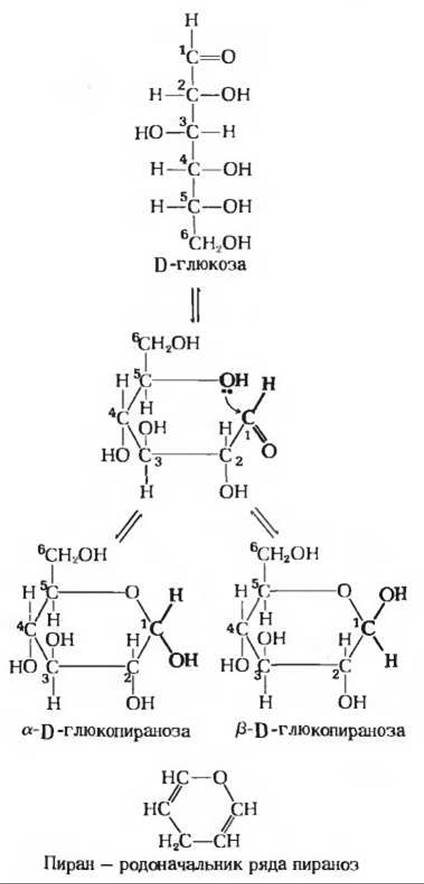
Fig. 11-8. Formation of the two forms of D-glucopyranose. When a hemiacetal bond is formed between the aldehyde group at C-1 and the hydroxyl group at C-5, two stereoisomers (designated as a and ß) can be formed due to the Asymmetry of the C-1 atom.
Ketohexoses also exist as a- and ß-anomers. In these compounds, the hydroxyl group at the fifth carbon atom interacts with the carbonyl group at the second carbon atom, forming a five-membered furanose ring with a hemiketal bond (Fig. 11-9). D-Fructose forms two furanoses (Fig. 11-10), of which ß-D-fructofuranose is the more commonly encountered.
Haworth projection formulas are generally used to depict the cyclic forms of monosaccharides. In these formulas, the portion of the ring closest to the reader is represented by bold lines (Fig. 11-10). It should be noted that in reality, the six-membered pyranose ring is not planar, contrary to the impression given by Haworth projections. For most sugars, the ring adopts a chair conformation, while in some cases it adopts a boat conformation; these Conformations are illustrated using conformational formulas (Fig. 11-11). As we will see later, the biological Properties and Functions of many Polysaccharides are largely determined by the conformational features of their constituent hexose sugars.
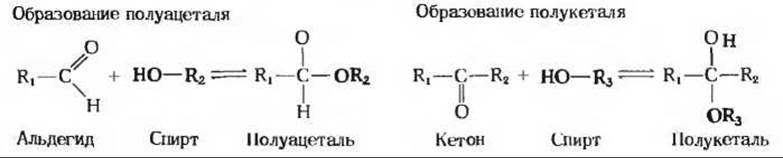
Fig. 11-9. Aldehydes and ketones can react with alcohols to form hemiacetals and hemiketals. In these reactions, the carbon atom of the carbonyl group becomes asymmetric.
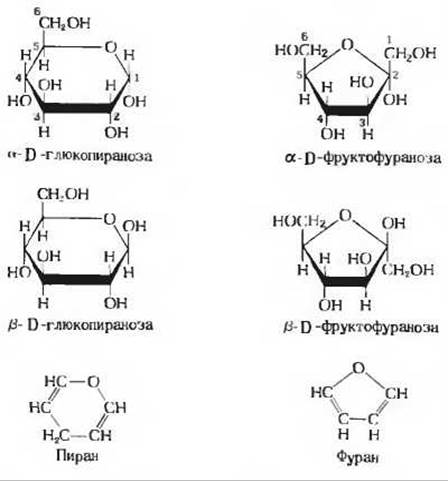
Fig. 11-10. Pyranose forms of D-glucose and furanose forms of D-fructose, depicted using Haworth projection formulas.

Fig. 11-11. A. Two isomeric forms of the pyranose ring (boat and chair), depicted using conformational formulas. B. Conformational formula of a-D-glucopyranose in the chair conformation.
Last update: 06/08/2026
Editorial and Educational Adaptation: This material has been compiled based on the primary/original source text. The project team performed an editorial review, corrected technical inaccuracies, structured sections, and adapted the content for an educational format.
What was processed:
- elimination of formatting defects (OCR errors, structural breaks, corrupted characters);
- editorial organization of content;
- standardization of terminology in accordance with academic sources;
- verification of factual statements against the original source text.
All mentions of the author, publication year, and origin of the primary text have been preserved in accordance with the source.