Principles of Biochemistry Volume 1 - A. Lehninger 1985
Biomolecules
Enzymes
There is a quantitative relationship between substrate concentration and the rate of an enzymatic reaction
Figure 9-4 shows a curve characterizing the dependence of the enzymatic reaction rate on Substrate Concentration. The figure shows that from this curve, which only approaches the point corresponding to the maximum reaction rate but never reaches it, it is difficult to determine precisely at which substrate concentration Vmах is reached. However, because this curve, which is a hyperbola, has the same shape for most Enzymes, Michaelis and Menten defined a constant, now designated as KM, which is convenient for expressing the exact relationship between substrate concentration and The rate of the enzyme-catalyzed reaction. The KM value, or the Michaelis-Menten constant, can be defined simply as the concentration of the specific substrate at which
the given enzyme yields a reaction rate equal to half of its maximum rate (Fig. 9-4).
The characteristic shape of the enzyme substrate saturation curve (Fig. 9-4) can be expressed mathematically by the Michaelis-Menten Equation
Class="center">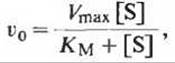
where v0 is the initial velocity at substrate concentration [S], Vmax is the maximum velocity, and KM is the Michaelis-Menten constant for the given enzyme, corresponding to a specific substrate.
This equation was derived by Michaelis and Menten based on the fundamental assumption that the rate-limiting step of enzymatic reactions is The breakdown of the ES complex into product and free enzyme. Box 9-1 presents a modern derivation of the Michaelis-Menten equation. This equation forms the basis for analyzing The kinetics of all enzymatic reactions. If the KM and Vmax values are known, the rate of the enzymatic reaction can be calculated at any given substrate concentration.
Box 9-1. The Michaelis-Menten Equation
Many enzymes exhibit a hyperbolic curve for the dependence of reaction velocity on substrate concentration (Fig. 9-4), asymptotically approaching the point corresponding to enzyme saturation with substrate. We have already seen that such curves have two key reference points: 1) KM, the substrate concentration at which the reaction velocity is half its maximum, and 2) Vmax — the maximum velocity, i.e., the limiting value that the reaction velocity approaches at an infinitely high substrate concentration. Michaelis and Menten showed that much additional useful information can be extracted from hyperbolic enzyme saturation curves by converting them into a simple mathematical form. The Michaelis-Menten equation is an algebraic expression of the hyperbolic shape of these curves. The terms of this crucial equation are: substrate concentration S, initial velocity v0, Vmax, and KM. The Michaelis-Menten equation lies at The Heart of all kinetic studies of enzymatic reactions, as it allows for the calculation of quantitative enzyme characteristics and the analysis of their inhibition.
Now we will examine in more detail the key logical and algebraic steps involved in the modern derivation of the Michaelis-Menten equation. First, let us write the two basic reactions for the formation and breakdown of the enzyme-substrate complex
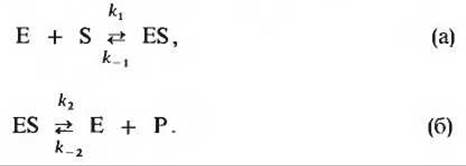
Let us introduce the following notation: [Et] is the total Enzyme Concentration (the sum of free and bound enzyme), [ES] is the concentration of the enzyme-substrate complex, and [Et] — [ES] is the concentration of free, i.e., unbound, enzyme. Since the substrate concentration [S] is usually much greater than [Et], The amount of substrate S bound to enzyme E at any given time can be considered negligible compared to the total amount of substrate S. The derivation of the equation begins by defining the rates of formation and breakdown of the enzyme-substrate complex ES.
1. Rate of ES formation. The rate of ES formation in reaction (a) is
Rate of formation = k1([Et] — [ES]) [S] (c)
where k1 is the rate constant of reaction (a). The rate of ES formation from E + P in the reverse reaction (b) is extremely small compared to the rate of the forward reaction and can therefore be neglected.
2. Rate of ES breakdown. The rate of ES breakdown is
Rate of breakdown = k-1 [ES] + k2 [ES], where k-1 and k2 are the rate constants of the reverse reaction (a) and forward reaction (b), respectively.
3. Steady state. When the rate of Formation of the enzyme-substrate complex ES equals its rate of breakdown, the concentration of ES is constant, and the reaction proceeds in a steady state:
Rate of ES formation = Rate of ES breakdown
k1 ([Et] - [ES]) [S] = k-1 [ES] + k2 [ES] (d)
4. Separating the rate constants. Rearranging the left side of equation (d) yields
k1 [Et] [S] - k1 [ES] [S]
Simplifying its right side yields (k-1 + k2) [ES]. Therefore,
k1 [Et] [S] - k1 [ES] [S] = (k-1 + k2) [ES].
Moving the term — k1 [ES] [S] to the right side of the equation and changing its sign yields
k1 [E] [S] = k1 [ES] [S] + (k-1 + k2) [ES] .
Further simplification yields
k1 [Et] [S] = (k1[S] + k-1 + k2) [ES].
We can now solve this equation for [ES]
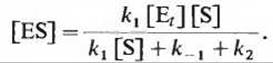
This equation can be simplified by combining the rate constants:

5. Expressing the initial velocity v0 in terms of [ES]. According to the Michaelis-Menten theory, the initial velocity is defined as the rate of breakdown of the enzyme-substrate complex, i.e., the rate of reaction (b), whose rate constant is k2. Thus, we can write
v0 = k2 [ES] .
Since, however, [ES] is equal to the right side of equation (d), we have:

The resulting equation can be simplified by defining (k2 + k-1)/k1 as KM (the Michaelis constant), and k2 [Et] as Vmax. Vmax is the maximum velocity of the reaction, observed under conditions where all the enzyme E is in the form of the enzyme-substrate complex ES. Substituting these two values into equation (e), we obtain:
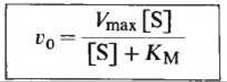
This is the Michaelis-Menten equation, which is the rate equation for a single-substrate enzyme-catalyzed reaction. It expresses the quantitative relationship between the initial reaction velocity v0, the maximum reaction velocity Vmax, and the initial substrate concentration, which are related through the Michaelis constant KM. In the special case when the initial reaction velocity is exactly equal to half the maximum velocity, i.e., when 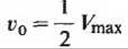 (Fig. 9-4), an important numerical relationship can be derived from the Michaelis-Menten equation:
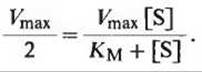
If we divide both sides of this equation by Vmax, we get
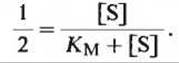
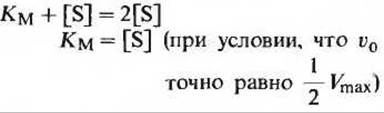
Solving this equation for KM, we obtain:
The Michaelis-Menten equation can be algebraically transformed into several equivalent forms that are useful for the practical Determination of kM and Vmax, and are also used in studying the action of inhibitors (Box 9-2).
The Michaelis-Menten theory allows for a quantitative description of most enzymatic reactions, including those involving two or more substrates. This serves as further compelling evidence that enzymes catalyze reactions by temporarily binding to their substrates, thereby lowering the activation energy of the overall reaction. The formation of enzyme-substrate complexes can be demonstrated by direct Physicochemical Methods, such as characteristic Changes in the absorption spectrum of the enzyme upon addition of the substrate.
Box 9-2. Transformations of the Michaelis-Menten Equation: The Double-Reciprocal Plot
The Michaelis-Menten equation

can be algebraically transformed into other forms that are more convenient for analyzing experimental data. One common transformation is simply to take the reciprocal of both sides of the Michaelis-Menten equation (a)
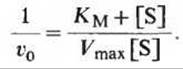
Dividing the numerator on the right side of the equation into its component terms yields
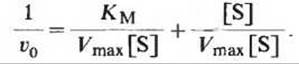
Simplifying this equation yields

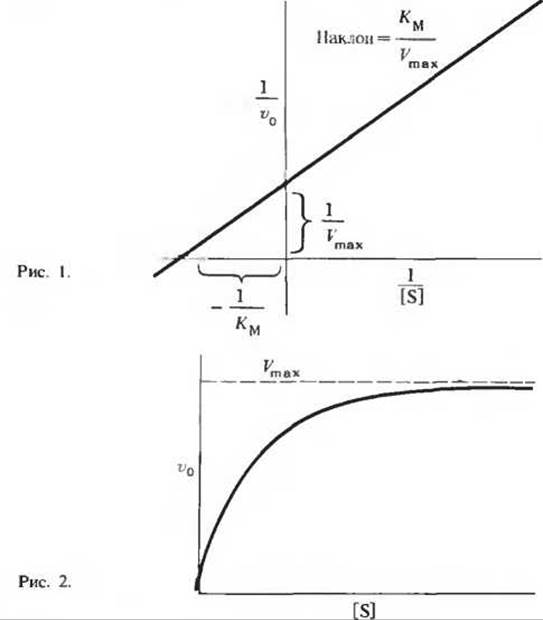
Equation (b), which is a rearranged form of the Michaelis-Menten equation, is called the Lineweaver-Burk equation. For enzymes obeying Michaelis-Menten kinetics, the dependence of 1/v0 on 1/[S] is represented by a straight line (Fig. 1). The slope of this line is KM/Vmax, the y-intercept is 1/Vmax, and the x-intercept is -1/KM. A double-reciprocal plot (Lineweaver-Burk plot) has the advantage of allowing a more accurate determination of Vmax, which can only be approximated on a plot of v0 versus [S] (as shown in Fig. 2). Other Methods of rearranging the Michaelis-Menten equation also exist. Each has its own advantages in studying the Kinetics of enzyme-catalyzed reactions.
As we will see later, double-reciprocal plots are also highly useful in studying the inhibition of enzyme-catalyzed reactions.
Last update: 06/08/2026
Editorial and Educational Adaptation: This material has been compiled based on the primary/original source text. The project team performed an editorial review, corrected technical inaccuracies, structured sections, and adapted the content for an educational format.
What was processed:
- elimination of formatting defects (OCR errors, structural breaks, corrupted characters);
- editorial organization of content;
- standardization of terminology in accordance with academic sources;
- verification of factual statements against the original source text.
All mentions of the author, publication year, and origin of the primary text have been preserved in accordance with the source.