Biochemical Engineering Fundamentals Part 1 - Bailey J., Ollis D. 1989
Molecular Genetics and Regulatory Systems
Recombinant DNA Technology
Enzymes for DNA Cleavage and Ligation
The advancements in Introduction/32.html">Genetic Engineering are largely driven by the isolation and subsequent commercial production of various Enzymes that allow DNA molecules to be cut, modified, and joined in laboratory settings. A special place among these enzymes is held by Restriction Endonucleases, which are capable of recognizing and cleaving specific nucleotide sequences within DNA molecules. For example, the restriction enzyme EcoRI is specific to a sequence of six nucleotide residues in a double helix of the following type:
Class="center">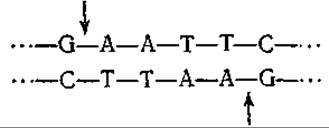
This restriction enzyme cleaves each strand between the A and G residues at the bonds indicated by the arrows. As a result, two fragments are formed:

Note that each fragment contains a short single-stranded sequence known as a "sticky end," because these two sequences are complementary and thus tend to associate with each other through Hydrogen Bonds between Base Pairs. Whether this association occurs depends on the experimenter, who can promote or disrupt hydrogen bonding by adjusting the pH or Temperature.
To date, more than 100 different enzymes with restriction activity have been identified. Table 6.7 lists the most commonly used restriction enzymes, their corresponding recognition sites, and the phosphodiester bonds they hydrolyze. It is easy to see that not all restriction enzymes produce sticky ends. The restriction enzyme HpaI, for instance, cleaves a specific sequence of six nucleotide residues in such a way that only double-stranded fragments with "blunt ends" are formed.
Table 6.7. Selected restriction endonucleases, their corresponding recognition sites, and Cleavage bonds (indicated by arrows)
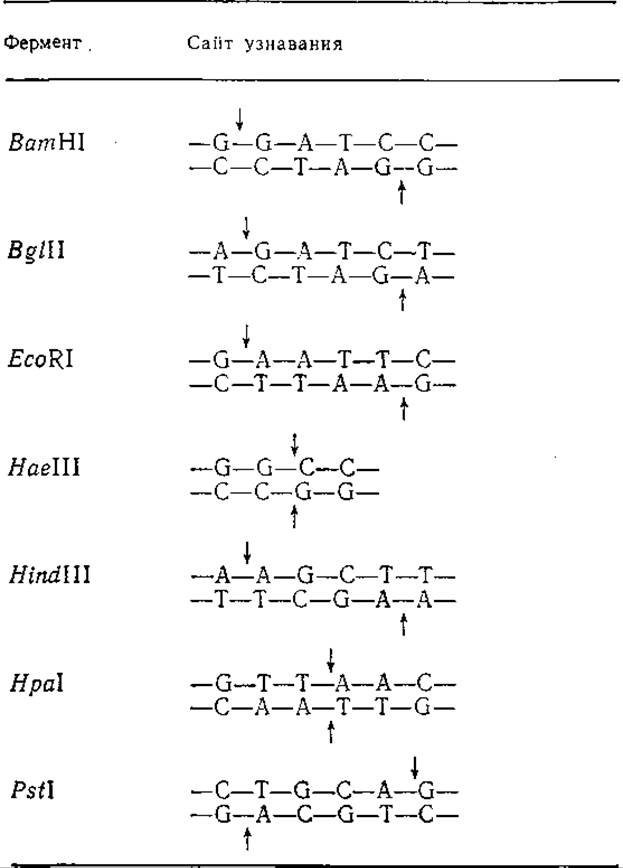
The nomenclature of restriction enzymes is based on the name of the Organism from which the specific restriction enzyme was first isolated. The first capital letter in the enzyme designation corresponds to the first letter of the organism's genus name, while the subsequent two or three lowercase letters are taken from the first two or three letters of the organism's species name. Finally, a Roman numeral denotes the numerical order of the enzyme, reflecting the chronology of its isolation from that organism. Thus, the restriction enzyme BglII is the second restriction enzyme discovered in the bacterium Bacillus globigii. To specify the strain producing the enzyme, additional letters are sometimes included in the name; for example, the restriction enzyme EcoRI was isolated from E. coli RY13.
The value of Restriction Enzymes in Recombinant DNA technology stems from their high Specificity—that is, their ability to cleave only strictly defined nucleotide sequences. Because the probability of finding specific recognition sites containing 4 to 6 nucleotide residues in a DNA molecule is relatively low, the DNA fragments resulting from restriction enzyme Hydrolysis typically have a fairly high molecular weight (usually several hundred nucleotide residues). This is large enough for the resulting fragments to carry valuable Genetic information, yet small enough to be studied and manipulated in vitro.
The Scope of this textbook allows for only a brief mention of other important enzymes used in recombinant DNA technology. First and foremost, DNA ligase should be noted. Suppose we establish conditions under which the sticky ends produced by the cleavage of different DNA molecules with EcoRI "anneal"—meaning they come together and associate via base-pairing. The resulting DNA molecules will not, however, be covalently closed, because phosphodiester bonds are missing between the A and G residues in both strands. These bonds can be re-formed using DNA ligase, which catalyzes the Condensation of a 3'-hydroxyl group with a 5'-phosphate group.
In this manner, for example, annealed fragments
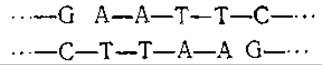
are covalently joined by DNA ligase:

In Conclusion, let us mention Other Enzymes that catalyze the synthesis of oligonucleotides (Fig. 6.22). On a DNA template strand, DNA polymerase catalyzes the synthesis of a complementary strand in the 5'–3' direction. This process requires the presence of all four deoxynucleoside triphosphates, as well as a primer with a free 3'-hydroxyl group. Reverse Transcriptase (an RNA-dependent DNA polymerase) performs a task that is required relatively infrequently; this enzyme effectively reverses the standard direction of genetic Information Flow by synthesizing a DNA strand complementary to an mRNA template. The joining of various DNA fragments is often facilitated by extending them with complementary homopolymer chains (tails); in the presence of a single nucleotide triphosphate, terminal transferase can repeatedly add that nucleotide to the 3'-OH terminus of a DNA molecule.
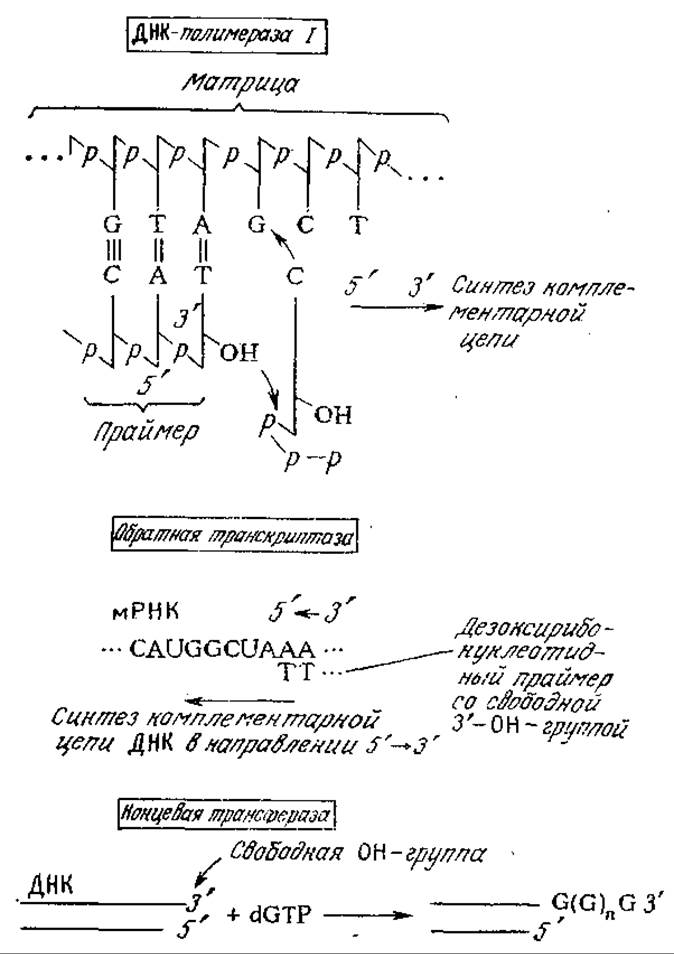
FIG. 6.22. Characteristic reactions of some synthetic enzymes used in recombinant DNA production.
We will discuss several other enzymes crucial to the methodology of genetic engineering later, while the next section will be devoted to the requirements for recombinant DNA vectors.
Last update: 06/08/2026
Editorial and Educational Adaptation: This material has been compiled based on the primary/original source text. The project team performed an editorial review, corrected technical inaccuracies, structured sections, and adapted the content for an educational format.
What was processed:
- elimination of formatting defects (OCR errors, structural breaks, corrupted characters);
- editorial organization of content;
- standardization of terminology in accordance with academic sources;
- verification of factual statements against the original source text.
All mentions of the author, publication year, and origin of the primary text have been preserved in accordance with the source.