Practical Protein Chemistry - A. Darbre 1989
Determination of the composition of protein oligomers. Preparation of monomers and polypeptide chains
Stoichiometric ratio of monomers in the oligomer
Dissociation and Assembly
The Tertiary and Quaternary structures of oligomers are disrupted in the presence of urea, guanidine hydrochloride, and SDS (Sec. 1.3), as well As a result of chemical modification (Sec. 1.4.3).
By identifying dissociation products, the subunit stoichiometry of an oligomer can be determined. The pH of the medium is often of critical importance. For example, wheat germ agglutinin and its succinylated derivative are dimers at pH>5, but dissociate at pH<5 [122]. The dependence of quaternary Structure on pH dictates the conditions for protein assembly and reconstitution. Hemocyanin, an aggregate of 8 hexamers, dissociates into monomers and dimers at pH 8.9 (in the presence of EDTA to chelate Ca2+). Conversely, altering Ionic strength, pH, and Ca2+ concentration causes hemocyanin to dissociate into intermediate-sized hexamer complexes [20].
Additional capabilities of the chemical modification method are discussed in [184] using the multienzyme Yeast fatty acid synthetase complex as an example. Instead of succinic anhydride, which irreversibly acylates Lysine residues, The Use of other dicarboxylic acid anhydrides—specifically citraconic anhydride or, preferably, dimethylmaleic anhydride—has been proposed. Unlike citraconylamides, dimethylmaleyl monoamides easily undergo Hydrolysis under mild conditions. Following acylation with dimethylmaleic anhydride, the α- and β-polypeptide chains dissociate upon increasing the pH or decreasing the ionic strength. The acylation reaction is reversible in a weakly acidic environment (pH 4.6), allowing subsequent assembly of the oligomer. Precisely because the native conformation of monomeric Enzymes is relatively easily reconstructed (Sec. 1.5.1.3), presumably as the thermodynamically most favorable state, it can be demonstrated that oligomeric enzymes retain their Specificity in vitro following reversible Denaturation and subsequent reconstitution [39].
Class="center">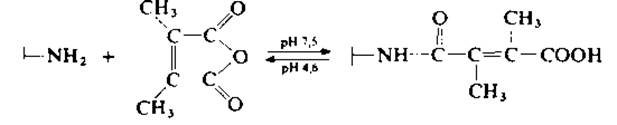
For certain oligomers, environmental parameters such as pH can be crucial. Following the dissociation of fumarase in urea [186] and dialysis against Water, assembly of the active tetramer does not occur; however, successful reconstitution is achieved by dialysis against a buffer in the absence of urea (Sec. 1.4.4.1). The initially formed product exhibits partial activity and is predominantly a dimer, although fluorescence and circular dichroism data match those of the native tetramer.
1.4.4.1. Procedures. Protocols for the dissociation and reconstitution of specific enzymes using Denaturing Agents (Example 1) and chemical modification (Example 2) are outlined below.
Example 1 [186]. Pig Heart fumarase (0.5–5 µg/mL) is inactivated at 25 °C for 30 min in the presence of 6 M urea (or guanidine-HCl) in a solution of the following composition: 50 mM phosphate buffer (pH 7.3) + 6 M urea (or guanidine-HCl) + 10 mM dithiothreitol + 0.1 mM EDTA + 10% glycerol + 200 mM KCl.
The solution is then dialyzed against the initial buffer lacking urea at 4 °C for 24 h, followed by incubation at 25 °C for 3 h.
Example 2 [184]. To a solution of fatty acid synthetase (5–6 mg/mL) in 0.3 M potassium phosphate buffer (pH 7.5) containing 10 mM 2-mercaptoethanol, 13 µL of a freshly prepared 0.8 M solution of dimethylmaleic anhydride in dry tetrahydrofuran is added. The mixture is incubated at 0 °C for 30 min and then dialyzed against 100 mM Tris-HCl buffer (pH 8.0) containing 1 mM dithiothreitol. Desalting is performed by Gel filtration on Sephadex G-50.
Enzyme reactivation. First, the acyl groups of the modified Amino Acids are removed via mild hydrolysis. The protein solution is diluted twofold with 0.2 M Tris-acetate buffer (pH 8.1). If the protein content is <1 mg/mL, bovine serum albumin is added to the solution to bring the total protein concentration to 1 mg/mL. The solution is carefully titrated at room Temperature with saturated ammonium sulfate (at 23 °C, 100% saturation) acidified to pH 2 with concentrated sulfuric acid. The protein begins to precipitate at pH ~6.5. The suspension is maintained at pH 4.6 and room temperature for 30–60 min, and then centrifuged at 28,000 × g and 4 °C for 30 min. The pellet is resuspended in a buffer cooled to 4 °C with the following composition: 100 mM potassium phosphate (pH 8.5) + 10 mM dithiothreitol + 0.5 mM potassium EDTA + 10 µM flavin mononucleotide. A small amount of bovine serum albumin contaminant (0.1 mg/mL) assists in dissolving the pellet. Ammonium sulfate is removed by gel filtration on Sephadex G-50 in the specified buffer. The desalted sample (1–2 mg/mL) is incubated in the reactivation buffer at 25 °C.
Last update: 06/08/2026
Editorial and Educational Adaptation: This material has been compiled based on the primary/original source text. The project team performed an editorial review, corrected technical inaccuracies, structured sections, and adapted the content for an educational format.
What was processed:
- elimination of formatting defects (OCR errors, structural breaks, corrupted characters);
- editorial organization of content;
- standardization of terminology in accordance with academic sources;
- verification of factual statements against the original source text.
All mentions of the author, publication year, and origin of the primary text have been preserved in accordance with the source.