Practical Protein Chemistry - A. Darbre 1989
Separation of protein and peptide mixtures by high-performance liquid chromatography
Reversed-phase peptide separation
Correlation between retention and structure
There is a definite correlation between the Structure/106.html">Hydrophobicity of Peptides and their retention on a reversed-phase (RP) support. Based on the Chromatography results of a series of peptides, their hydrophobicity coefficients were calculated taking into account the partition coefficients of the peptides in the octanol-Water system [15]. A relationship was found between the sum of the individual amino acid hydrophobicity coefficients and the peptide retention time. However, it should be noted that significant discrepancies exist in the published data.
To minimize conformational effects and improve peak shape, a chaotropic agent (0.1 M sodium perchlorate supplemented with 5 mM sodium phosphate or 0.1% phosphoric acid to yield a solution at pH 7.4 or 2.1) and an acetonitrile concentration gradient were used [12]. This yielded a good correlation between changes in retention coefficients and the elution times of the isolated peptides. A detailed study of equilibrium distribution theory was carried out [5, 11]; this work demonstrated the feasibility of reasonably predicting Peptide elution order using the sum of The amino acid side-chain hydrophobicity coefficients. Numerous compelling Examples of using RP-HPLC for the preparative and analytical fractionation of peptides have demonstrated the undeniable value of this method.
Class="center">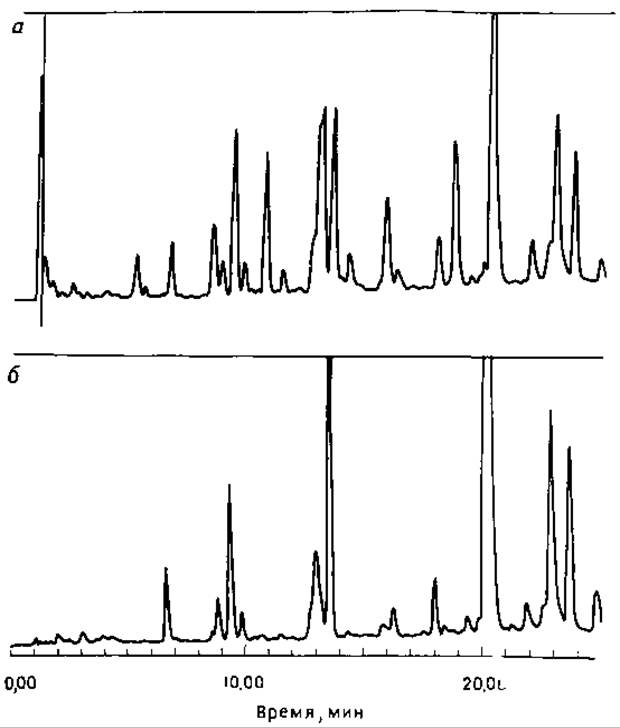
FIG. 6.10. RP-HPLC Separation of cytochrome c tryptic peptides. The hydrolyzate was fractionated on a Vydac RP (C18) Column (4.6 x 75 mm) in 0.08% TFA with a 1–40% acetonitrile gradient. Eluate absorbance was monitored using a photodiode array detector (Hewlett Packard 1040). (a) and (b) Determination of optical absorbance at 215 nm (a) and 280 nm (b); (c) results of scanning fractions lacking aromatic Amino Acids (1), containing Tyr (2), Trp (3), and the heme group (4). Based on the scan results, individual peptides were collected for subsequent analysis.

The Use of multi-wavelength detection for assessing purity or selectively isolating individual peptides is particularly attractive for peptide analysis. Currently, several companies manufacture computer-equipped optical scanners that record the baseline, slope, and signal level during peak scanning (Fig. 6.10). In some cases, it is useful to employ absorbance ratios at different wavelengths.
Last update: 06/08/2026
Editorial and Educational Adaptation: This material has been compiled based on the primary/original source text. The project team performed an editorial review, corrected technical inaccuracies, structured sections, and adapted the content for an educational format.
What was processed:
- elimination of formatting defects (OCR errors, structural breaks, corrupted characters);
- editorial organization of content;
- standardization of terminology in accordance with academic sources;
- verification of factual statements against the original source text.
All mentions of the author, publication year, and origin of the primary text have been preserved in accordance with the source.