Practical Protein Chemistry - A. Darbre 1989
Determination of the composition of protein oligomers. Preparation of monomers and polypeptide chains
Stoichiometric ratio of monomers in the oligomer
Cross-linking of subunits with bifunctional reagents
To determine the number of monomers in an oligomer, the method based on monomer cross-linking with bifunctional Reagents followed by Analysis of the reaction products using SDS-Polyacrylamide gel Electrophoresis (SDS-PAGE) is becoming increasingly widespread [44]. The electrophoregram represents a set of zones corresponding to mixture components whose molecular weights are multiples of the monomer molecular weight, up to the complete oligomer. In the case of oligomers composed of identical or nearly identical monomers, the number of major zones should correspond to the set of monomers.
Bifunctional reagents can be used to determine The quaternary Structure of oligomers [72, 82], although this issue requires special Discussion. Nevertheless, when dealing with a simple system—a tetramer, hexamer, or octamer—it makes sense to use this approach to determine the arrangement of monomers within the oligomer.
In the vast majority of experiments, carboxylic acid bisiminoesters with varying chain lengths are used as cross-linking agents, primarily dimethyl suberimidate (n = 6). These highly specific modifying reagents readily react with α- and ε-amino groups of Lysine residues to form amidines (pKa>11). Reagents of a different type include acyl azides, sulfhydryl-directed reagents, and glutaraldehyde [132]. Relatively stable succinic acid bisiminoesters, which form stable or hydrolyzable cross-links, are also employed [77].
Class="center">
Bisiminoesters are hydrolyzed in solution at one or both functional groups, whereas the other may be bound to a protein amino group. Some reagent molecules interact with two protein molecules, forming both intra- and intermolecular covalent bonds [132].
The Molecular Weight of the final product is significantly affected only by intermolecular bonds, which are easily detected under denaturing conditions. Cross-links within subunits (similar to Disulfide Bonds) hold the polypeptide chain in a folded state, thereby reducing the hydrodynamic volume and apparent molecular weight. Some of the products obtained by cross-linking α4- and α2β2-type tetramers are shown in Fig. 1.6. The molecular weight distribution of the polymers is determined by the number and position of the cross-links.
Nevertheless, the molecular weight "spectrum" of overlapping polymers can be used to determine the number of monomers in a simple oligomer. Oligomers composed of monomers with different molecular weights (e.g., of the α2β2 type) form a more complex set of polymers, and the interpretation of the results obtained can be difficult.
1.4.2.1. Reaction conditions for Proteins with bifunctional reagents. When proteins interact with bifunctional reagents, the medium pH, the distance between the Functional groups of the reagent, and the concentrations of the reagent and protein may vary.
Effect of medium pH. Bisiminoesters interact with the ε-amino groups of lysine residues (pKa 9.5–10) and the α-amino group of the N-terminal amino acid at pH>8, i.e., with amino groups in the unprotonated form. The products of these reactions are amidines with pKa>11; therefore, in the pH range <8, the modified protein retains a positive charge. Side Reactions are possible at pH≤8 [132, 165], whereas the yield of amidines reaches a maximum at pH≥10. Under these conditions, many oligomers dissociate, so it is recommended to carry out the reaction in the pH range 8–10. If the oligomer is stable at high pH for at least 1–2 min, modification in this medium is entirely feasible due to the high reaction rate. Generally speaking, it is worthwhile to study The Role of medium pH by examining the COMPOSITION OF THE reaction products [162, 171].
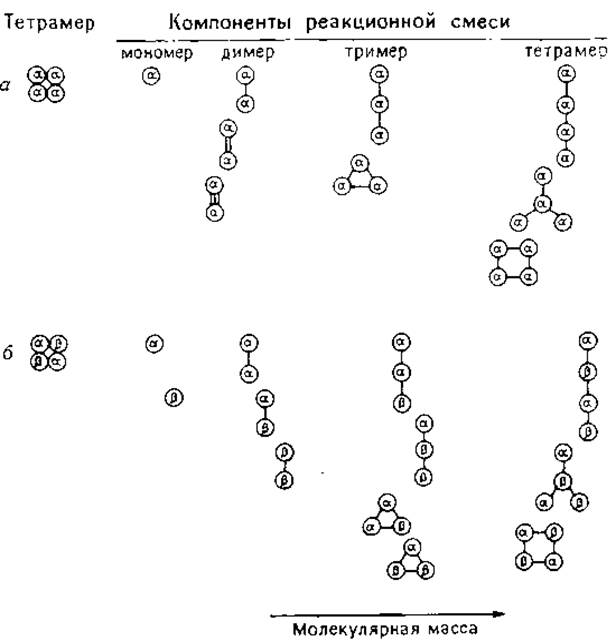
FIG. 1.6. Composition of the mixture obtained by partial cross-linking of α4 and α2β2 tetramers with bifunctional reagents
Distance between the functional groups of the reagent. The distance between the functional groups of the selected reagent is determined by the arrangement of amino groups in the native oligomer. Known bifunctional reagents—dimethyl esters of dicarboxylic imino acids—have the following parameters [45, 132]:
|
Acid |
Distance between functional groups, nm |
|
Iminomalonic |
0,5 |
|
Iminosuccinic |
0,6 |
|
Iminoadipic |
0,9 |
|
Iminosuberic |
1,1 |
|
Iminododecanedioic |
1,5 |
Working with a single reagent can lead to ambiguous or even erroneous Conclusions. It is best to conduct studies using several reagents belonging to the same homologous series.
Concentration of the bifunctional reagent. The degree of oligomer cross-linking directly depends on the concentration of the bifunctional reagent; in other words, the higher the concentration, the greater the degree of cross-linking. However, it has been noted [132] that an excess of the cross-linking reagent relative to The amount of oligomer does not significantly affect the reaction rate, whereas an excessive excess apparently induces undesirable side reactions. If increasing the reagent concentration fails to raise the degree of oligomer cross-linking to the desired value, this may indicate the preferential formation of intramolecular cross-links.
Protein concentration. To prevent oligomer polymerization, the protein concentration in the reaction mixture should be low. If the molecular weight of the oligomer is known, The formation of intermolecular bonds (between oligomer molecules) will be indicated by the presence in the mixture of components with a molecular weight exceeding the M of the oligomer. Oligomer cross-linking can be prevented by preliminary protein immobilization on an insoluble matrix [135], for example, via disulfide bond formation with thiol groups of Sepharose 4B (sec. 3.2.5); subsequently, Treatment with bisimino esters can be carried out [32].
1.4.2.2. Procedures.
Preparation of bisimino esters [108]. Dimethyl esters of iminoadipic and iminosuberic acids are commercially available reagents. Other bisimino esters can be synthesized from readily available dinitriles According to the standard Procedure [108].
Dissolve 0,5 g of suberic acid dinitrile in a mixture of 2 ml of methanol (dried over molecular sieves) and 15 ml of ethyl ether at 0 °C. Dry HCl is passed through the solution for 30 min, and the reaction mixture is kept at 4 °C for 24 h. Add 10 ml of dry diethyl ether; the precipitated crystals are thoroughly washed with a dry methanol–ether mixture (1:3) protected from moisture. The resulting bisimino ester hydrochloride (yield 0,81 g, 81%) is used without additional recrystallization.
Preparation of amidinated proteins [44]. The protein sample is dissolved (to a concentration of 0,5 mg/ml) or thoroughly dialyzed against a buffer solution containing: 0,2 M triethanolamine+HCl (pH 8,5). Immediately before the reaction, dissolve the bisimino ester hydrochloride in the same buffer (concentration 10 mg/ml) and adjust the pH to 8,5 using NaOH. The calculated amount of the reagent solution is added to the protein solution (so that the reagent concentration in the reaction mixture is 1 mg/ml), and the reaction mixture is incubated at 20 °C for 3 h. If the reagent needs to be added in portions, the second portion is introduced 30 min after THE START OF the reaction.
When searching for optimal reaction conditions, the protein concentration is varied in the range of 0,1—5,0 mg/ml, and the concentration of the bisimino ester in the reaction mixture is 0,2—5 mg/ml. The pH of the buffer solution can be varied from 8 to 10,5. At pH 8—8,5, 0,2 M triethanolamine–HCl is used, and at pH>8,5, 0,2 M borate buffer is used. To increase buffer capacity (maintain pH upon addition of reagents), relatively concentrated Buffer solutions are used, which must not contain primary amines.
After three hours, the excess reagent is completely hydrolyzed. When determining reaction kinetics, aliquots are taken, and the reaction is quenched by adding a twofold excess (relative to the reagent) of hydroxylamine.
SDS-PAGE. Reaction products are analyzed by SDS-PAGE (sec. 1.3.1.1) or by Gel filtration and ultracentrifugation in the presence of Denaturing Agents. Since cross-linked products are likely to have M>100 000, a 5% gel is prepared, and a 50 µg sample is applied. For simple oligomers containing identical or nearly identical monomers, the composition is determined by the number of principal zones. If the degree of cross-linking is low, the molecular weights of hybrid molecules, which are multiples of the monomer molecular weight, can be found from a calibration curve. A high content of cross-links may cause anomalous electrophoretic behavior of polymers.
If the protein concentration in the sample is sufficiently high, the sample is applied (when using a discontinuous system) without prior dialysis. It may be necessary to concentrate the sample; this is best done by trichloroacetic acid precipitation. The precipitate is dissolved in the sample buffer (section 1.3.1.1).
1.4.2.3. Limitations of the method. A number of Oligomeric Proteins of known composition have been studied using cross-linking with bifunctional reagents. In principle, the method can be applied to any oligomeric protein; however, sometimes this approach fails to yield the required information. Cross-linking may not occur due to a deficiency of amino groups, their unfavorable Location, or the presence of protecting groups. Failure may also be caused by the quality of the reagent, such as an insufficient hydrocarbon chain length and the presence of a monofunctional derivative as an impurity.
Some oligomeric proteins do not form hybrid molecules for reasons that remain unclear [82], although in certain cases the lack of monomer binding reflects an unfavorable local geometry of the polypeptide chain [135]. Categorical conclusions should not be drawn from such negative results [132].
The Dissociation and Assembly of an oligomeric protein can be influenced by the pH of the medium, which may lead to ambiguous data. It has been observed [171] that in some instances the conformation of the monomer depends so heavily on the ambient pH that the reaction with cross-linking agents fails to occur altogether.
The application range of the method is limited to oligomers with a molecular weight not exceeding 500,000, as this value represents the upper resolution limit for SDS-polyacrylamide gel electrophoresis (SDS-PAGE).
Last update: 06/08/2026
Editorial and Educational Adaptation: This material has been compiled based on the primary/original source text. The project team performed an editorial review, corrected technical inaccuracies, structured sections, and adapted the content for an educational format.
What was processed:
- elimination of formatting defects (OCR errors, structural breaks, corrupted characters);
- editorial organization of content;
- standardization of terminology in accordance with academic sources;
- verification of factual statements against the original source text.
All mentions of the author, publication year, and origin of the primary text have been preserved in accordance with the source.