Biotechnology - Yu.O. Sazykin 2006
Applied Biotechnology
Challenges in the Discovery, Development, and Application of Antibiotics in Medical Practice
Antibiotic Resistance: Discovery of Novel Natural Beta-Lactams and Targeted Transformation of the Beta-Lactam Molecule
As noted earlier, bacterial Cells possess multiple targets for beta-lactams, featuring various types of penicillin-binding Proteins (PBPs). Predominant affinity for a specific PBP type leads to different biological effects, such as lysis, bactericidal action without lysis, or bacteriostasis of varying duration. All of this is clinically crucial when selecting a drug for a specific patient and determining the antibiotic therapy regimen, including administration frequency and the potential use of combinations of two beta-lactam Antibiotics.
In certain beta-lactam-resistant strains encountered in clinical practice, resistance manifests at the PBP level; in other words, the targets exhibit reduced affinity for "classical" beta-lactams. Therefore, novel natural and semisynthetic beta-lactams are screened for their degree of affinity toward the PBPs of these resistant strains.
High affinity indicates the strong clinical potential of new beta-lactam structures. Furthermore, the evaluation of novel beta-lactam structures involves assessing their resistance to various beta-lactamases—specifically penicillinases and cephalosporinases of plasmid and chromosomal origin isolated from diverse Bacteria. Large panels of beta-lactamases possessing different substrate specificities are employed for this purpose. If the majority of the tested beta-lactamases fail to inactivate a new beta-lactam Structure, it is deemed clinically promising and warrants further in-depth investigation.
Initial breakthroughs in this direction were achieved when chemists synthesized Semisynthetic Penicillins—such as methicillin and oxacillin, which are resistant to the penicillinases prevalent in staphylococci, as well as carbenicillin, which is resistant to the enzyme from Pseudomonas aeruginosa. These semisynthetic penicillins were successfully obtained following the isolation of 6-aminopenicillanic acid (6-APA) from benzylpenicillin:
Class="center">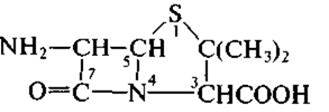
conventionally referred to as the "core" of the penicillin molecule. Industrially, 6-APA is produced via the Enzymatic Hydrolysis of either benzylpenicillin (in Russia) or phenoxymethylpenicillin (abroad) using the enzyme penicillin acylase. This enzyme cleaves the peptide bond between the acyl side chain and the 6-APA Nucleus (the CO–NH bond), yielding 6-APA. Subsequent acylation of 6-APA yielded the aforementioned antibiotics.
It was subsequently demonstrated that the Introduction of a methoxy group or certain other substituents at the C6 position of penicillins, and correspondingly at the C7 position of Cephalosporins, prevents many beta-lactamases from hydrolyzing the beta-lactam ring in such natural or semisynthetic beta-lactam antibiotics as, for example, cephamycin C:

The efficacy of beta-lactams against Gram-negative bacteria also depends on factors such as The rate of permeation through porin channels. Compact molecules hold a distinct advantage here, as they can penetrate both cation-selective and anion-selective channels. For instance, an antibiotic of this type that has found Practical Application is imipenem:
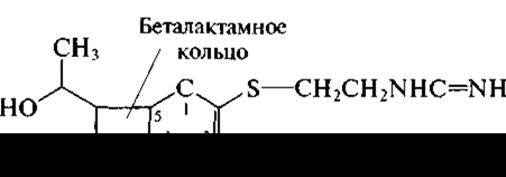
Among its valuable properties is also resistance to a range of beta-lactamases.
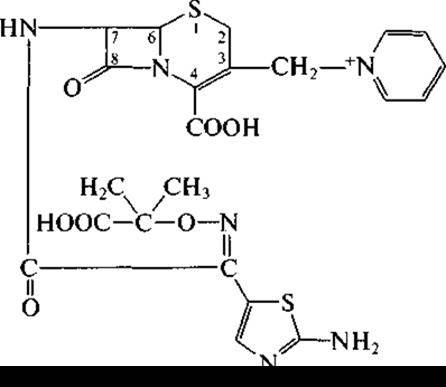
Beta-lactam structures in which substituent molecules introduced into the core generate a cationic center possess considerable value.
Such beta-lactams exhibit high activity against many enteric bacteria due to the cation selectivity of the porin channels found in bacteria inhabiting the intestinal tract.
As an example, we can cite the molecular structure of ceftazidime, a clinically utilized beta-lactam:
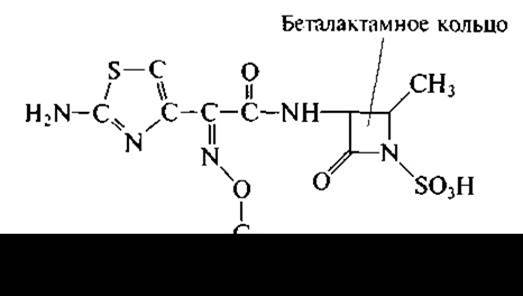
It should be noted that chemical modifications increasingly target The structure of the five- or six-membered ring fused to the beta-lactam ring. When the sulfur atom in the five-membered (penicillins) or six-membered (cephalosporins) ring is replaced by oxygen or carbon, these compounds are designated as "unconventional" or "non-classical" beta-lactams. This group includes imipenem, which was mentioned earlier and rapidly penetrates porin channels. "Unconventional" beta-lactams also encompass those in which the beta-lactam ring is not fused to another ring (whether five- or six-membered). These are termed "Monobactams," of which aztreonam has gained the greatest prominence as a valuable agent in medical practice:
Of significant interest are also natural compounds containing a gamma-lactam (i.e., five-membered) ring that exhibit high antibacterial activity and a broad spectrum of action. Similarly to beta-lactams, their targets are peptidoglycan transpeptidases, namely various PBPs. Upon contacting the target, the gamma-lactam ring is cleaved—analogously to the beta-lactam ring—resulting in the acylation of one of The amino acid residues within the active center of the transpeptidases. Beta-lactamases can also inactivate gamma-lactams, as it turns out. However, the greater Stability of the five-membered gamma-lactam ring compared to the four-membered beta-lactam ring broadens the possibilities for chemical synthesis, allowing for the generation of synthetic gamma-lactams featuring steric Protection of the gamma-lactam ring against beta-lactamases.
The ranges of synthesized gamma-lactams are expanding rapidly, and some of these compounds are already undergoing preclinical evaluation.
Last update: 06/08/2026
Editorial and Educational Adaptation: This material has been compiled based on the primary/original source text. The project team performed an editorial review, corrected technical inaccuracies, structured sections, and adapted the content for an educational format.
What was processed:
- elimination of formatting defects (OCR errors, structural breaks, corrupted characters);
- editorial organization of content;
- standardization of terminology in accordance with academic sources;
- verification of factual statements against the original source text.
All mentions of the author, publication year, and origin of the primary text have been preserved in accordance with the source.