Biological Chemistry - Berezov, T. T., & Korovkin, B. F. 1998
Vitamins
Vitamin-like Compounds
Pyrroloquinoline Quinone (PQQ)
A new Class of Proteins has recently been discovered—quinoproteins, or PQQ Enzymes, which contain a hitherto unknown, novel vitamin-like factor, pyrroloquinoline quinone (PQQ), as a coenzyme. It has the following Structure:
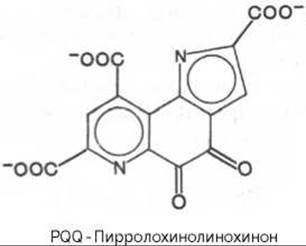
PQQ has turned out to be a quinone derivative that is quite widespread in microorganisms, animal Tissues, and plants. Among the bacterial enzymes that incorporate PQQ as a coenzyme, methanol dehydrogenase and Alcohol dehydrogenase are particularly noteworthy. A copper-containing enzyme, methylamine oxidase, has been isolated from animal, plant, fungal, and Yeast tissues, which also contains covalently bound PQQ as a coenzyme.
Animal and plant quinoproteins are components of oxidases and Decarboxylases (amine oxidases, diamine oxidases, Monooxygenases, Dioxygenases). Evidence suggests the possible presence of two Coenzymes—Pyridoxal phosphate and PQQ—within Certain amino acid decarboxylases (glutamate decarboxylase and DOPA decarboxylase).
It is interesting to note that in their MECHANISM OF ACTION, PQQ dehydrogenases and oxidases are analogous to Flavoproteins, which catalyze The transfer of 2 electrons and protons, possibly directly to ubiquinone. In contrast, PQQ decarboxylases are analogous in their mechanism of action to pyridoxal enzymes, as both systems contain a carbonyl group. Data obtained from the three-dimensional structure of one quinoprotein, methylamine oxidase, indicate that its coenzyme is not free PQQ, but rather its precursor Pro-PQQ (containing PQQ, indole, and glutamic acid residues) covalently linked to the protein molecule.
As the example of PQQ demonstrates, nature may harbor A number of other essential dietary factors that participate in key metabolic reactions, although their true vitamin properties, including those of PQQ, have not yet been fully elucidated.
Last update: 06/08/2026
Editorial and Educational Adaptation: This material has been compiled based on the primary/original source text. The project team performed an editorial review, corrected technical inaccuracies, structured sections, and adapted the content for an educational format.
What was processed:
- elimination of formatting defects (OCR errors, structural breaks, corrupted characters);
- editorial organization of content;
- standardization of terminology in accordance with academic sources;
- verification of factual statements against the original source text.
All mentions of the author, publication year, and origin of the primary text have been preserved in accordance with the source.