Amino Acids, Peptides and Proteins - Dеvеny T., Gеrgеy Ya. 1976
End-Group Analysis and Stepwise Degradation of Proteins and Peptides
Determination of N-Terminal Groups by the 2,4-Dinitrofluorobenzene Method
Paper Chromatography of DNP-Amino Acids
DNP-Amino Acids are identified using one- or two-dimensional paper Chromatography, and their quantities are determined by corresponding Methods [11].
PROCЕDURE
A. Levy's method using toluene. Purification of toluene. The distilled toluene is stirred with sulfuric acid (1 : 1) for 24 hours. The organic phase is decanted and distilled over AlCl3. The distilled toluene is shaken several times with a 20% Na2CО3 solution to remove the acid, then dehydrated with CaCl2 and redistilled.
Preparation of the Glass chamber for paper chromatography. Chromatography is carried out in the dark at a constant Temperature in a glass cylinder 46 cm high and 23 cm in diameter, at the bottom of which two crystallizers with diameters of 15 and 19 cm are placed one inside the other.
Filter paper sheet size. The size and shape of the filter paper sheet, as well as the spot where the sample is applied in two-dimensional paper chromatography, are shown in Fig. 57.
Preparation of the phosphate buffer solution. Chromatography requires a 1.5 M phosphate buffer solution, pH 6, which is prepared as follows: 138 g of NaH2PО4 ∙ Н2О and 71 g of Na2HPО4 are dissolved in warm Water, and the volume is made up to 1 L.
Preparation of the toluene system. 60 mL of toluene, 18 mL of pyridine, 36 mL of Ethylene chlorohydrin, and 36 mL of 0.8 M ammonia are thoroughly shaken in a separatory funnel and left for several hours. The lower aqueous phase is discarded, and the organic phase is filtered through paper to remove water droplets.
Chromatography. After applying the sample, the paper is rolled into a cylinder and placed between two crystallizers into the organic phase of the solvent mixture 6 h after the organic phase has been poured into the outer space and 200 mL of 0.8 M ammonia into the inner space. Ascending chromatography lasts for 15 h, after which the chromatogram is dried at 40–50° C. Then, descending chromatography is carried out in the other direction using the aforementioned phosphate buffer solution.
Class="center">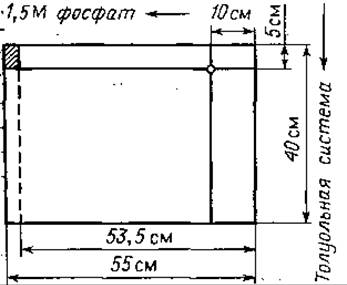
Fig. 57. Dimensions of the filter paper sheet for DNP-amino acid chromatography [11].
The distribution of DNP-amino acids in two-dimensional chromatography is shown in Fig. 58. When analyzing complex mixtures of unknown composition, identification is performed using simultaneously prepared one-dimensional control chromatograms.
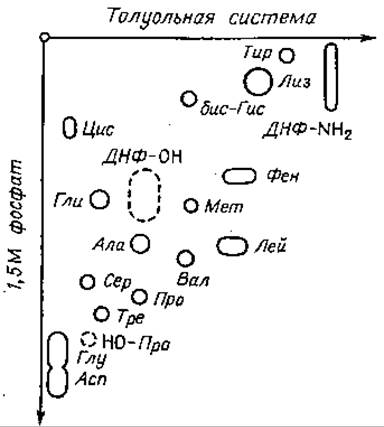
Fig. 58. Two-dimensional chromatography of DNP-amino acids [11].

Fig. 59. Chromatography of DNP-amino acids in citrate buffer solution.
B. Blackburn's citrate method [15]. Most DNP-Amino acids can be separated in a 1 M citrate buffer solution, pH 6.4 (Fig. 59). This method is particularly convenient for quantitative determinations in the case of relatively simple mixtures, such as a mixture of several DNP-Amino Acids and DNP.
C. Tertiary amyl alcohol–phthalate system [1].
1) Preparation of the phthalate buffer solution. 22.45 g of potassium biphthalate is suspended in 220 mL of water, which dissolves in this volume upon addition of 4 g of NaOH with stirring and gentle heating. If necessary, the solution is filtered and then diluted 10-fold with water. The pH of the solution is checked, and if it is not 6.0, it is adjusted to this value with dilute NaOH or acetic acid solutions. Deviations in pH by 0.1–0.2 units are not critical for chromatography.
When using the phthalate buffer solution at pH 5, the Separation of DNP-amino acids differs significantly from fractionation in the pH 6 buffer solution. At pH 5, DNP-Asp and DNP-Glu are well separated, whereas under other conditions they migrate together.
Preparation of pH 5 phthalate buffer solution. 50 mL of a 0.1 M potassium biphthalate solution is mixed with 23.9 mL of 0.1 N NaOH, and the mixture is diluted to 100 mL with distilled water.
2) Preparation of the solvent mixture. 300 mL of tertiary amyl alcohol and 300 mL of phthalate buffer are poured into a 1 L separatory funnel. The mixture is shaken thoroughly and allowed to stand for several hours. The phases are then separated, the organic phase is filtered through paper and poured into the chromatographic chamber.
3) Preparation of filter paper. The filter paper is pre-equilibrated with the phthalate buffer solution and air-dried for several days. The best results are obtained using Schleicher & Schüll 2043 b paper.
The separation of DNP-amino acids in the tertiary amyl alcohol–phthalate system is shown in Fig. 60.

Fig. 60. Chromatography of DNP-amino acids in the tertiary amyl alcohol–phthalate system.
Last update: 06/08/2026
Editorial and Educational Adaptation: This material has been compiled based on the primary/original source text. The project team performed an editorial review, corrected technical inaccuracies, structured sections, and adapted the content for an educational format.
What was processed:
- elimination of formatting defects (OCR errors, structural breaks, corrupted characters);
- editorial organization of content;
- standardization of terminology in accordance with academic sources;
- verification of factual statements against the original source text.
All mentions of the author, publication year, and origin of the primary text have been preserved in accordance with the source.