Amino Acids, Peptides and Proteins - Dévényi T., Gergely J. 1976
End-group analysis and stepwise degradation of proteins and peptides
Determination of N-terminal groups by the 2,4-dinitrofluorobenzene method
Identification of DNP-amino acids by thin-layer chromatography
Thin-Layer Chromatography is successfully used to identify DNP-Amino Acids. Compared to paper chromatography, this method is more sensitive and less time-consuming. Mixtures are most commonly separated on silica gel using the following solvent systems [2]: a) toluene–pyridine–Ethylene chlorohydrin–ammonia (0.8 M) (100 : 30 : 60 : 60); this system is heterogeneous, with the upper phase used for chromatography and the lower phase for adsorbent equilibration; b) chloroform–benzyl alcohol–acetic acid (70 : 30 : 3); c) benzene–pyridine–acetic acid (80 : 20 : 2); d) chloroform–methanol–acetic acid (95 : 5 : 1). Approximately 0.2–0.5 µg of DNP-amino acid is sufficient for identification. The Separation of DNP-amino acids by two-dimensional chromatography in various solvent systems is shown in Fig. 61.
Class="center">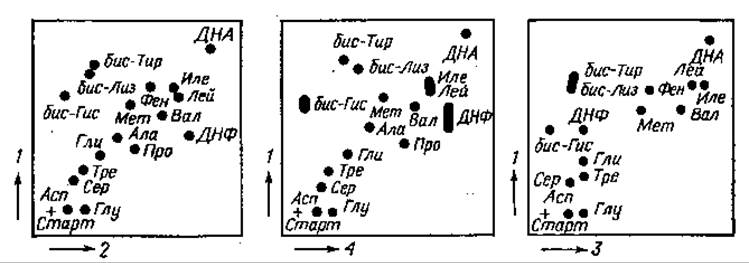
Fig. 61. Identification of DNP-amino acids by thin-layer chromatography on silica gel.
Solvent 1: toluene–pyridine–ethylene chlorohydrin–0.8 M ammonia (100 : 30 : 60 : 60). Solvent 2: chloroform–benzyl alcohol–acetic acid (70 : 30 : 3). Solvent 3: benzene–pyridine–acetic acid (80 : 20 : 2). Solvent 4: chloroform–methanol–acetic acid (95 : 5 : 1). DNA — dinitroaniline, DNP — dinitrophenol.
Last update: 19/08/2026
Editorial and Educational Adaptation: This material has been compiled based on the primary/original source text. The project team performed an editorial review, corrected technical inaccuracies, structured sections, and adapted the content for an educational format.
What was processed:
- elimination of formatting defects (OCR errors, structural breaks, corrupted characters);
- editorial organization of content;
- standardization of terminology in accordance with academic sources;
- verification of factual statements against the original source text.
All mentions of the author, publication year, and origin of the primary text have been preserved in accordance with the source.