Vertebrate Zoology - V. M. Konstantinov 2011
Chordates
Terrestrial, or Four-Legged, Vertebrates — Vertebrates with Embryonic Membranes
Class Reptilia, or Reptiles — Subclass Lepidosauria — Order Sphenodontia
The order Rhynchocephalia includes one of the most ancient groups of reptiles, of which only a single species has survived to the present day: the tuatara, or sphenodon (Sphenodon punctatus). Externally, the tuatara resembles a large lizard, yet numerous Anatomical Features point to its archaic nature. Its body length is about 50 cm, with older males occasionally reaching 70 — 75 cm. The upper PARTS OF THE HEAD and body are covered with small, primitive, granular horny scales. In some areas, within Skin folds along the back and belly, the scales take the form of relatively large plates. A crest of triangular horny plates runs along the spine (Fig. 103).
The vertebrae of the tuatara are amphicoelous, as in fish and lower amphibians, with the notochord persisting between the vertebral centra. So-called abdominal Ribs are present—small bones of dermal origin located beneath the skin on the ventral side of the body, which may represent remnants of the abdominal armor of ancestral land tetrapods, the stegocephalians. In juveniles, Teeth are borne not only on the jaw and palatine bones but also on the Vomer, much like in amphibians. In adults, most of the teeth become worn down. A parietal eye is noticeable on the dorsal surface of the head between the parietal bones; it possesses a cornea, lens, and retina. A tympanic cavity and eardrum are absent. Copulatory Organs are lacking.
Class="center">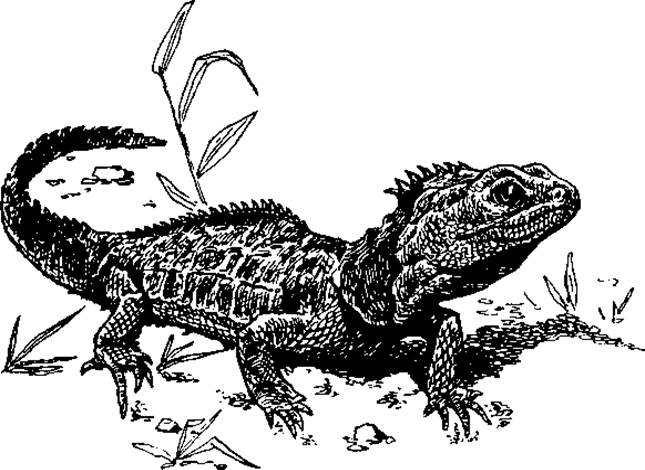
Fig. 103. Tuatara
The tuatara is a sluggish animal that leads a predominantly nocturnal lifestyle. By day, it shelters in the burrows of albatrosses and other oceanic birds; it is not uncommon for a bird to nest and a tuatara to live in the same burrow. The tuatara feeds on worms, insects, and snails. Reproduction occurs in spring—November and December in the Southern Hemisphere. It lays its eggs in a shallow pit dug in the ground, which is then covered over after laying. A clutch consists of 8—12, rarely 15—17 eggs. Embryonic development is exceptionally prolonged, lasting 12—14 months. Juveniles reach sexual maturity at approximately 20 years of age. In captivity, tuataras can live up to 70 years.
At present, the tuatara survives only on small islets lying off the northeastern coast of New Zealand's North Island and in the Cook Strait. In the 19th century, it inhabited both main islands of New Zealand, but human persecution and predation by introduced dogs and pigs led to a drastic reduction in the range of this fascinating animal.
Last update: 13/08/2026
Editorial and Educational Adaptation: This material has been compiled based on the primary/original source text. The project team performed an editorial review, corrected technical inaccuracies, structured sections, and adapted the content for an educational format.
What was processed:
- elimination of formatting defects (OCR errors, structural breaks, corrupted characters);
- editorial organization of content;
- standardization of terminology in accordance with academic sources;
- verification of factual statements against the original source text.
All mentions of the author, publication year, and origin of the primary text have been preserved in accordance with the source.