INVERTEBRATE ZOOLOGY IN THREE VOLUMES - BOOK 2 - H.Y. Shcherbak - 1996
PHYLUM ARTHROPODA
SUBPHYLUM TRACHEATA
CLASS ENTOGNATHA
These are small animals living primarily in soil, leaf litter, and less frequently in grass cover. About 11,000 species have been described, though this animal group remains insufficiently studied.
The body of entognaths consists of the HEAD, Thorax, and abdomen. The head is solid, covered by a cuticular capsule. The mouthparts are retracted into a special oral pouch formed by the sides of the head and the lower lip fused with them; only their tips protrude outward. They include a pair of mandibles, a pair of maxillae, and an unpaired lower lip. The Structure of the mouthparts is described in greater detail using insects as an example.
The thorax consists of three, most commonly free, segments (fused only in some springtails), each bearing a pair of legs. The leg, as in insects, consists of the coxa, trochanter, Femur, Tibia, and tarsus. In some entognaths, the tibia is fused with the tarsus. Wings are absent.
The abdomen comprises 11–12 segments, sometimes six (in springtails). Modified or vestigial appendages are retained on the abdomen.
Compound eyes are absent. The protocerebrum is located above the deutocerebrum. Tracheae are poorly developed or entirely absent, in which case respiration occurs through the entire body surface.
Development is direct, without metamorphosis. Growth is accompanied by numerous molts.
The Class Entognatha includes three orders (considered by many researchers to be subclasses): Protura, Collembola, and Diplura.
Order Protura. This group comprises small animals, up to several millimeters in length, living in soil, leaf litter, or decaying wood, with about 300 species known.
The body consists of the head and trunk, which is indistinctly divided into the thorax and abdomen (Fig. 115). Eyes and antennae are absent. Mouthparts are modified into elongated, piercing-sucking setae. The tibia and tarsus have fused to form a solid tibiotarsus bearing a single claw at the end. The first pair of legs is directed forward and Functions as a tactile organ, while the posterior two pairs are walking legs.

Fig. 115. Protura: Eosentomon transitorum
The abdomen consists of 12 segments. The first three segments bear paired one- or two-segmented appendages—underdeveloped abdominal legs upon which the abdomen rests during movement.
Development is of the anamorphosis type, accompanied by numerous molts; immature stages are externally similar to adults.
Feeding Methods and other ecological characteristics of proturans have been insufficiently studied, and their practical significance remains undetermined.
Order Collembola (or springtails) includes up to 10,000 species, with researchers describing many new taxa to science each year. It is likely that their actual diversity is considerably greater.
Body dimensions are on a millimeter scale. Simple eyes and four- to six-segmented antennae are present on the head. Mouthparts are chewing or piercing-sucking. Near the Base of the antennae lies a specialized postantennal organ containing olfactory and humidity receptors. Like proturans, they possess a tibiotarsus with a single terminal claw.
The abdomen consists of six segments. The fourth segment bears a segmented furcula (springing fork) consisting of an unpaired basal part and a pair of terminal branches. Typically, the furcula is tucked under the abdomen and secured by an appendage of the third abdominal segment—the tenaculum (retinaculum) (Fig. 116). Upon jumping, the furcula is released from the tenaculum and pushes off the substrate, propelling the body into the air. The first abdominal segment bears a specialized appendage known as the ventral tube (collophore). Upon landing after a jump, this tube secretes an adhesive fluid that anchors the body to the substrate. Some springtails can jump distances of up to 1 m.

Fig. 116. Springtails:
a - Entomobrya pulchella; b - Sminthurus viridis
The Respiratory system in springtails is poorly developed or absent; Malpighian tubules are also lacking. Fertilization is spermatophore-based: males deposit stalked spherical spermatophores, which females pick up with their genital aperture.
Development proceeds via epimorphosis; juveniles differ from adults primarily in size.
Among collembolans, there are species with a segmented, elongated abdomen and a weakly developed furcula (suborder Arthropleona), which inhabit mainly soils,
leaf litter, and decaying wood. They are predominantly found in soil, where their concentrations can reach many thousands of individuals per 1 m2. They play a crucial role in soil formation by facilitating the decomposition of PLANT AND ANIMAL residues. In Ukraine, the mushroom springtail (Ceratorhysella armata) is widespread, inhabiting fertilized soils; in greenhouses, it may damage cultivated mushroom mycelium.
The second group of springtails (suborder Symphypleona) features a shortened body, fused thoracic and abdominal segments, and a well-developed furcula. They mostly live on plants and occasionally damage garden crops, such as the globally distributed lucerne flea (Sminthurus viridis).
Order Diplura (Two-pronged bristletails). This group comprises about 400 species. Body length ranges from 1–2 mm to 5 cm. The body is elongated. The head bears long, segmented antennae; mouthparts are of the chewing type; eyes are absent (Fig. 117). The tibia is not fused with the tarsus, and the latter ends in two claws. All legs are similar in structure. The abdomen consists of 11 segments, the first seven of which bear rudimentary abdominal appendages—unsegmented paired styles. The tip of the abdomen bears a pair of cerci; in some representatives (Campodea), these are antenniform, segmented, and function as tactile Organs, while in others (Japyx), they are shortened, unsegmented, pincer-like structures adapted for capturing prey, such as springtails.
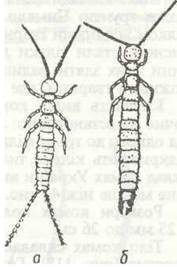
Fig. 117. Diplurans:
a - Campodea plusiochaeta; b - Japyx confusus
The respiratory system is quite well developed, with three to four pairs of spiracles on the thorax. Fertilization is spermatophore-mediated.
Development is epimorphic; juveniles resemble adults in appearance and undergo multiple molts.
Diplurans inhabit soil, rotting wood, anthills, and under stones. As predators, they hunt small soil insects, mites, and nematodes. They are predominantly distributed in warm-temperate regions. In Ukraine, the species Campodea staphylinus is known, reaching 1 cm in length, while the Crimean endemic Japyx ghilarovi is found on the southern coast of the peninsula.
Until recently, Entognatha were considered closely related to true insects (Ectognatha). However, the presence of a gnathal pouch enclosing the mouthparts and THE POSITION OF the protocerebrum above the deutocerebrum indicate that entognathans represent a distinct branch of tracheates adapted to life in soil and similar substrates (featuring reduced body size, poorly developed visual organs, etc.).
Last update: 13/08/2026
Editorial and Educational Adaptation: This material has been compiled based on the primary/original source text. The project team performed an editorial review, corrected technical inaccuracies, structured sections, and adapted the content for an educational format.
What was processed:
- elimination of formatting defects (OCR errors, structural breaks, corrupted characters);
- editorial organization of content;
- standardization of terminology in accordance with academic sources;
- verification of factual statements against the original source text.
All mentions of the author, publication year, and origin of the primary text have been preserved in accordance with the source.