INVERTEBRATE ZOOLOGY IN THREE BOOKS - BOOK 1 - H.Y. Shcherbak - 1995
SUBKINGDOM MULTICELLULAR ANIMALS (METAZOA)
SECTION EUMETAZOA (TRUE MULTICELLULAR ANIMALS)
PHYLUM ACANTHOCEPHALA (THORNHEADED WORMS)
Acanthocephalans are a group of parasitic worms comprising about a thousand species, with approximately 60 species recorded in Ukraine. As adults, they parasitize the intestines of vertebrates, whereas their larval stages develop in the body cavity of Arthropods.
In terms of their level of Organization, acanthocephalans are closely related to rotifers, yet they exhibit a distinctive Morphology shaped by their parasitic mode of life.
These are bilaterally symmetrical animals characterized by an anterior attachment proboscis armed with cuticular hooks. The ciliary covering is completely reduced, and the body is covered by a cuticle. Acanthocephalans possess a Skin-Muscle sac and a primary body cavity, the schizocoel. Their Digestive System is entirely absent, and the excretory system is of the protonephridial type. The Nervous system consists of a cerebral ganglion (endon) and a pair of lateral nerves. Acanthocephalans are gonochoric (dioecious) animals with a urogenital cloaca. Cleavage is spiral, and development proceeds through metamorphosis. Their life cycle involves intermediate hosts.
The phylum Acanthocephalans includes a single Class — Acanthocephala.
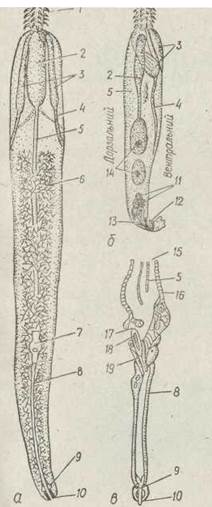
Fig. 179. Diagram of the anatomy of Acanthocephalus lucii — female (a), male (b), diagram of the uterine bell Structure (c): 1 — proboscis; 2 — proboscis receptacle; 3 — lemniscii; 4 — Muscles; 5 — ligament; 6 — eggs and ovarian balls; 7 — uterine bell; 8 — Uterus; 9 — Vagina; 10 — genital aperture; 11 — cement glands; 12 — bursa copulatrix; 13 — copulatory organ; 14 — Testis; 15 — anterior opening of the bell; 16 — wall of the bell; 17 — slit-like opening of the bell; 18 — mature egg; 19 — oviduct
Last update: 13/08/2026
Editorial and Educational Adaptation: This material has been compiled based on the primary/original source text. The project team performed an editorial review, corrected technical inaccuracies, structured sections, and adapted the content for an educational format.
What was processed:
- elimination of formatting defects (OCR errors, structural breaks, corrupted characters);
- editorial organization of content;
- standardization of terminology in accordance with academic sources;
- verification of factual statements against the original source text.
All mentions of the author, publication year, and origin of the primary text have been preserved in accordance with the source.