GENERAL MICROBIOLOGY - T.P. Pyrog - 2004
16. UTILIZATION OF INORGANIC HYDROGEN DONORS: AEROBIC CHEMOLITHOTROPHIC BACTERIA
16.2. OXIDATION OF REDUCED SULFUR COMPOUNDS
The ability to derive energy from the Oxidation of reduced sulfur compounds is characteristic of Gram-negative polar-flagellated Bacteria grouped within the genus Thiobacillus. This bacterial group also includes Representatives of the genera Sulfolobus and Thiomicrospira (see table).
Most thiobacilli oxidize various sulfur compounds, producing sulfate as the end product:
Class="center">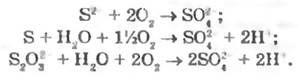
Some sulfur-oxidizing bacteria are obligate chemolithoautotrophs, whereas others are capable of utilizing Organic compounds as sources of energy and carbon, as well as electron Donors. These bacteria are aerobes, although Thiobacillus denitrificans can use nitrate In addition to oxygen as a terminal electron acceptor. Consequently, this bacterium is capable of anaerobic nitrate Respiration and denitrification. However, it lacks the ability for assimilatory nitrate reduction and therefore requires ammonia (ammonium salts) as its sole nitrogen source.
Bacteria oxidizing sulfur and its compounds
Bacteria |
pH range for growth |
Electron donors |
Obligate (O) or facultative (F) autotroph |
Thiobacillus thiooxidans Thiobacillus ferrooxidans Thiobacillus thioparus Thiobacillus denitrificans Thiobacillus intermedias Thiobacillus novellus Thiomicrospira pelophila Sulfolobus acidocaldartus |
2-5 2-6 6-8 6-8 2-6 6-8 6-8 2-3 |
S2 , S2О32- , S Fe2-, S2О32- , S CNS . S2О32- , S CNS , S2О32- , S S2О32-, S, glutamate S2О42- , S glutamate S2, S2О32- , S S glutamate, peptone |
O F O O F F O F |
Thiobacillus thiooxidans produces large amounts of sulfuric acid and exhibits a high tolerance to low pH values. The Cells remain viable even in 1 N sulfuric acid solutions. These properties are exploited in agriculture to reduce soil alkalinity: elemental sulfur is applied to calcareous soils, and the sulfuric acid generated by thiobacilli converts insoluble calcium carbonate into more soluble calcium sulfate, which is subsequently leached from the soil.
In environments where hydrogen sulfide is produced within the sediments of stagnant or slow-flowing waters, colorless filamentous sulfur bacteria such as Beggiatoa, Thiothrix, and Thioploca can frequently be found on the black surface of the sludge. However, isolating pure cultures of these classic sulfur bacteria is difficult and not always successful, presumably because they require organic substances for growth.
Hydrogen sulfide as The basis of an aphotic ecosystem. All higher heterotrophic organisms require biomass produced via Photosynthesis (plants). However, there is an exception to this rule. In deep oceanic regions, at sites of tectonic plate divergence, hydrothermal
vents gush from the seafloor with Water temperatures reaching approximately 350 "С. The water of these vents is rich in various dissolved minerals, including hydrogen sulfide. Where this hot water mixes with cold, oxygenated seawater, bacteria capable of oxidizing sulfur or hydrogen sulfide can proliferate. These bacteria serve as food for Mollusks, crustaceans, and worms. Thus, in the deep ocean, where light cannot penetrate, an ecosystem thrives in the immediate vicinity of hydrothermal vents, where biomass production is driven not by photosynthesis, but by chemolithoautotrophy.
Last update: 12/08/2026
Editorial and Educational Adaptation: This material has been compiled based on the primary/original source text. The project team performed an editorial review, corrected technical inaccuracies, structured sections, and adapted the content for an educational format.
What was processed:
- elimination of formatting defects (OCR errors, structural breaks, corrupted characters);
- editorial organization of content;
- standardization of terminology in accordance with academic sources;
- verification of factual statements against the original source text.
All mentions of the author, publication year, and origin of the primary text have been preserved in accordance with the source.