GENERAL MICROBIOLOGY - T.P. Pirog - 2004
14. TYPES OF FERMENTATION
14.1. GENERAL CHARACTERISTICS OF THE FERMENTATION PROCESS
14.1.1. ATP regeneration during fermentation
During glucose Fermentation, one to four moles of ATP are formed. Substrate-level phosphorylation involves the following three most important reactions:
Class="center">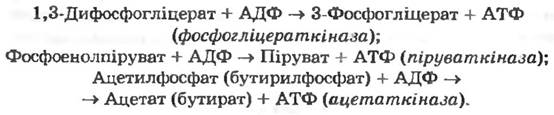
Most microorganisms utilize the first two reactions. In this process, the required hydrogen acceptors are formed from Pyruvate or acetyl-CoA. During the fermentation of one mole of glucose, only two or three moles of ATP are produced, and the fermentation products include lactate, ethanol, acetone, butyrate, n-butanol, 2-propanol, 2,3-butanediol, caproate, acetate, СО2, and Н2.
When utilizing the third reaction, which is catalyzed by acetate kinase, additional ATP is produced. Acetyl phosphate is formed from acetyl-CoA via phosphotransacetylase:

In addition, acetyl phosphate can be formed from phosphorylated sugars (xylulose-5-phosphate, fructose-6-phosphate) with the participation of phosphoketolase.
The ability of Bacteria to carry out the third reaction depends on whether they can evolve molecular gas. Upon transferring reducing equivalents (electrons) to protons, they can be released as molecular hydrogen. In this case, The Cell does not need to synthesize hydrogen acceptors. To understand this mechanism, it is necessary to examine the mechanisms of hydrogen release.
Mechanisms of hydrogen release. Anaerobic bacteria oxidize pyruvate to acetyl-CoA in two ways:
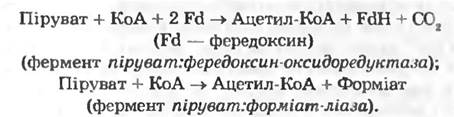
In the first reaction (characteristic of clostridia), ferredoxin is reduced, the Redox Potential of which is very low (-420 mV), so hydrogen can be released with the help of a special Hydrogenase:

In the second reaction (characteristic of enterobacteria), formate is formed, the redox potential of which is also low, so it can be cleaved to produce Н2:

Considering that the redox potentials of both FdH and formate are quite low, it is not difficult for the cell to get rid of the reducing equivalents formed during the Oxidation of Pyruvate to acetyl-CoA.
In contrast, the hydrogen generated during the dehydrogenation of glyceraldehyde-3-phosphate in the form of NADH in most anaerobic bacteria is subsequently transferred to organic acceptors.
However, some bacteria can release molecular hydrogen even from NADH due to the presence of the NADH-ferredoxin oxidoreductase enzyme:

As is well known, hydrogen is produced from FdH with the help of hydrogenase. However, these reactions can only proceed if the generated hydrogen is continuously removed (consumed). This is due to the fact that such hydrogen-producing reactions are associated with an increase in the potential H (from -320 mV for NADH to -420 mV for ferredoxin), and their equilibrium is unfavorable for hydrogen evolution. Therefore, organisms that can produce hydrogen from NADH can use this elegant way of getting rid of hydrogen in the form of Н2 only when they coexist with microorganisms that continuously consume hydrogen. This is exactly how it happens in nature. This phenomenon is called interspecies hydrogen transfer, which is a special form of Symbiosis in microbial communities.
Naturally, bacteria capable of getting rid of NADH-bound hydrogen by evolving it as Н2 can dispense with reactions converting acetyl-CoA into acceptors for NADH. Therefore, they are able to convert acetyl-CoA into acetyl phosphate and regenerate additional ATP via the acetate kinase reaction. They predominantly excrete acetate and are capable of regenerating up to four moles of ATP.
Last update: 12/08/2026
Editorial and Educational Adaptation: This material has been compiled based on the primary/original source text. The project team performed an editorial review, corrected technical inaccuracies, structured sections, and adapted the content for an educational format.
What was processed:
- elimination of formatting defects (OCR errors, structural breaks, corrupted characters);
- editorial organization of content;
- standardization of terminology in accordance with academic sources;
- verification of factual statements against the original source text.
All mentions of the author, publication year, and origin of the primary text have been preserved in accordance with the source.