GENERAL MICROBIOLOGY - T.P. Pyrog - 2004
11. MAIN MECHANISMS OF METABOLISM AND ENERGY TRANSFORMATION IN MICROORGANISMS
11.5. PATHWAYS OF GLUCOSE AND OTHER CARBOHYDRATE CATABOLISM
11.5.8. Tricarboxylic acid cycle
The Tricarboxylic Acid Cycle (TCA cycle) involves The oxidation of acetyl-CoA to CO2 with The transfer of reducing equivalents to NAD, NADP, and FAD (Fig. 11.7). This cycle was discovered by H.A. Krebs and L.W. Eggleston in animal Tissues. It is also known as the Krebs cycle or The Citric Acid Cycle. The name "citric acid cycle" is less frequently used in scientific literature.
Class="center">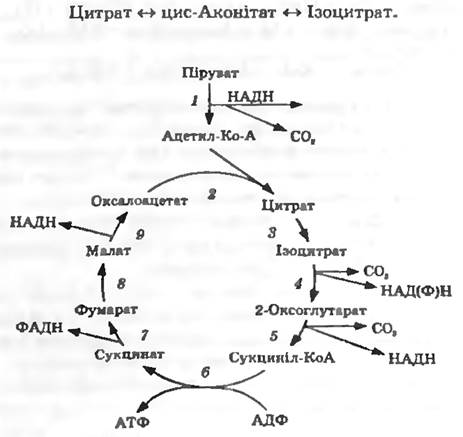
Fig. 11.7. Tricarboxylic acid cycle
Acetyl-CoA enters the cycle via the citrate synthase reaction, in which oxaloacetate and acetyl-CoA condense to form citrate. This step is catalyzed by the enzyme citrate synthase. Subsequently, the reversible interconversion of three tricarboxylic acids is carried out by the enzyme aconitate hydratase:

The enzyme isocitrate dehydrogenase catalyzes The conversion of isocitrate to 2-oxoglutarate. Isocitrate dehydrogenase can be either NAD- or NADP-dependent. Under the action of 2-oxoglutarate dehydrogenase, 2-oxoglutarate is converted into succinyl-CoA, which is then transformed into succinate with the participation of the enzyme succinate thiokinase. The conversion of succinyl-CoA to succinate is coupled with The formation of ATP.
Succinate dehydrogenase oxidizes succinate to fumarate. Succinate dehydrogenase transfers electrons from succinate to FAD (flavin adenine dinucleotide). Electrons from FAD enter the Respiratory Chain. NAD is not used as an electron acceptor in this reaction.
In the next stage of the cycle, the enzyme fumarase (fumarate hydratase) adds Water to fumarate to form malate. Malate is subsequently dehydrogenated to oxaloacetate by malate dehydrogenase.
All Reactions of the cycle are reversible, with the exception of the formation of succinyl-CoA.
The oxidation of acetyl-CoA in the tricarboxylic acid cycle yields two molecules of CO2 and eight protons, six of which are at the pyridine nucleotide level and two at the flavoprotein level. In addition, one molecule of a high-energy compound is formed.
Stoichiometry of the TCA cycle:

The tricarboxylic acid cycle is the main source of NADH, the subsequent oxidation of which in the respiratory chain generates ATP in heterotrophic aerobic microorganisms.
Last update: 12/08/2026
Editorial and Educational Adaptation: This material has been compiled based on the primary/original source text. The project team performed an editorial review, corrected technical inaccuracies, structured sections, and adapted the content for an educational format.
What was processed:
- elimination of formatting defects (OCR errors, structural breaks, corrupted characters);
- editorial organization of content;
- standardization of terminology in accordance with academic sources;
- verification of factual statements against the original source text.
All mentions of the author, publication year, and origin of the primary text have been preserved in accordance with the source.