Fundamentals of Molecular Biology - V.I. Rezyapkin 2009
RNA, RNA Processing
rRNA. Ribosomes
Ribosomes are subcellular structures that serve as the site of Protein Synthesis. They are large ribonucleoprotein complexes with a Molecular Weight of 2.5–4.2 MDa, composed of Proteins and rRNA. The number of ribosomes is about 104 in E. coli Cells and 106 in eukaryotes.
Prokaryotic and eukaryotic ribosomes differ in size. In eukaryotes, they are represented by 80S particles, while in prokaryotes, they are 70S (Fig. 5.4). Ribosomes consist of a small and a large subunit: prokaryotic subunits are 30S and 50S, respectively, whereas eukaryotic ones are 40S and 60S.
Class="center">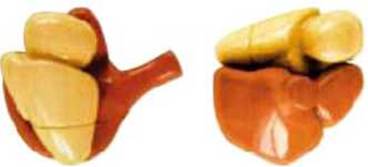
Fig. 5.4. Model of E. coli ribosomes
Prokaryotic ribosomes contain Three types of rRNA and 55–60 ribosomal proteins, whereas eukaryotic ones contain 4 rRNA species and 70–85 ribosomal proteins (Fig. 5.5). rRNAs play a crucial role in the Structure and biosynthetic function of ribosomes. Specifically, rRNA catalyzes the peptidyl transferase reaction, which drives peptide bond formation during Protein Synthesis on Ribosomes. Ribosomal Proteins are essential for maintaining the proper conformation of rRNA.
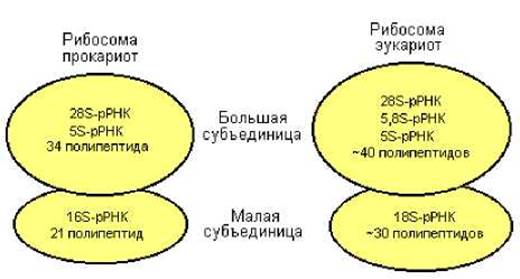
Fig. 5.5. Ribosome composition
rRNA is concentrated in the core of the particles, whereas ribosomal proteins occupy a peripheral position (Fig. 5.6).
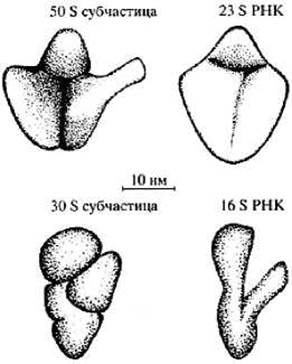
Fig. 5.6. Outlines of ribosomal subunits and isolated rRNAs in a compact conformation
Approximately 2/3 of the rRNA molecule forms double-stranded regions (Fig. 5.7).
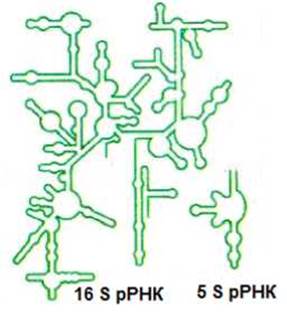
Fig. 5.7. rRNA
Each ribosomal protein specifically interacts with a distinct region of rRNA. Mixing 16S rRNA with the Proteins of the small subunit leads to its spontaneous self-assembly. Similarly, the large subunit can be reconstructed in vitro from its constituent rRNAs and proteins.
Last update: 12/08/2026
Editorial and Educational Adaptation: This material has been compiled based on the primary/original source text. The project team performed an editorial review, corrected technical inaccuracies, structured sections, and adapted the content for an educational format.
What was processed:
- elimination of formatting defects (OCR errors, structural breaks, corrupted characters);
- editorial organization of content;
- standardization of terminology in accordance with academic sources;
- verification of factual statements against the original source text.
All mentions of the author, publication year, and origin of the primary text have been preserved in accordance with the source.