Fundamentals of Molecular Biology - V.I. Rezyapkin 2009
Transcription
Non-template RNA synthesis
There are Enzymes capable of synthesizing RNA in the absence of a template. These include polynucleotide phosphorylase and polyadenylate polymerase.
Polynucleotide phosphorylase is found in Bacteria and utilizes ribonucleoside 5’-diphosphates (NDPs) — ADP, CDP, GDP, and UDP — as substrates. This enzyme catalyzes a reaction that can be generally represented as follows:
Class="center">
The reaction is reversible. The enzyme catalyzes The formation of 3’-5’ phosphodiester bonds:

Polynucleotide phosphorylase cannot use NTPs and deoxynucleoside triphosphates as substrates for RNA Synthesis.
Polyadenylate polymerase mediates the Synthesis of the poly(A) tail at the 3’ end of mRNA. It uses ATP and RNA as substrates (Fig. 4.10).
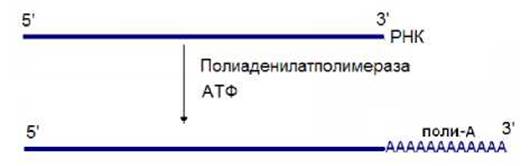
Fig. 4.10. Polyadenylate polymerase synthesizes the poly(A) sequence at the 3’ end of mRNA
The enzyme catalyzes the formation of 3’-5’ phosphodiester bonds.
In Conclusion, it should be noted that METABOLISM/31.html">Transcription is one of the most complex biological processes, playing a central role in the expression of Genetic information. Numerous protein molecules take part in its execution.
Last update: 12/08/2026
Editorial and Educational Adaptation: This material has been compiled based on the primary/original source text. The project team performed an editorial review, corrected technical inaccuracies, structured sections, and adapted the content for an educational format.
What was processed:
- elimination of formatting defects (OCR errors, structural breaks, corrupted characters);
- editorial organization of content;
- standardization of terminology in accordance with academic sources;
- verification of factual statements against the original source text.
All mentions of the author, publication year, and origin of the primary text have been preserved in accordance with the source.