Medical Genetics - V. M. Zaporozhan 2005
Monogenic Disorders
Clinical Features and Genetics of Certain Monogenic Disorders
Sex-Linked Inheritance - X-Linked Dominant Disorders
X-linked dominant traits occur in both males and females. A heterozygous affected mother transmits the disorder to both sons and daughters with a 50% probability. An affected father passes the trait to 100% of his daughters and never to his sons. Pedigree characteristics are described in section 4.2.3.
In many X-linked dominant disorders, the mutant Gene is lethal to male embryos. For instance, the loss of male fetuses carrying the disease-causing dominant gene is observed in incontinentia pigmenti (Bloch–Sulzberger syndrome).
Hypophosphatemia (Phosphate Diabetes, or vitamin D-resistant Rickets) (OMIM 307800)
The inheritance pattern is X-linked dominant (Xp22.2-p22.1). The disease is caused by impaired renal tubular reabsorption of phosphates.
Clinical presentation. Hypophosphatemia can be detected right after birth, whereas signs of rickets appear by the end of the first or the beginning of the second year of life, when children start walking. Lower limb deformities are more pronounced, presenting as genu varum (bowlegs) of the long tubular bones. Characteristic features include short stature, restricted mobility in major joints (hip, knee, elbow), dolichocephaly, and nail Dysplasia (Fig. 6.27). Unlike vitamin D-deficiency rickets, the general condition is not impaired. Skeletal abnormalities are less severe in females.
Class="center">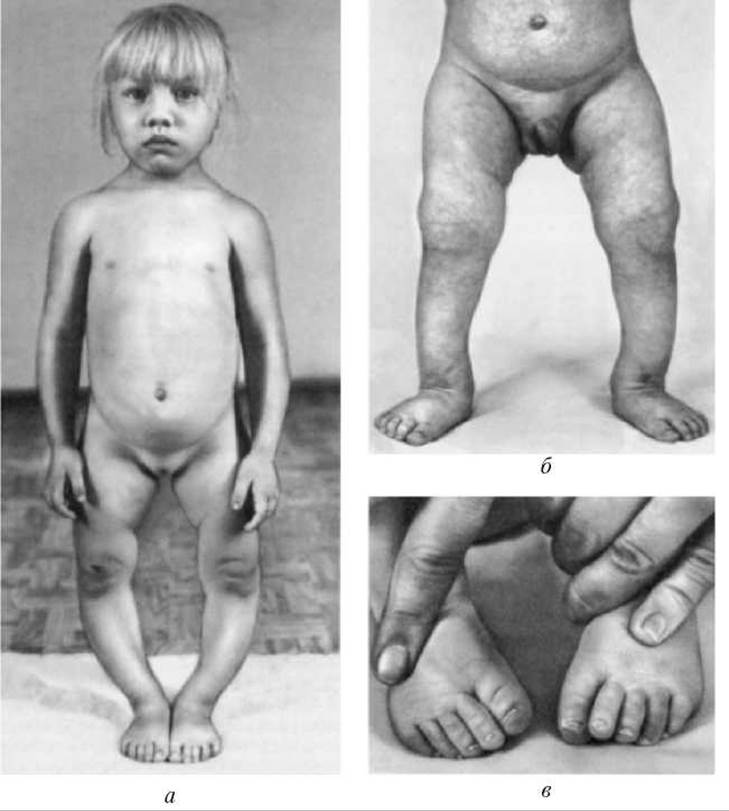
Fig. 6.27. Hypophosphatemia:
a — Varus deformity of the lower extremities; b — cutis marmorata, Flat-valgus FOOT deformity; c — nail dysplasia
Diagnostics. Radiography reveals typical rachitic changes—coarse trabecular Structure OF THE spongy bone. Blood tests show elevated alkaline phosphatase and decreased phosphorus levels, with normal calcium levels.
Last update: 11/08/2026
Editorial and Educational Adaptation: This material has been compiled based on the primary/original source text. The project team performed an editorial review, corrected technical inaccuracies, structured sections, and adapted the content for an educational format.
What was processed:
- elimination of formatting defects (OCR errors, structural breaks, corrupted characters);
- editorial organization of content;
- standardization of terminology in accordance with academic sources;
- verification of factual statements against the original source text.
All mentions of the author, publication year, and origin of the primary text have been preserved in accordance with the source.