Medical Genetics - V. M. Zaporozhan 2005
Fundamentals of Oncogenetics
Genetics and Oncological Diseases
Oncogenetics is a branch of genetics that studies the genetic mechanisms of tumor development.
Tumors are classified as Multifactorial Diseases. Their development is driven by both environmental factors—carcinogens (physical, chemical, and biological agents such as Oncogenic Viruses, certain Bacteria, and helminths)—and a wide range of genes, including viral and cellular oncogenes, Cell growth suppressor genes, and Mutator Genes.
Tumors can also be regarded as genetic diseases of somatic Cells, since every tumor originates from a chain of somatic Mutations across various genes.
Carcinogenesis is a prolonged, multi-step process. The Transformation of a normal cell into a tumor cell requires a sequence of 6–7 or even more somatic mutations in different genes, along with other genetic events occurring in a specific order. For example, Colorectal Cancer results from mutations in multiple genes, including the
APC (5q) Gene, K-RAS (12q) gene, DCC (18q) gene, p53 (17q) gene, mutator genes (such as MSH1 and MSH2), aberrant DNA Methylation, and other processes (Fig. 8.1). The Development of certain solid tumors may involve dozens of distinct genetic events.
These mutations affect genes responsible for Cell Division, apoptosis, DNA Repair, intercellular interactions, vascular growth, and more. Occasionally, the initial mutation may be inherited from parents through Germ Cells (hereditary cancer syndromes). However, as a rule, a single mutation is insufficient to transform a normal cell into a malignant tumor cell. Therefore, in both sporadic and hereditary cancers, an additional cascade of somatic mutations in specific genes must take place. Theoretically, the probability of such sequential mutations occurring is extremely low, yet two mechanisms significantly increase this likelihood: first, certain mutations accelerate cell proliferation, thereby expanding the pool of cells susceptible to subsequent mutations; second, mutations can compromise genomic stability, which elevates the frequency of further mutations.
Tumor cells differ from normal tissue cells in several key characteristics.
1. Capacity for uncontrolled proliferation.
Class="center">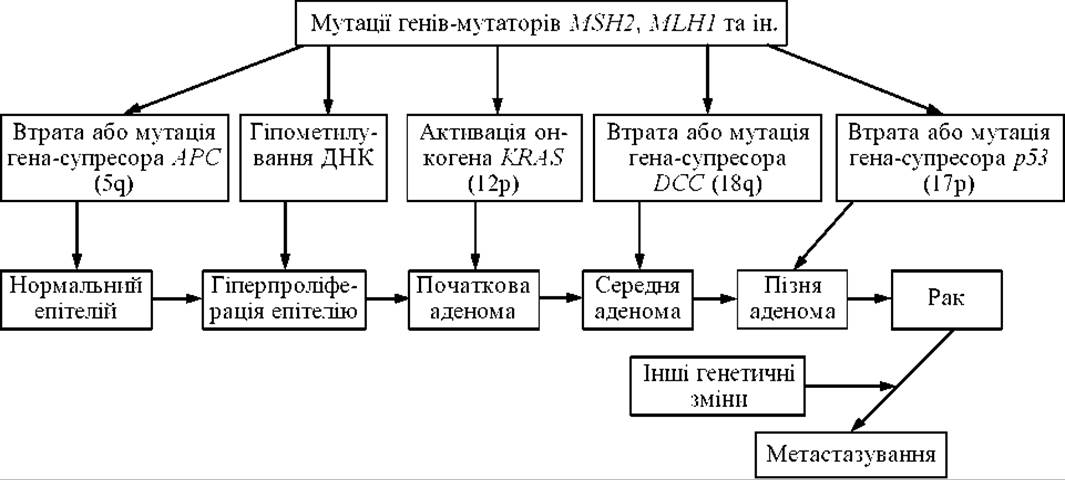
Fig. 8.1. Genetic events associated with the initiation and progression of colorectal cancer
2. Self-sufficiency in growth signals.
3. Insensitivity to anti-growth signals.
4. Evasion of apoptosis. Normal cells are mortal, and their life cycle is genetically programmed to end in cell death, or apoptosis. The American geneticist L. Hayflick (1965) demonstrated that normal human fibroblasts in culture undergo 50–60 divisions before dying. In contrast, malignant tumor cells acquire immortality. A classic example is the HeLa cell line, derived from Cervical cancer tissue taken from a patient who died in 1951 (named after Henrietta Lacks), which continues to be cultured in laboratories worldwide to this day. Cells achieve immortality when telomerase becomes activated or through alternative mechanisms of telomere lengthening.
5. Capacity for invasive growth (infiltration into adjacent Tissues and Organs) and metastasis.
6. Ability to induce angiogenesis (Blood vessel formation).
7. Morphological deviation from normal cells. Tumor cells typically appear more rounded due to the loss of adhesion to neighboring cells, and their cell membranes exhibit increased fluidity, which accelerates the Transport of substances into The Cell. Cancer cells are less differentiated than normal cells, bearing a resemblance to embryonic cells. While normal cells grown in vitro form a uniform monolayer during division, cancer cells are capable of piling on top of one another, enabling them to form a solid tumor mass.
8. A fundamental and defining feature of any tumor is its monoclonal origin. A tumor descends from a clone of a single initial genetically altered cell that acquired the capacity for unregulated growth. Subsequently, new mutations arise within the tumor cell population, generating secondary clones that establish genetic heterogeneity inside the tumor itself. However, this diversity is secondary. Clonal heterogeneity is a cardinal property of tumors and the driving force behind all subsequent progression. The population of tumor cells is constantly subject to natural Selection. Clones that proliferate most rapidly and exhibit resistance to the body's defense mechanisms gain a selective advantage. Driven by selection, the genotype and phenotype of tumor cells continuously evolve, rendering them increasingly aggressive and malignant. Genomic instability and the resulting clonal heterogeneity confer exceptional resilience, environmental adaptability, and resistance to therapeutic interventions upon the tumor.
Last update: 11/08/2026
Editorial and Educational Adaptation: This material has been compiled based on the primary/original source text. The project team performed an editorial review, corrected technical inaccuracies, structured sections, and adapted the content for an educational format.
What was processed:
- elimination of formatting defects (OCR errors, structural breaks, corrupted characters);
- editorial organization of content;
- standardization of terminology in accordance with academic sources;
- verification of factual statements against the original source text.
All mentions of the author, publication year, and origin of the primary text have been preserved in accordance with the source.