Genetics - A. V. Sivolob 2008
Genetics of Multicellular Eukaryotes
Epigenetic Inheritance
HP1-Dependent Repression System
An example of HP1 (Heterochromatin Protein 1) recruitment in heterochromatin formation is provided by chromosome centromeres (Fig. 6.9). HP1 contains two Structural domains: one recognizes methylated Lysine residues of Histones, while the other exhibits affinity for specific histone deacetylases (HD) and histone methyltransferases (HMT), and is also capable of interacting with another HP1 molecule.
Deacetylation of the disordered histone H3 tail promotes the binding of a specific HMT, which methylates Lys9 of histone H3. This methylated Lys (Me-Lys9) is recognized by HP1, which in turn recruits HD and HMT to maintain the deacetylated status and methylate adjacent nucleosomes. This triggers a self-sustaining, avalanche-like process that spreads to neighboring regions. The interaction between HP1 Proteins provides additional compaction of the Chromatin fiber. The Nature of the boundary separating heterochromatin in the centromeric region remains elusive, but the border area contains its own specific marker—methylated Lys4 of histone H3 (and demethylated Lys9).
Class="center">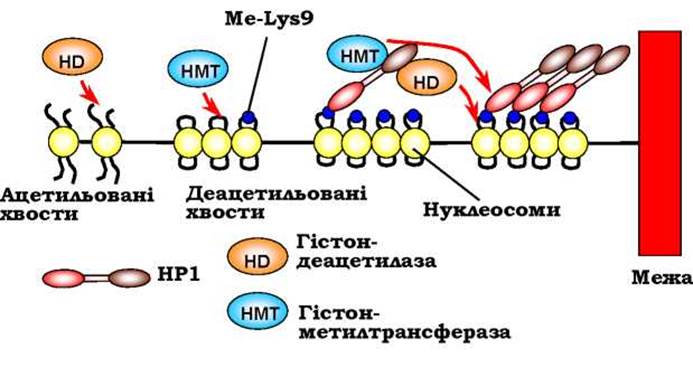
Fig. 6.9. Propagation and Maintenance of the heterochromatic state at centromeres
During Replication, which occurs asynchronously across different genomic regions (with heterochromatin replicating last), proteins are temporarily dissociated from DNA at the Replication fork (Chapter 1). Past the replication point, parental chromatin histones (carrying heterochromatic markers) return to the daughter DNA molecules along with de novo synthesized histones. HP1 also returns to its original locus, restoring the modification patterns of the new histones and the compact (repressed) state of the heterochromatic region. Consequently, the heterochromatic state of a given locus is faithfully reproduced in daughter Cells. Furthermore, HP1 has an affinity for lamin proteins (Chapter 1), which determines the peripheral localization of heterochromatin within the Cell Nucleus.
A similar repression system involving HP1 is widely utilized in other heterochromatic regions, as well as for the guaranteed silencing of genes within euchromatic zones. Methylation of histone H3 Lys9 and the deacetylated state of H3/H4 lysines are the hallmark features of such regions. As described above, both modifications are self-sustaining and mutually reinforcing through the mediated action of HP1. Additionally, DNA cytosine methylation plays a crucial role in maintaining the repressed state; this covalent modification is also restored upon Cell Division, completing a distinctive "repressive loop" (Fig. 6.10).
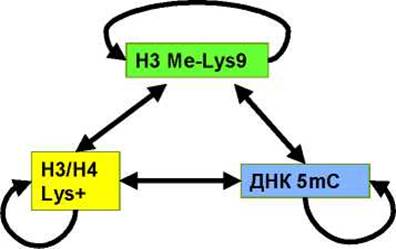
Fig. 6.10. Interplay between histone deacetylation, histone H3 Lys9 methylation, and DNA Methylation in heterochromatin. Lys+ stands for deacetylated lysines
Last update: 11/08/2026
Editorial and Educational Adaptation: This material has been compiled based on the primary/original source text. The project team performed an editorial review, corrected technical inaccuracies, structured sections, and adapted the content for an educational format.
What was processed:
- elimination of formatting defects (OCR errors, structural breaks, corrupted characters);
- editorial organization of content;
- standardization of terminology in accordance with academic sources;
- verification of factual statements against the original source text.
All mentions of the author, publication year, and origin of the primary text have been preserved in accordance with the source.