Review of Medical Physiology - William F. Ganong 2002
Blood Circulation
Body Circulating Fluids
Blood - Bone Marrow
In adults, erythrocytes, most leukocytes, and thrombocytes are produced in the Bone Marrow. In the fetus, Blood Cells are also formed in The Liver and Spleen. In adults, such extramedullary hematopoiesis may occur in diseases accompanied by the destruction or fibrosis of the bone marrow. In children, blood cells are actively produced in the bone marrow located within the cavities of all bones. After the age of 20, the marrow in the cavities of most long bones, except for the upper humerus and Femur, loses its hematopoietic activity (Fig. 27-1). Active bone marrow is referred to as Cytology/practical/86.html">Red bone marrow; inactive marrow is replaced by adipose tissue and is called yellow bone marrow. Bone marrow is one of the largest Organs in the body, comparable in size and mass to the liver. It is also one of the most metabolically active organs. Normally, 75% of marrow cells belong to the myeloid Lineage, which gives rise to leukocytes, while only 25% are maturing erythrocytes, even though the peripheral blood contains 500 times more erythrocytes than leukocytes. This disparity reflects the fact that the average lifespan of leukocytes is short, whereas that of erythrocytes is long.
Class="center">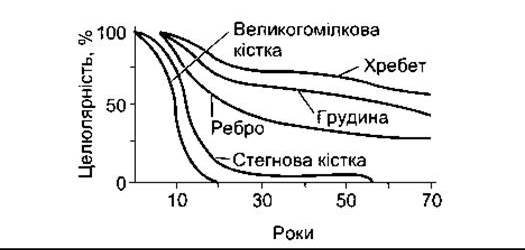
Fig. 27-1. Age-related changes in red bone marrow cellularity. Cellularity at birth is taken as 100% (reproduced with permission from Whitby LEN, Britton CJC: Disorders of the Blood, 10th ed. Churchill Livingstone, 1969).
The bone marrow contains multipotent, undifferentiated, uncommitted stem cells (pluripotent stem cells) that differentiate into the next generation of committed stem cells (progenitor cells). These cells subsequently develop into various types of blood cells. The number of pluripotent cells is small, yet their population is capable of completely regenerating the bone marrow if transplanted into an Organism whose own marrow has been destroyed. Separate progenitor cells exist for megakaryocytes, lymphocytes, erythrocytes, eosinophils, and basophils, whereas neutrophils and monocytes share a common progenitor. Bone marrow stem cells also serve as the source for osteoclasts (see Chapter 21), Kupffer cells (see Chapter 26), mast cells, dendritic cells, and Langerhans cells (see below).
Pluripotent stem cells originate from undifferentiated totipotent stem cells, the activation of which can, at least in theory, give rise to any Cell type in the body. Today, cultures of totipotent cells derived from human embryos have already been established, generating intense interest in stem cell research. However, A number of ethical and scientific questions remain to be addressed.
Last update: 10/08/2026
Editorial and Educational Adaptation: This material has been compiled based on the primary/original source text. The project team performed an editorial review, corrected technical inaccuracies, structured sections, and adapted the content for an educational format.
What was processed:
- elimination of formatting defects (OCR errors, structural breaks, corrupted characters);
- editorial organization of content;
- standardization of terminology in accordance with academic sources;
- verification of factual statements against the original source text.
All mentions of the author, publication year, and origin of the primary text have been preserved in accordance with the source.