Influenza: Diagnosis, Treatment, and Prevention - V.D. Moskalyuk 2010
Characteristics of patients with influenza A, influenza B, adenoviral infection, respiratory syncytial infection, and ARVI of unspecified etiology
Efficacy of aerosol interferon therapy combined with microwave resonance therapy
Microwave (MW) radiation exerts an excitatory effect on the receptor apparatus of biologically active points, triggering efferent impulses that alter The activity of the autonomic, endocrine, and immune systems. The body's response manifests as Skin-visceral Reflexes, alongside a general reaction aimed at enhancing adaptive and defensive Functions, thereby enabling the Organism to withstand external and internal aggressive factors [V.N. Kydalov et al., 2001; E.N. Chuyan et al., 2003].
The administration of aerosol Interferon Therapy (laferon at a dose of 500 thousand IU daily for 3 days) combined with microwave therapy (1 session per day lasting 10 minutes for 5 consecutive days targeting biologically active points of the auricle) also effectively influenced the dynamics of clinical symptoms across all patient groups.
In patients with Influenza A and B, the proposed Treatment facilitated a more rapid disappearance of clinical signs within just 1–3 days. Fever, headache, cough, and general weakness subsided the fastest. At the same time, symptoms such as lymphadenopathy, oropharyngeal mucosal hyperemia, and Conjunctivitis persisted longer—in (20.3±7.7)–(33.4±8.6)% of patients. However, by days 4–5, these symptoms had vanished in the vast majority of patients.
Fig. 6 illustrates the efficacy of aerosol interferon therapy—both administered alone and in combination with PF or MW therapy—using the duration of cough in patients with influenza A and RSV infection as an example. Treatment was most effective in patient subgroups receiving L-1 million IU and L-500 thousand IU combined with PF (P<0.001).
Class="center">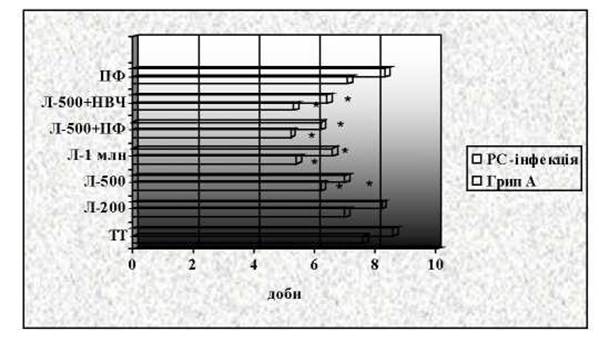
TT - traditional therapy; L-200 - laferon 200 thousand IU; L-500 - laferon 500 thousand IU; L-1 mln IU - laferon 1 million IU; L-500+PF - laferon 500 thousand IU + proteflazid; L-500+MW - laferon 500 thousand IU + microwave therapy; PF - proteflazid
* — P<0.05-0.001 relative to TT results
Fig. 6. Duration of cough (in days) in patients with influenza A and RSV infection depending on the treatment regimen
In patients with AI, RSV infection, and acute respiratory viral infections (ARVI) of undetermined Etiology, a trend toward greater clinical efficacy of the proposed treatment was observed compared to patients with influenza A and B. The mean rate of symptom resolution after 1–3 days of therapy was (59.3±7.7)% for influenza A, (63.3±7.7)% for influenza B, (75.3±8.5)% for AI, (66.0±8.3)% for RSV infection, and (69.4±7.7)% for ARVI of undetermined etiology.
Against the Background of traditional treatment, this indicator in patients with influenza A was (17.6±6.1)%, in influenza B - (16.3±5.9)%, in AI - (20.0±6.2)%, in RSV infection - (14.0±6.7)%, and in ARVI of undetermined etiology - (17.0±6.2)%. The difference in this integral indicator between patient groups receiving conventional versus the proposed treatment was statistically significant (P<0.001).
Thus, when aerosol interferon therapy (laferon at a dose of 500 thousand IU daily for 3 days) is combined with microwave therapy in patients with the investigated ARVI, a significant reduction in symptom frequency is observed as early as 1–3 days compared to patients who received traditional treatment.
A substantial effect of the combination of laferon aerosol at a dose of 500 thousand IU with microwave therapy on the resolution dynamics of Cardiovascular system alterations was revealed. Specifically, the mean rate of resolution of corresponding clinical signs in influenza A patients undergoing traditional treatment was (22.0±6.3)%, whereas following aerosol interferon therapy combined with microwave therapy, it reached (78.0±7.4)% in influenza A, (81.4±7.3)% in influenza B, (85.2±5.1)% in AI, (81.3±5.1)% in RSV infection, and (85.3±5.8)% in ARVI of undetermined etiology (P<0.001).
Therapy for patients with AI, RSV infection, and ARVI of undetermined etiology proved to be more effective than in patients with influenza A and B (P<0.05), particularly within the subgroups receiving L-1 million and L-500 thousand IU with PF (P<0.001).
Aerosol interferon therapy combined with microwave therapy significantly reduced the frequency of ECG abnormalities arising against the backdrop of various ARVI. The mean resolution rate of ECG changes after 1–3 days of the proposed treatment was (82.8±6.8)% for influenza A, (85.5±12.6)% for influenza B, (87.8±6.0)% for AI, (81.1±6.0)% for RSV infection, and (88.8±6.7)% for ARVI of undetermined etiology (P<0.001). The highest efficacy of aerosol interferon therapy combined with microwave therapy was observed in patients with AI, RSV infection, and ARVI of undetermined etiology. Under traditional therapy, improvement in ECG parameters occurred later.
The efficacy of aerosol interferon therapy combined with microwave therapy, as well as conventional therapy, was also evaluated by analyzing the dynamics of endogenous intoxication indicators. The results obtained in influenza A patients demonstrated that The rate of normalization of LII, LI, and ISLC within 4–6 days was superior to that in the conventional therapy group. In the latter, a similar positive effect was achieved only after 7–10 days of treatment. The mean rate of resolution of endogenous intoxication signs within 4–6 days with the proposed treatment was (88.5±4.2)% for influenza A, (89.1±3.6)% for influenza B, (94.3±4.2)% for AI, (86.6±5.0)% for RSV infection, and (94.4±3.3)% for ARVI of undetermined etiology. The difference was statistically significant compared to patients receiving traditional therapy (P<0.001).
Consequently, the study results in patients with ARVI of various etiologies demonstrated that after 4–6 days of aerosol interferon therapy combined with microwave therapy, there was a substantial decrease in indices of endogenous intoxication compared to patients who received traditional management.
Thus, the aerosol administration of interferon-alpha (laferon), both alone and in combination with proteflazid or microwave therapy, as part of the complex treatment of young patients with influenza A, influenza B, AI, RSV infection, and ARVI of undetermined etiology significantly facilitates the clinical course of these diseases, improves the body's immune status, reduces endogenous intoxication, decreases the incidence of complications, and shortens the duration of patient treatment.
Last update: 10/08/2026
Editorial and Educational Adaptation: This material has been compiled based on the primary/original source text. The project team performed an editorial review, corrected technical inaccuracies, structured sections, and adapted the content for an educational format.
What was processed:
- elimination of formatting defects (OCR errors, structural breaks, corrupted characters);
- editorial organization of content;
- standardization of terminology in accordance with academic sources;
- verification of factual statements against the original source text.
All mentions of the author, publication year, and origin of the primary text have been preserved in accordance with the source.