Influenza: Diagnosis, Treatment, Prevention - V.D. Moskalyuk 2010
Characteristics of patients with influenza A, influenza B, adenoviral and respiratory syncytial infections, and ARVI of unknown etiology
Dynamics of cellular immunity parameters under the influence of various treatment methods
An important aspect of the study was ensuring the representativity of subgroups based on a practically identical baseline (at THE START OF therapy) level of the studied cellular Immunity parameters.
The administration of standard therapy in patients with Influenza A was accompanied by an increase in Blood leukocyte count by 20.5% (P<0.001). However, no significant changes occurred in the absolute and relative counts of lymphocytes, or the absolute and relative counts of CD3+, CD4+, and CD8+ Cells (P>0.05).
In patients with influenza B, there was a statistically significant increase in blood leukocyte count by 15.7% (P<0.01) and absolute lymphocyte count by 29.5% (P<0.01). The relative content of CD3+ and CD8+ cells increased slightly by 4.0% and 7.6%, respectively. In patients with AI, standard therapy did not cause significant deviations in blood leukocyte count, relative lymphocyte count, CD4+, CD8+, or absolute and relative CD3+ counts (P>0.05). At the same time, an increase in the absolute count of CD8+ cells by 15.4% was observed (P<0.001).
The administration of standard therapy in patients with acute respiratory viral infections (ARVI) of unknown Etiology was accompanied by an increase in the absolute counts of CD3+ and CD4+ cells (by 19.9% and 27.2%, respectively, P<0.05) and a slight increase in the relative counts of CD3+ and CD8+ subpopulations (by 3.0% and 3.9%, respectively, P>0.05). There was a tendency toward an increase in blood lymphocyte count, relative CD4+ count, and the CD4+/CD8+ ratio.
The inclusion of L-200 in the complex therapy of patients with influenza A manifested as an increase in most of the studied cellular immunity parameters. Specifically, the blood leukocyte count increased by 16.0% (P<0.01), the absolute lymphocyte count more than doubled, and their relative count increased by 10.6% (P<0.05). Similarly, the relative count of CD3+ cells increased by 17.5% (P<0.05). The absolute count of CD4+ cells increased by 108.8% (P<0.05), and their relative count by 18.0%. The count of CD8+ cells also increased, with the absolute number rising by 40.0% and the relative number by 20.4%. These changes were statistically significant (P<0.001). Deviations in the absolute CD3+ count were non-significant. An increase in the CD4+/CD8+ ratio by 38.0% was also observed (P<0.001).
The inclusion of L-200 in the complex therapy of patients with influenza B was accompanied by a more pronounced increase in blood leukocyte count (by 15.9%, P<0.01), absolute and relative lymphocyte numbers (by 55.8%, P<0.001, and 9.2%, P<0.05, respectively), absolute CD3+ count by 41.7% (P<0.001), and relative CD4+ count by 17.7% (P<0.001).
The administration of L-200 in the complex Treatment of patients with AI contributed to a significant increase in all studied parameters. Thus, the blood leukocyte count increased by 18.3% (P<0.01), absolute and relative lymphocyte counts by 31.6% and 23.2% (P<0.001), CD3+ by 126.3% (P<0.001) and 8.5% (P>0.05), CD4+ by 62.1% and 15.7% (P<0.001), and CD8+ by 90.4% and 22.4% (P<0.001), respectively. These deviations also led to an increase in the CD4+/CD8+ ratio by 34.1% (P<0.001).
The Use of L-200 in the complex therapy of ARVI of unknown etiology was accompanied by an increase in the absolute and relative counts of lymphocytes and the studied T-lymphocyte subpopulations. Thus, the lymphocyte content increased by more than 30.0% (P<0.001), the relative CD3+ count by 19.1% (P<0.05), and the absolute count by 131.3% (P<0.001). The relative content of CD4+ and CD8+ cells increased by 32.4% and 43.1%, respectively (P<0.001). Their absolute counts increased by 97.3% and 50.4%, respectively (P<0.001). These fluctuations in T-lymphocyte subpopulations resulted in an increase in the CD4+/CD8+ ratio by 70.7% (P<0.001).
An even greater increase in cellular immunity parameters was revealed in patients with influenza A after the aerosol administration of L-500 (Table 5).
Against the Background of receiving the specified dose of laferon, the blood leukocyte count increased by 30.1% (P<0.001). The absolute counts of lymphocytes and CD3+ cells increased more than 2-fold, and CD4+ cells more than 4-fold (P<0.001). The absolute count of CD8+ cells increased by more than 1.5 times (P<0.001).
Table 5
Dynamics of cellular immunity parameters in patients with influenza A whose complex therapy included aerosolized laferon at a daily __________ dose of 500 thousand IU (n=30, M±m)
|
Parameter |
Upon admission to the hospital |
Upon discharge from the hospital |
Degree of deviation, % |
P |
|
Lk, x109, х л-1 |
5.07±0.15 |
6.42±0.10 |
+30.1±4.44 |
<0.001 |
|
Лф, % |
23.93±0.35 |
34.20±0.62 |
+43.8±3.54 |
<0.001 |
|
Лф, х109, х л-1 |
0.68±0.05 |
2.05±0.03 |
+268.7±38.1 |
<0.001 |
|
CD3+, % |
41.10±1.22 |
72.67±0.36 |
+80.8±4.80 |
<0.001 |
|
CD3+ х109, х л-1 |
0.49±0.03 |
1.40±0.02 |
+222.1±24.8 |
<0.001 |
|
CD4+, % |
26.27±0.36 |
43.57±0.35 |
+66.7±2.59 |
<0.001 |
|
CD4+ х109, х л-1 |
0.25±0.02 |
1.01±0.02 |
+428.1±52.9 |
<0.001 |
|
CD8+, % |
24.43±0.39 |
37.63±0.24 |
+55.1±2.68 |
<0.001 |
|
CD8+ х109, х л-1 |
0.30±0.02 |
0.75±0.02 |
+178.7±18.2 |
<0.001 |
|
CD4+/CD8+ |
0.38±0.02 |
1.32±0.01 |
+285.7±24.6 |
<0.001 |
Note (here and below): P represents the statistical significance of differences between absolute parameters established upon admission and discharge.
The relative values of the studied parameters also increased: lymphocytes by 43.8%, CD3+ by 80.8%, CD4+ by 66.7%, and CD8+ by 55.1% (P<0.001). A significant increase in the CD4+/CD8+ ratio was also observed—more than 2.5-fold (P<0.001).
Increasing the daily dose of laferon to 500 thousand IU in the complex therapy of patients with influenza B caused an increase in blood leukocyte count by 24.1% (P<0.001). The absolute counts of CD3+, CD4+, and CD8+ cells increased almost twofold (P<0.001), and their relative numbers increased by 34.0%, 60.7%, and 54.4%, respectively (P<0.001). The CD4+/CD8+ ratio increased significantly—more than 2-fold (P<0.001).
The inclusion of L-500 in the complex therapy of patients with AI was accompanied by an increase in blood leukocyte count by 24.8%, absolute and relative lymphocyte counts by 57.5% and 34.5%, CD3+ by 96.5% and 15.2%, CD4+ by 114.8% and 17.7%, and CD8+ by 60.6% and 25.4%, respectively, as well as an increase in the CD4+/CD8+ ratio by 87.8%. All observed changes were statistically significant (P<0.001).
An even greater increase in cellular immunity parameters was observed in patients with ARVI of unknown etiology after the inclusion of L-500 in their complex therapy. The relative and absolute lymphocyte contents increased significantly (by 44.1% and 73.1%, respectively, P<0.001). The absolute contents of CD3+, CD4+, and CD8+ cells increased by 123.8%, 107.8%, and 107.5%, respectively (P<0.001), while their relative counts increased by 19.8%, 38.3%, and 61.8%, respectively (P<0.001). All of this was accompanied by a significant increase in the CD4+/CD8+ ratio by 95.8% (P<0.001).
When the laferon dose was increased to 1 million IU in patients with influenza A, the blood leukocyte count increased by 25.8% (P<0.001), and the absolute lymphocyte count increased by 84.2% (P<0.001). Their relative count increased more than 4-fold (P<0.001). The absolute counts of Cell subpopulations also increased: CD3+ by 35.6%, CD4+ by 69.4%, and CD8+ by 70.5% (P<0.001). A significant increase in the relative content of these T-lymphocyte subpopulations was also detected—more than 3-fold (P<0.001). All of this contributed to a substantial increase in the CD4+/CD8+ ratio by more than 3-fold (P<0.001).
Raising the laferon dose to 1 million IU in the complex therapy of patients with influenza B was accompanied by an almost 2-fold increase in the absolute quantitative values of lymphocytes, CD4+, and CD3+ (1.5-fold), and CD8+ (more than 2-fold) (P<0.001). Similarly, a pronounced increase in relative indicators was noted: lymphocytes by 55.7%, CD3+ by 31.3%, CD4+ by 71.1%, and CD8+ by 50.8% (P<0.001).
A more than twofold increase in the CD4+/CD8+ ratio was observed (P<0.001).
In patients with AI, following the aerosol administration of L-1 million IU, both absolute and relative lymphocyte counts were higher by 40.8% and 29.0%, and CD3+ counts by 83.3% and 28.0%, respectively (P<0.001). A more pronounced increase was observed in the absolute and relative counts of CD4+ (by 144.1% and 80.4%) and CD8+ (by 96.2% and 32.9%), as well as the CD4+/CD8+ ratio (by 76.4%) (P<0.001).
Increasing the laferon dose to 1 million IU in patients with ARVI of unknown etiology led to an even greater increase in the absolute lymphocyte count—by 73.3% (P<0.001)—as well as CD3+ and CD8+ counts by nearly 1.5 times, and CD4+ count by more than 1.5 times (P<0.001). The CD4+/CD8+ ratio after the inclusion of L-1 million IU in complex therapy increased by 163.7% compared to the baseline period (P<0.001).
Fig. 5 illustrates The Effect of standard therapy and laferon at a dose of 1 million IU on the dynamics of Changes in the relative count of CD4+ cells in patients with influenza A and B, AI, and ARVI of unknown etiology.
Class="center">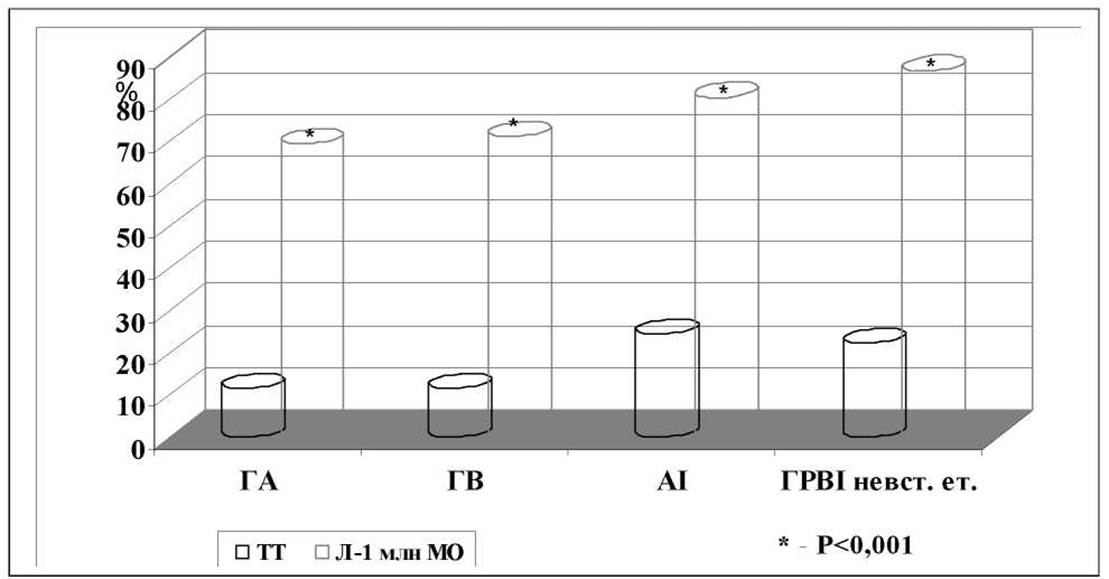
Fig. 5. Increase (in %) of the relative count of CD4 lymphocytes in patients with influenza A and B, AI, and acute respiratory viral infections of unknown etiology during the administration of TT and laferon at a daily dose of 1 million IU compared to the baseline period.
The inclusion of PF in the complex therapy of patients with influenza A was accompanied by an increase in the absolute leukocyte count in the blood by 21.3% (P<0.001). The relative lymphocyte count increased by 15.3% (P<0.001). Against the background of PF administration, the relative counts of CD3+, CD4+, and CD8+ increased by 12.3, 33.7, and 13.6%, respectively (P<0.05).
Treatment with PF did not significantly alter the absolute levels of CD4+ and CD8+ subpopulations (P>0.05). These fluctuations in T-lymphocyte subpopulations were also accompanied by an increase in the CD4+/CD8+ ratio by 37.5% (P<0.001).
The use of PF in the complex therapy of patients with influenza B contributed to moderate variations in the studied parameters without altering the absolute lymphocyte count, the absolute and relative counts of CD3+, or the CD4+/CD8+ ratio. An increase was observed in the blood leukocyte count by 11.7% (P<0.01), the relative lymphocyte count by 11.8% (P<0.05), the absolute and relative counts of CD4+ (by 22.4 and 17.1%, respectively, P<0.001), and CD8+ (by 54.5%, P<0.001 and 5.7%, P>0.05, respectively).
During the administration of PF in patients with AI, the leukocyte count increased by 27.4% (P<0.001). The absolute and relative counts of lymphocytes increased by 29.1 and 13.5%, CD3+ by 56.8 and 28.3%, CD4+ by 104.9 and 15.1%, and CD8+ by 20.5 and 35.5% (P<0.01–0.001). A substantial increase in the CD4+/CD8+ ratio was also observed (by 63.4%, P<0.001).
The inclusion of PF in the complex treatment of patients with acute respiratory viral infections of unknown etiology was accompanied by moderate changes in cellular immunity parameters. A slight increase in the peripheral blood leukocyte count by 8.8% was noted (P>0.05). The absolute counts of lymphocytes and CD8+ didnot undergo significant changes under METABOLISM/18.html">The Influence of PF. Of note is the increase in the relative lymphocyte count and the studied T-lymphocyte subpopulations by an average of 11.3–22.7% (P<0.05–0.001). The monotherapy with PF also caused a significant increase in the CD4+/CD8+ ratio by 49.1% (P<0.001).
The combination of L-500 with PF in the treatment of patients with influenza A revealed deviations in cellular immunity parameters (Table 6). As in the previous groups, the blood leukocyte and lymphocyte counts increased significantly (P<0.001). Specifically, the absolute leukocyte count increased by 31.8%. The relative lymphocyte count rose by 71.9%. These changes were statistically significant (P<0.001).
The absolute counts of the studied T-lymphocyte subpopulations CD3+, CD4+, and CD8+ increased more than 3-fold (P<0.001), and their relative levels increased by 35.9, 89.3, and 73.2%, respectively (P<0.001). The CD4+/CD8+ ratio in this group of patients also increased more than threefold (P<0.001).
Table 6
Dynamics of cellular immunity parameters in patients with influenza A whose complex therapy included a combination of L-500 and PF (n=30, M± m)
|
Parameter |
Upon admission |
Upon discharge |
Degree of deviation, % |
P |
|
Leukocytes x109, x L-1 |
4.96±0.09 |
6.48±0.11 |
+31.8±3.19 |
<0.001 |
|
Lymphocytes, % |
21.57±0.33 |
36.80±0.30 |
+71.9±3.22 |
<0.001 |
|
Lymphocytes x 109, x L-1 |
0.28±0.02 |
1.25±0.03 |
+234.5±22.3 |
<0.001 |
|
CD3+, % |
54.83±0.80 |
74.07±0.34 |
+35.9±2.14 |
<0.001 |
|
CD3+ x 109, x L-1 |
0.40±0.02 |
1.57±0.01 |
+344.7±31.18 |
<0.001 |
|
CD4+, % |
23.57±0.26 |
44.47±0.22 |
+89.3±2.38 |
<0.001 |
|
CD4+ x 109, x L-1 |
0.25±0.02 |
0.99±0.02 |
+365.0±41.1 |
<0.001 |
|
CD8+, % |
22.40±0.32 |
38.60±0.20 |
+73.2±2.39 |
<0.001 |
|
CD8+ x 109, x L-1 |
0.23±0.02 |
0.79±0.02 |
+311.7±34.2 |
<0.001 |
|
CD4+/CD8+ |
0.36±0.02 |
1.38±0.02 |
+342.1±41.8 |
<0.001 |
The combination of L-500 with PF in patients with influenza B caused virtually identical changes in most studied cellular immunity parameters compared to the administration of L-1 million IU. Only a greater increase in the absolute lymphocyte count and a decrease in the relative lymphocyte count increment were observed against the background of the combination therapy (P<0.05).
The combined use of L-500 and PF in patients with AI was accompanied by a similar positive effect. An increase in the absolute and relative lymphocyte counts was observed by 31.6 and 24.1%, respectively (P<0.001). The absolute and relative counts of CD3+ increased by 85.1 and 37.7% (P<0.001), CD4+ by 126.7 and 26.3% (P<0.001), and CD8+ by 72.5% (P<0.001) and 29.8% (P<0.05), respectively, while the CD4+/CD8+ ratio increased by 72.2% (P<0.001). The inclusion of L-500 along with PF in the complex therapy of patients with acute respiratory viral infections of unknown etiology proved to be quite effective. Upon discharge from the hospital, a significant increase in the lymphocyte count and T-lymphocyte subpopulations was observed compared to baseline levels.
The absolute levels of lymphocytes and CD8+ increased by more than 60% (P<0.001), whereas CD3+ and CD4+ increased by nearly 1.5-fold (P<0.001). The relative levels of these parameters rose by an average of 28.8–51.2% (P<0.001), and the CD4+/CD8+ ratio increased by 128.0% (P<0.001).
Last update: 10/08/2026
Editorial and Educational Adaptation: This material has been compiled based on the primary/original source text. The project team performed an editorial review, corrected technical inaccuracies, structured sections, and adapted the content for an educational format.
What was processed:
- elimination of formatting defects (OCR errors, structural breaks, corrupted characters);
- editorial organization of content;
- standardization of terminology in accordance with academic sources;
- verification of factual statements against the original source text.
All mentions of the author, publication year, and origin of the primary text have been preserved in accordance with the source.