Sexually Transmitted Diseases - I. I. Mavrov 2005
Molluscum Contagiosum
Molluscum contagiosum is an infectious Skin condition characterized by the appearance of small, firm, slightly shiny erythematous papules on the lower abdomen, genitalia, pubic area, and inner thighs.
Etiology. The causative agent is the molluscum contagiosum virus, which belongs to unclassified Poxviruses (family Poxviridae). It was studied (J. Shand et al., 1976) using an Electron microscope in samples of affected human skin. The purified virus is oval or rectangular, measuring 230x330 nm. In ultrathin sections of infected Cells, inclusion bodies are located in compartments separated by thin walls, containing nests of mature Viral Particles that fill the spaces between the partitions. The Cytoplasm surrounding these cavities resembles a honeycomb and is divided into spherical segments larger than the viral particles.
The virus exerts a cytopathic effect on human tissue culture cells; however, it does not replicate in serial tissue culture passages.
Transmission. Molluscum contagiosum is transmitted sexually as well as through household contact (sharing a bath, bedding, washcloths, etc., with an infected person). Infections frequently occur in swimming pools, particularly among children. Y. Foulds (1982) described a patient who developed typical molluscum contagiosum papules on tattooed areas of the body 7 months after getting a tattoo.
Epidemiology. The disease is prevalent worldwide in both sporadic and epidemic forms. The incubation period of molluscum contagiosum ranges from 14–15 days to several months.
The Clinical presentation of the disease is highly distinctive (see insert XII, 1–3). Firm, painless, dome-shaped or slightly flattened papules ranging in size from a pinhead to a lentil bean or larger appear on unchanged skin; they are skin-colored or pale pink, and occur either singly or in multiples (Fig. 41). Subjective sensations are generally absent.
The center of the papules, especially the larger ones, features an umbilicated depression with a small opening. Upon compressing the papule, a white, paste-like mass is expelled, containing ovoid bodies known as molluscum bodies.
Class="center">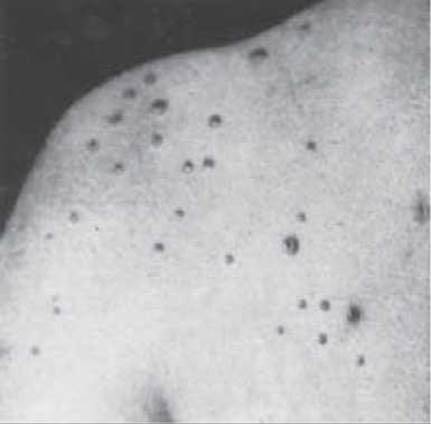
Fig. 41. Molluscum contagiosum.
The disease runs a chronic course, sometimes lasting several months. Without Treatment, the papules resolve spontaneously within 2–3 months.
Diagnosis. Recognition of molluscum contagiosum is based on the Clinical Presentation and laboratory findings.
The sharp demarcation of the papules from the surrounding skin, the absence of inflammatory signs, and the presence of an umbilicated depression in the center, from which a white paste-like mass exudes, allow for a straightforward and accurate diagnosis.
Microscopic examination of the papular contents reveals cornified epidermal cells and A large number of characteristic, ovoid (molluscum) bodies typical of this condition. Histological examination shows that these inclusions form in the basal layers of the epithelium, gradually increasing in size, displacing The Nucleus to the periphery, and filling the entire Cell.
Differential diagnosis. In some cases, papules coalesce, reach the size of a fingernail or larger, and ulcerate centrally, resembling an epithelioma. Lateral compression yields the characteristic cheesy mass, which does not occur in epithelioma. Molluscum contagiosum must also be differentiated from other conditions, notably chickenpox, pustulosis vacciniformis acuta (Kaposi), pustular Syphilis, and others.
Treatment. The papules are removed by curettage using a sharp dermal curette. Their contents are expressed with forceps, after which the lesion is treated with a 5% alcoholic iodine solution. In some cases, removal via diatermo-coagulation or electrolysis is recommended. If a very large number of papules are present (generalized forms of molluscum contagiosum), tetracycline Antibiotics (tetracycline, oletetrin, methacycline, doxycycline, chlortetracycline) should be prescribed.
Prevention involves early diagnosis, treatment of patients and their sexual partners. Until complete recovery, patients must refrain from sexual contact and avoid sharing bed linen, towels, baths, etc. They should remain under medical supervision until full recovery is achieved.
Last update: 10/08/2026
Editorial and Educational Adaptation: This material has been compiled based on the primary/original source text. The project team performed an editorial review, corrected technical inaccuracies, structured sections, and adapted the content for an educational format.
What was processed:
- elimination of formatting defects (OCR errors, structural breaks, corrupted characters);
- editorial organization of content;
- standardization of terminology in accordance with academic sources;
- verification of factual statements against the original source text.
All mentions of the author, publication year, and origin of the primary text have been preserved in accordance with the source.