Human Anatomy, Part 1 - K. A. Dyubenko, A. K. Kolomiytsev, Y. B. Chaykovsky 2002
Special Part
Bones of the lower limb, ossa membri inferioris
Pelvic girdle - Hip bone
The ilium, os ilii [ilium, os iliacum] (BNA), is located superior to the acetabulum (see Fig. 67A). It consists of a body, corpus ossis ilii, which contributes to The formation of the acetabulum, and a wing, ala ossis ilii. Separating the two is the arcuate line, linea arcuata. The wing of the ilium features a thickened upper margin known as the iliac crest, crista iliaca, which terminates anteriorly in the anterior superior iliac spine, spina iliaca anterior superior, and posteriorly in the posterior superior iliac spine (note: *posterior* corresponds to the anatomical term, though text reads *anterior posterior*). Just below these are the anterior and posterior inferior iliac spines, spina iliaca anterior inferior et posterior, respectively. The iliac spines serve as attachment sites for Muscles and ligaments. The outer margin of the wing presents three lines, or Lips: the outer lip, labium externum, the inner lip, labium internum, and the intermediate line, linea intermedia, situated between them. The outer surface of the wing bears three rough gluteal lines—the anterior gluteal line, linea glutealis anterior, the posterior gluteal line, linea glutealis posterior, and the inferior gluteal line, linea glutealis inferior—to which muscles attach. The inner surface of the ilium is referred to as the iliac fossa, fossa iliaca (see Fig. 67B), which gives origin to the iliacus Muscle. On the posteromedial aspect of the wing lies the auricular surface, facies auricularis. Superior and posterior to the auricular surface is the iliac tuberosity, tuberositas iliaca.
Class="center">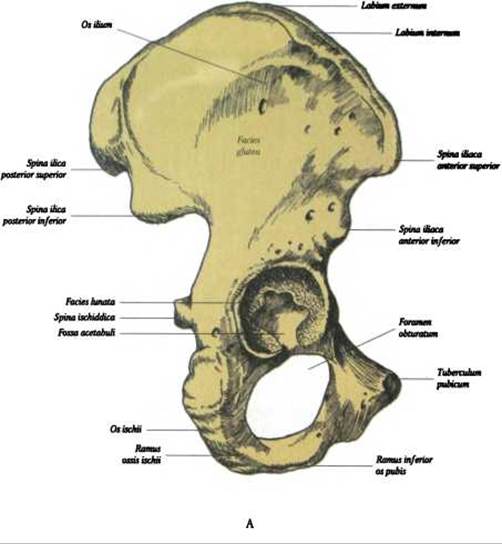
Fig. 67. Hip bone, os coxae [pelvicum]: A — external surface
Last update: 08/08/2026
Editorial and Educational Adaptation: This material has been compiled based on the primary/original source text. The project team performed an editorial review, corrected technical inaccuracies, structured sections, and adapted the content for an educational format.
What was processed:
- elimination of formatting defects (OCR errors, structural breaks, corrupted characters);
- editorial organization of content;
- standardization of terminology in accordance with academic sources;
- verification of factual statements against the original source text.
All mentions of the author, publication year, and origin of the primary text have been preserved in accordance with the source.