Human Anatomy Part 1 - K. A. Dyubenko, A. K. Kolomiytsev, Yu. B. Chaykovsky 2002
Special Part
Urinary System, systema urinarium - General Overview
Urinary Organs - Ureter
The Ureter, ureter, is a paired organ through which urine flows from the renal pelvis into the Urinary Bladder (Fig. 311). It is shaped like a cylindrical tube, slightly flattened, with a diameter of 0.4–0.7 cm and a length ranging from 25 to 34 cm, depending on the height of the Kidneys.
Three PARTS OF THE ureter are distinguished: the abdominal part, pars abdominalis, the pelvic part, pars pelvica (separated by the terminal line, linea terminalis), and the intramural part, pars intramuralis. The ureter has three constrictions:
- at the exit from the renal pelvis (pelvic constriction),
- at the crossing of the common iliac vessels,
- at the site of entry into the urinary bladder.
Dilatations are located between these constrictions. Knowledge of the ureteral constrictions is of great importance in urological practice, as they are common sites where calculi become lodged during their passage along the ureter in urolithiasis.
Class="center">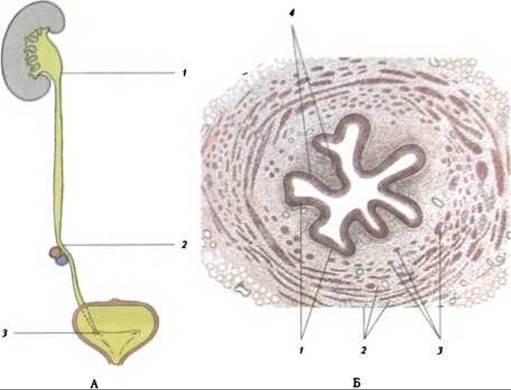
Fig. 311. The ureter, ureter.
A - constrictions of the ureter: 1 - pelvic constriction; 2 - at the crossing of the common iliac vessels; 3 - at the site of entry into the urinary bladder; B - cross-section of the ureter: 1 - tunica mucosa; 2 - stratum circulare tunicae muscularis; 3 - stratum longitudinale tunicae muscularis; 4 - tela submucosa
The ureter obliquely pierces the wall of the urinary bladder and opens into it via the ureteral orifice, ostium ureteris. In newborns, the ureter is 5–7 cm long. In two-year-old children, its length is already twice as great, in three-year-old children—three times, and it reaches its final adult length by the age of 18–25 years.
Last update: 08/08/2026
Editorial and Educational Adaptation: This material has been compiled based on the primary/original source text. The project team performed an editorial review, corrected technical inaccuracies, structured sections, and adapted the content for an educational format.
What was processed:
- elimination of formatting defects (OCR errors, structural breaks, corrupted characters);
- editorial organization of content;
- standardization of terminology in accordance with academic sources;
- verification of factual statements against the original source text.
All mentions of the author, publication year, and origin of the primary text have been preserved in accordance with the source.