MEDICAL BIOLOGY, HUMAN ANATOMY, PHYSIOLOGY, AND PATHOLOGY - Ya.I. Fedoniuk 2010
ANATOMY, PHYSIOLOGY, PATHOLOGY
CHAPTER 7. THE DIGESTIVE PROCESS AND ITS PATHOLOGY
ANATOMY AND PHYSIOLOGY OF THE DIGESTIVE ORGANS
PANCREAS
The Pancreas is an unpaired organ located posterior to The Stomach on the posterior abdominal wall at the level of the First and Second lumbar vertebrae, consisting of a HEAD, body, and tail. The head lies to the right within the duodenal loop, the body abuts the posterior wall of the stomach, and the tail extends into the left hypochondrium, contacting the visceral surface of the Spleen (Fig. 7.22 - see Appendix). The length of the gland is approximately 12-15 cm. Peritoneally, it lies extraperitoneally (covered by the Peritoneum anteriorly and inferiorly). Externally, the gland is covered by a Connective Tissue capsule. It is structured into lobules whose Cells secrete pancreatic juice, which enters the descending part of the duodenum via the excretory duct. The Endocrine Part of the Pancreas is represented by cells arranged as islets (of Langerhans), which secrete Hormones directly into the Blood (see "Endocrine glands"). Thus, the pancreas is a gland of mixed secretion.
Class="center">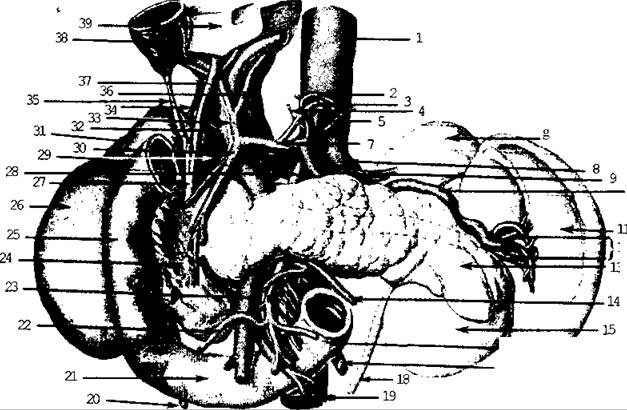
Fig. 7.22. Interrelationship of the duodenum and pancreas with Internal Organs
Last update: 08/08/2026
Editorial and Educational Adaptation: This material has been compiled based on the primary/original source text. The project team performed an editorial review, corrected technical inaccuracies, structured sections, and adapted the content for an educational format.
What was processed:
- elimination of formatting defects (OCR errors, structural breaks, corrupted characters);
- editorial organization of content;
- standardization of terminology in accordance with academic sources;
- verification of factual statements against the original source text.
All mentions of the author, publication year, and origin of the primary text have been preserved in accordance with the source.