HUMAN MEDICAL BIOLOGY, ANATOMY, PHYSIOLOGY AND PATHOLOGY - Ya.I. Fedonyuk 2010
BIOLOGY
CHAPTER 1. BIOLOGICAL BASES OF HUMAN VITAL ACTIVITY
1.4. ONTOGENETIC LEVEL OF LIFE ORGANIZATION
1.4.2. Basics of human genetics
INTERACTION OF NON-Allelic Genes
The main forms of non-allelic Gene interaction are complementarity, epistasis, and polygeny. They primarily modify the classical phenotypic segregation ratio established by G. Mendel for dihybrid crosses (9:3:3:1).
Complementarity (Lat. complementum — completion). Complementarity is a form of non-allelic gene interaction in which one gene mutually complements the action of another, non-allelic gene. When complementary genes are present simultaneously in the genotype, they determine The Development of a new trait (a novel characteristic). In sweet peas, flower color is determined by two dominant non-allelic genes, of which one gene (A) ensures the synthesis of a colorless substrate, and the other (B) ensures the Synthesis of the pigment. Therefore, when crossing plants with white flowers (AAbb x aaBB), all plants in the first generation F1 (AaBb) have colored flowers, whereas In the second generation F2, phenotypic segregation occurs in a 9:7 ratio, where 9/16 of the plants have colored flowers and 7/16 have uncolored ones.
In humans, normal Hearing is determined by the complementary interaction of two dominant non-allelic genes, D and E, one of which determines the Development of the cochlea, and the other the auditory nerve. People with D-E- genotypes have normal hearing, while those with D-ee and ddE- genotypes are deaf. In a marriage where both parents are deaf (DDee x ddEE), all children will have normal hearing (DdEe).
Epistasis is an interaction of non-allelic genes in which one gene suppresses the action of another, non-allelic gene. The first gene is called epistatic, or a suppressor (inhibitor), while the other, non-allelic gene is called hypostatic. If the epistatic gene is dominant, the epistasis is termed dominant (A>B). Conversely, if the epistatic gene is recessive, the epistasis is recessive (aa>B or aa>bb). Gene interaction in epistasis is opposite to complementarity.
In chickens, the dominant allele C of one gene determines the development of plumage coloration, but the dominant allele I of another gene acts as its suppressor. Therefore, chickens with the I-C- genotype are white, whereas those with iiCC and iiCc genotypes are colored. When crossing white chickens (IICC x iicc), the first-generation hybrids F1 (IiCc) turn out to be white, but when F1 individuals are crossed among themselves, phenotypic segregation occurs in the second generation F2 in a 13:3 ratio. Out of 16 individuals, 3 will be colored (iiCC, iiCc) because they lack the dominant suppressor gene and possess the dominant coloration gene. The remaining 13 individuals will be white. This example illustrates The phenomenon of dominant epistasis.
An example of recessive epistasis is the Bombay phenotype—an unusual inheritance of ABO Blood Groups, first discovered in an Indian family. In a family where the father had blood group I (0) and the mother had group III (B), a girl was born with blood group I (0); she married a man with blood group II (A), and they had two girls: one with blood group IV (AB) and the other with group I (0). The birth of a girl with blood group IV (AB) in a family where the father had blood group II (A) and the mother had group I (0) was unusual. Geneticists explained this phenomenon as follows: the girl with blood group IV (AB) inherited the IA allele from her father and the IB allele from her mother; however, in the mother, the IB allele was not phenotypically expressed because her genotype contained a rare recessive epistatic gene s in a homozygous state, which suppressed the phenotypic expression of the IB allele (Fig. 1.61, 1.62).
Class="center">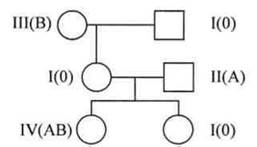
Fig. 1.61. Pedigree of a family with the Bombay phenotype. Phenotypes by ABO blood group system are indicated
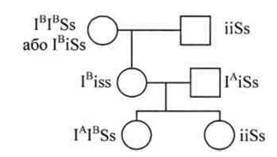
Fig. 1.62. The same pedigree; genotypes by ABO blood group system are indicated; s is the epistatic gene
Hypostasis is an interaction of non-allelic genes in which the dominant gene of one allelic pair is suppressed by an epistatic gene from another allelic pair. If gene A suppresses gene B (A>B), then with respect to gene B, the non-allelic gene interaction is called hypostasis, and with respect to gene A, it is called epistasis.
Polygeny (multiple gene inheritance) is an interaction of non-allelic genes in which the same trait is determined by several dominant non-allelic genes that act on this trait in the same direction and to an equal degree, enhancing its expression. Such equivalent genes are called polymeric genes (multiple genes, polygenes) and are designated by the same letter of the Latin alphabet but with different numerical indices. For example, dominant polymeric genes are A1, A2, A3, etc., and recessive ones are a1, a2, a3, etc. Genotypes are designated accordingly — A1A1A2A2; a1a1a2a2, etc. Traits controlled by several genes (polygenes) are called polygenic, and the inheritance of these traits is called polygenic inheritance, in contrast to monogenic inheritance, where a trait is controlled by a single gene. The phenomenon of polygeny was first described in 1908 by the Swedish geneticist H. Nilsson-Ehle while studying the inheritance of grain color in wheat.
Polygeny can be cumulative and non-cumulative. In cumulative polygeny, each gene individually has a weak effect (weak dose), but the sum of the doses of all genes ultimately adds up, so that the degree of trait expression depends on the number of dominant alleles. The summation of polymeric gene doses (additivity) ensures the existence of continuous series of quantitative changes.
Height, body weight, Skin color, mental abilities, and blood pressure levels are inherited in humans According to the polygenic type. For instance, human skin pigmentation is determined by 4-6 pairs of polymeric genes. The genotype of indigenous African populations predominantly contains dominant alleles (P1P1P2P2P3P3P4P4), whereas Representatives of the Caucasoid race possess recessive alleles (p1p1p2p2p3p3p4p4). A marriage between a Black individual and a white woman results in children with an intermediate skin color—mulattoes (P1p1P2p2P3p3P4p4). If both parents are mulattoes, it is possible to have children with skin pigmentation ranging from maximally light to maximally dark.
Typically, Quantitative Traits are inherited polygenically. However, Examples of polygenic inheritance of qualitative traits exist in nature, where the final result does not depend on the number of dominant alleles in the genotype—the trait either manifests or does not manifest (non-cumulative polygeny).
Last update: 08/08/2026
Editorial and Educational Adaptation: This material has been compiled based on the primary/original source text. The project team performed an editorial review, corrected technical inaccuracies, structured sections, and adapted the content for an educational format.
What was processed:
- elimination of formatting defects (OCR errors, structural breaks, corrupted characters);
- editorial organization of content;
- standardization of terminology in accordance with academic sources;
- verification of factual statements against the original source text.
All mentions of the author, publication year, and origin of the primary text have been preserved in accordance with the source.