CYPRINID FISHES (CYPRINIDAE) OF UKRAINIAN WATER BODIES - V. V. Zamorov - 2015
GENUS ASP - ASPIUS AGASSIZ
Body elongated, strongly compressed laterally; scales firmly embedded in the Skin; l. l. (59, 60) 61-105, D (7) 8-9 (10), originating slightly behind the insertion of the pelvic fins, its last unbranched ray neither thickened nor serrated. A 10-14 (15). Mouth large, terminal. Lower jaw projecting beyond the upper one, featuring a prominent knob that fits into a distinct notch in the upper jaw. Pharyngeal Teeth robust, hooked, smooth, biserial. Gill rakers few, 7-10 (11), short. Belly behind the pelvic fin with a scaled keel. HEAD laterally compressed. Two species are known in Europe and the Tigris. One species is distributed in the Water bodies of Ukraine.
Asp - Aspius aspius (Linnaeus)
Morphological features: D III (IV) 8-9; A III - IV (12)13-14; P I 16-18 (19); VI 8 (9); l. l. (59-60) 61-70 (71. 73); Squ1 10-12, Squ2 (4)5-6; vert. (48) 49-52; sp. br. 7-10 (11); d. f. 3.5-5.3. Maximum length 40-50 cm, weight up to 8 kg, lifespan up to 15 years (Fig. 45).
Body slender, elongated, strongly compressed laterally, its maximum depth accounts for 19.8-26.2% of the body length. Dorsal profile straight, occasionally with a slight convexity in the region of the dorsal fin; ventral profile smoothly convex. The back, like the belly, is rounded, yet may be compressed laterally in front of the dorsal fin.
Class="center">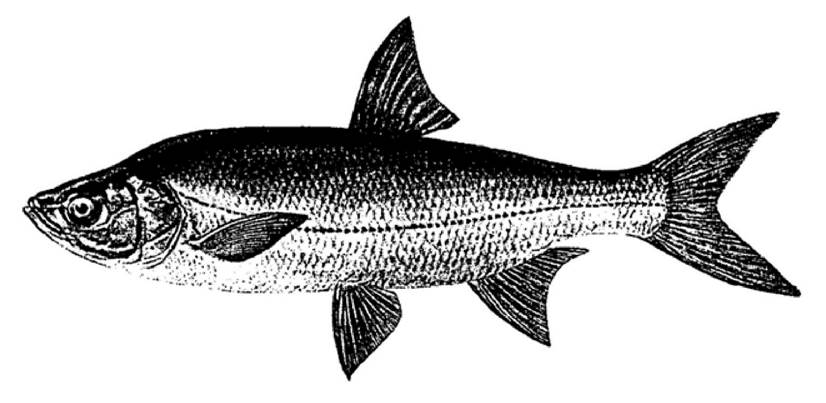
Fig. 45. Asp Aspius aspius
A scaled keel is present on the belly posterior to the pelvic fins. Caudal peduncle accounts for 18.1-22.9% (average 20.0-20.8) of the body length. Dorsal fin short at the base, always with a clearly visible notch; anal fin relatively long at the base, with a notch in the anterior portion. Paired fins slightly rounded; caudal fin deeply forked, typically with lobes of equal length, slightly pointed at the tips, occasionally the lower lobe being somewhat longer than the upper. The dorsal fin originates behind the vertical line of the posterior margin of the pelvic fin base or almost directly above it; the anal fin is noticeably positioned behind the vertical line of the posterior margin of the dorsal fin base. Pectoral fins long, exceeding 2/3 of the pectroventral distance. An elongated scale is present on the outer side at the Base of the pelvic fins.
Scales of medium size, densely covering the body. Lateral line always complete, curving in a smooth arc toward the belly, occasionally wavy; in the anterior part of the body, it extends from the trunk onto the head, where it is arranged in several rows. Head large, laterally compressed, its length accounting for 23.7-29.7% of the body length. Snout relatively short, pointed at the tip. Mouth large, terminal, obliquely cut, directed upwards. Its apex typically lies at the level of the upper edge of the eye or slightly below it. Eyes small, in adult specimens nearly half the length of the snout. Forehead fairly wide, flat, its width slightly less than the length of the upper jaw, which articulates with the cranium on the vertical line of the anterior margin of the eye or slightly ahead of it. Lower jaw projecting slightly beyond the upper, its articulation with the cranium typically located on the vertical of the middle of the eye. When the mouth is closed, the knob of the lower jaw fits into the notch of the upper. Gill rakers short, rather coarse, sparsely distributed. Pharyngeal teeth robust, arranged in two rows, typically smooth, hooked at the tip. Abdominal cavity dark.
Last update: 07/08/2026
Editorial and Educational Adaptation: This material has been compiled based on the primary/original source text. The project team performed an editorial review, corrected technical inaccuracies, structured sections, and adapted the content for an educational format.
What was processed:
- elimination of formatting defects (OCR errors, structural breaks, corrupted characters);
- editorial organization of content;
- standardization of terminology in accordance with academic sources;
- verification of factual statements against the original source text.
All mentions of the author, publication year, and origin of the primary text have been preserved in accordance with the source.