CYPRINID FISHES (CYPRINIDAE) OF UKRAINIAN WATERBODIES - V. V. Zamorov - 2015
GENUS BLEAK (MODDERBUDDY) - LEUCASPIUS HECKEL ET KNER
Body moderately elongate and somewhat compressed laterally. Scales drop off easily, of moderate size, arranged in 39-51 transverse rows; each scale bears one to three faint radial tubules in its apical part. Lateral line incomplete, ending on the first 6-15, rarely 18-19 scales, sometimes completely absent. Dorsal fin short, D II-III (7) 8-9 (10), originating slightly behind the vertical of the pelvic fin base; anal fin elongated, A III (9) 10-13 (14), originating beneath the posterior end of the dorsal fin. Belly in front of the anal fin slightly compressed, but lacks a scaleless keel. Mouth terminal, the lower jaw with a terminal projection fitting into a notch of the upper jaw. Branchial membranes attached beneath the posterior margin of the preoperculum. Gill rakers of moderate size, set fairly close together (10-17). Pharyngeal Teeth biserial (1.5-4.1, 1.5-5.1, 2.5-4.2) or uniserial (5-4, 5-5), or uniserial on one side and biserial on the other (4-4.1); teeth compressed laterally, crown slightly serrate and hooked at the tip.
There are two to three species in Europe, on the island of Rhodes, and also in Transcaucasia.
A single species is widely distributed in the waterbodies of Ukraine.
Belorica (Belorica) - Leucaspius delineatus (Heckel)
Morphological features: DIII 7-10; А III 9-14; P І 16; VII 8; С І 17 І; І. І. (0-3) 6-15 (18-19); Squ 39-51; vert. 36-40; sp. br. 10-17; d. f 54, 4-4, (4-5), 1.5-5, 1.5-4, 5-4.1, (4-4.1), 1.5-5.1, 1.4-4.1, 1.5-4.1, (1.4-5.2,
2.5-6.1). Length up to 6.5 cm, body weight of the largest specimen 4.7 g, lifespan about 5 years (Fig. 43).
Class="center">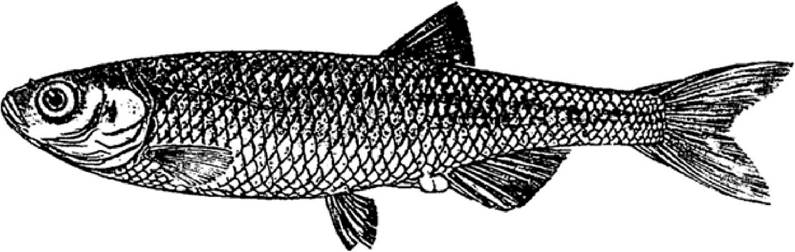
Fig. 43. Belorica Leucaspius delineates
Body somewhat elongate, laterally compressed, more so at the caudal peduncle. The profiles of the dorsal and ventral body margins are almost equally weakly convex. Maximum body depth (H) is contained 4.2-4.5 times in its length l, averaging 21.1-22.2% of l across various river systems of Ukraine, is one and a half times greater than body thickness, and 2.4-2.7 times greater than the minimum body depth (h). Close to H are the length of each caudal lobe and the P - V distance. The dorsal fin is positioned slightly behind, and the pelvic fin slightly in front of the vertical through the middle of the body; the predorsal distance is slightly greater, and the preventral distance slightly less than half of l. The postdorsal distance equals 1/3, the preanal distance 2/3, the length of the caudal peduncle 1/5, and the HEAD length 1/4 of l. The length of the pectoral fin is close to the V — A distance, as well as to the height of the dorsal fin and the length of the anal fin base (about 17% of l); the length of the pelvic fin is close to the height of A. Head height averages 66.5-69.9% of its length. Eyes are relatively large, their diameter constituting about 1/3 of the head length. They are located significantly closer to the anterior margin of the head than to the posterior; the snout length (26.3-32.5%) is considerably smaller than the postorbital distance (43.9-46.1%). Interorbital width is slightly less than the eye diameter and equals the length of the upper jaw, while the length of the lower jaw is somewhat greater.
In Ukraine, it is a common inhabitant of overgrown rivers, lakes, reservoirs, ponds, marshlands, and oxbows; it has also entered certain Crimean waterbodies along with Dnipro Water.
Last update: 07/08/2026
Editorial and Educational Adaptation: This material has been compiled based on the primary/original source text. The project team performed an editorial review, corrected technical inaccuracies, structured sections, and adapted the content for an educational format.
What was processed:
- elimination of formatting defects (OCR errors, structural breaks, corrupted characters);
- editorial organization of content;
- standardization of terminology in accordance with academic sources;
- verification of factual statements against the original source text.
All mentions of the author, publication year, and origin of the primary text have been preserved in accordance with the source.