FISHES OF THE FAMILY CYPRINIDAE IN UKRAINIAN WATERBODIES - V. V. Zamorov - 2015
GENUS BLEAK - ALBURNUS RAFINESQUE
Key for the identification of species of the genus Alburnus
1 (2). Anal fin originates below the Base of the 4th-6th branched rays of the dorsal fin; usually 17-20 branched rays in the anal fin. Common bleak - A. alburnus
2 (1). Anal fin originates behind the vertical line from the base of the dorsal fin, or if at the level of the first ray of this fin, the lateral line contains 54-56 scales. Anal fin usually has 13-17 branched rays.
3 (4). First gill arch with 18-25 gill rakers. During the spawning season, males develop large, sparse keratinized tubercles. Waterbodies of Crimea. Crimean shemaya - A. mentoides
4 (3). First gill arch with 24-35 gill rakers. During the spawning season, males develop numerous small keratinized tubercles.
5 (6). First gill arch with 24-28 gill rakers. Basin of the Sea of Azov. Azov shemaya - A. leobergi
6 (5). First gill arch with 27-34 gill rakers. Basin
of the northwestern part of the Black Sea. Black Sea shemaya - A. sarmaticus
Common bleak - Alburnus alburnus (Linnaeus)
Morphological features: D III (6-7) 8-9; А III 17-20; P I (1112) 13-16; VI (7) 8 (9); І. І. 45-48; Squ1 8, Squ2 3; sp. br. 16-22; d. f 2.55.2. Maximum body length 15-17 cm, commonly 10-12 cm, weight up to 60-65 g, lifespan about 9 years (Fig. 36).
Class="center">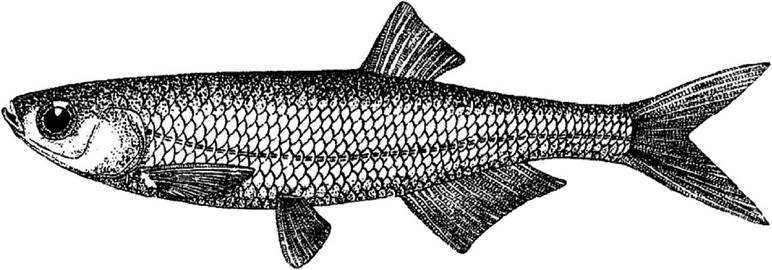
Fig. 36. Common bleak Alburnus alburnus
Body elongated, relatively low, laterally compressed. Anal fin begins at the level of the 4th-5th branched rays. Abdominal keel is visible from the pelvic fins to the anus. Mouth small, terminal, obliquely cut, directed slightly upwards; the prominence of the lower jaw fits into the notch of the upper jaw. Scales detach easily upon Touch. Back dark brown, greenish, or grayish-blue; sides and belly silvery-white or silvery. A dark lateral stripe along the sides of the body is absent in live fish. Occasionally, small dark dots appear above the lateral line. Dorsal and caudal fins dark gray; all other fins yellowish or reddish at the base and colorless at the tips. During the spawning season, males develop very small whitish keratinized tubercles on the HEAD and often on the back.
Non-commercial fish. In certain waterbodies, it achieves very high population density. Included in the IUCN Red List and the European Red List.
In Ukraine, it occurs in the basins of almost all rivers, in lakes, reservoirs, ponds, enters the brackish waters of estuaries, inhabits lowland stretches of mountain rivers, and has penetrated some Crimean waterbodies via the Dnieper Water supply.
Crimean shemaya - Alburnus mentoides (Kessler)
Morphological features: D (II) III 7-9; A III 13-17; l. l. 58-69; sp. br. 18-25; d. f. 2.5-5.2. Maximum body length 13 cm, weight up to 100 g, lifespan about 5-6 years (Fig. 37).
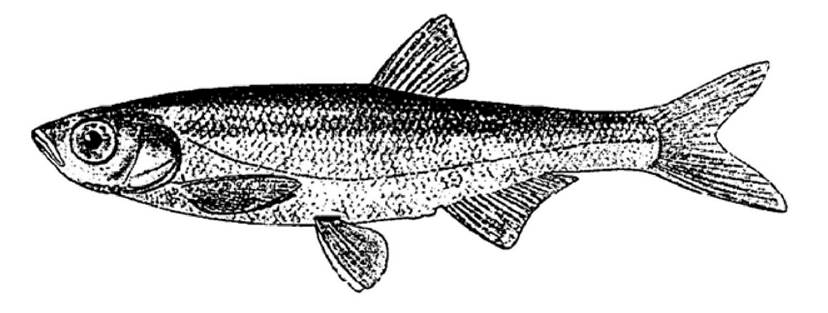
Fig. 37. Crimean shemaya Alburnus mentoides
Body elongated, relatively low, laterally compressed. Origin of the anal fin lies 0.5-1.5 scales behind the vertical of the base of the last branched ray of the dorsal fin. Mouth terminal, obliquely
cut, lower jaw protruding slightly forward. Scales are firmly attached and do not detach upon touch. Behind the base of the pelvic fins near the anus (at a distance of 8-10 scales from the vent), there is an unscaled keel. Back dark gray or brownish with a greenish or bluish tint, sides grayish-silvery with a greenish sheen, belly silvery-white, along the sides of the body sometimes an indistinct dark stripe. All fins grayish; dorsal and caudal fins may have a dark margin. Spawning males have sparse large keratinized tubercles on the head and partially on the body.
Biology requires further study. Of no commercial value due to its low Abundance.
In Ukraine, it is found in the rivers of Crimea (Chorna, Kacha, Belbek, Alma, and has presumably disappeared from the Salgir and Biyuk-Karasu). A rather rare, low-abundance fish. Included in the Red Data Book of Ukraine.
Azovshemaya (Azovshemaya) - Alburnus leobergi Freyhof et Kottelat
Morphological features: D (II) III 7-9; A III 15-17; l. l. 54-64; sp. br. 24-28; d. f. 2.5-5.2. Maximum body length 31.0 cm, weight up to 200 g, lifespan about 5-6 years (Fig. 38).
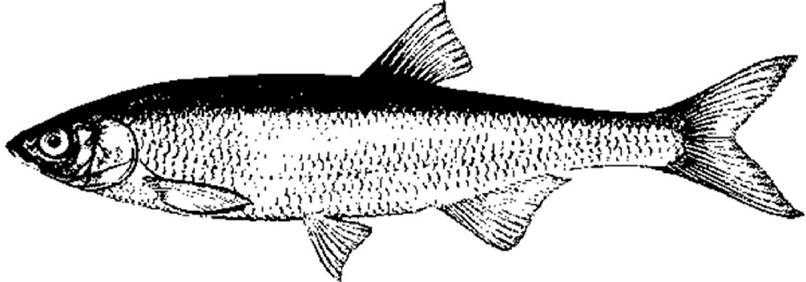
Fig. 38. Azov shemaya Alburnus leobergi
Morphological features require further study; the body is elongated, low, and laterally compressed. THE ORIGIN OF the anal fin is located 1.5-2.5 scales behind the level of the base of the last branched ray of the dorsal fin. The mouth is terminal and obliquely cut, with the lower jaw projecting slightly forward. Scales adhere tightly and do not detach upon touch. Behind the base of the pelvic fins, near the anus (at a distance of 4-6 scales from the vent), there is an unscaled keel. The back is dark gray or brownish with a greenish or bluish tint, the flanks are grayish-silver with a greenish sheen, and the belly is silvery-white. All fins are grayish, with the dorsal and caudal fins sometimes featuring a dark margin. Spawning males develop numerous small keratinized tubercles on the head and partially on the body, and adult mature specimens have gray bases of the paired fins.
The biology of the species requires further study and clarification. It is a semi-migratory, schooling pelagic-demersal fish capable of withstanding varying water salinity, ranging from completely fresh water to salinities of 10-12 %.
A valuable commercial fish whose population has drastically declined, having disappeared from many water bodies. It commonly hybridizes with Squalius cephalus (Linnaeus, 1758).
In Ukraine, it is distributed in the northern and northwestern PARTS OF THE Azov Sea (including the Molochnyi and Utlytskyi estuaries, among others), from which it ascends into the rivers of the northern Azov region (Berda, Obitichna, etc.). It has now virtually disappeared from the Seversky Donets basin (occasionally straying from the Tsimlyansk Reservoir, where a freshwater population has established), and has become extremely scarce in the Azov Sea. It is a rather rare, low-abundance fish, listed in the Red Data Book of Ukraine.
Black Sea shemaya (Black Sea shemaya) Alburnus sarmaticus Freyhof et Kottelat
Morphological features: D (II) III 7-9; A III 15-17; l. l. 56-63, sp. br. 24-34; d. f. 2.5-5.2. Maximum body length 25 cm, weight up to 150 g, lifespan about 5-6 years (Fig. 39).
Morphological features require further study. The body is elongated, slender, low, and laterally compressed. The origin of the anal fin is located 1.5-2.5 scales behind the level of the base of the last branched ray of the dorsal fin.

Fig. 39. Black Sea shemaya Alburnus sarmaticus
The mouth is terminal and obliquely cut, with the lower jaw projecting slightly forward. Scales adhere tightly and do not detach upon touch. Behind the base of the pelvic fins, near the anus (at a distance of 4-6 scales from the vent), there is an unscaled keel. The back is dark gray or brownish with a greenish or bluish tint, the flanks are grayish-silver with a greenish sheen, and the belly is silvery-white. All fins are grayish, with the dorsal and caudal fins sometimes featuring an indistinct dark margin. Spawning males develop numerous small keratinized tubercles on the head and partially on the body.
The biology of the species requires further study and clarification.
A valuable commercial fish whose population has drastically declined, having disappeared from many water bodies. It commonly hybridizes with Squalius cephalus (Linnaeus, 1758).
In Ukraine, it is known from the rivers of the northwestern part of the Black Sea (from the Danube to the Dnieper), freshened mouth areas of the sea, and desalinated estuaries. It has now practically disappeared from the Danube and Dniester basins, and has become extremely scarce in the lower reaches of the Southern Bug and the Dnieper. It is a rather rare fish, listed in the Red Data Book of Ukraine.
Last update: 07/08/2026
Editorial and Educational Adaptation: This material has been compiled based on the primary/original source text. The project team performed an editorial review, corrected technical inaccuracies, structured sections, and adapted the content for an educational format.
What was processed:
- elimination of formatting defects (OCR errors, structural breaks, corrupted characters);
- editorial organization of content;
- standardization of terminology in accordance with academic sources;
- verification of factual statements against the original source text.
All mentions of the author, publication year, and origin of the primary text have been preserved in accordance with the source.